Guani Benedetta, Gaillard Thomas, Teo-Fortin Ly-Ann, Balaya Vincent, Feki Anis, Paoletti Xavier, Mathevet Patrice, Plante Marie, Lecuru Fabrice
Department of Gynecology, Centre Hospitalier Universitaire Vaudois (CHUV), Lausanne, Switzerland.
Department of Gynecology, Hopital Fribourgeois (HFR), Fribourg, Switzerland.
Front Oncol. 2022 Aug 12;12:935628. doi: 10.3389/fonc.2022.935628. eCollection 2022.
Lymph node status is a major prognostic factor in early-stage cervical cancer. Predicting the risk of lymph node metastasis is essential for optimal therapeutic management. The aim of the study was to develop a web-based application to predict the risk of lymph node metastasis in patients with early-stage (IA1 with positive lymph vascular space invasion, IA2 and IB1) cervical cancer.
We performed a secondary analysis of data from two prospective multicenter trials, Senticol 1 and 2 pooled together in the training dataset. The histological risk factors were included in a multivariate logistic regression model in order to determine the most suitable prediction model. An internal validation of the chosen prediction model was then carried out by a cross validation of the 'leave one out cross validation' type. The prediction model was implemented in an interactive online application of the 'Shinyapp' type. Finally, an external validation was performed with a retrospective cohort from L'Hôtel-Dieu de Québec in Canada.
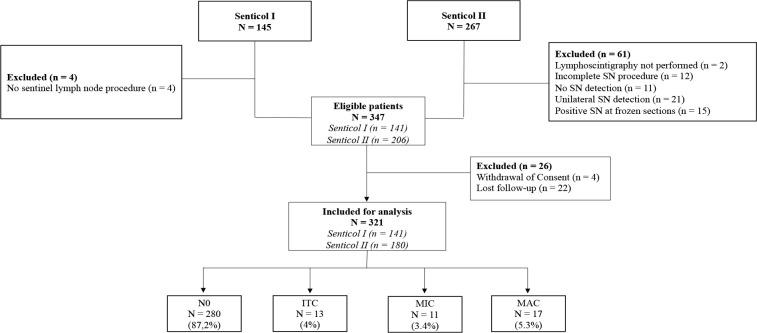
Three hundred twenty-one patients participating in Senticol 1 and 2 were included in our training analysis. Among these patients, 280 did not present lymph node invasion (87.2%), 13 presented isolated tumor cells (4%), 11 presented micrometastases (3.4%) and 17 macrometastases (5.3%). Tumor size, presence of lymph-vascular space invasion and stromal invasion were included in the prediction model. The Receiver Operating Characteristic (ROC) Curve from this model had an area under the curve (AUC) of 0.79 (95% CI [0.69- 0.90]). The AUC from the cross validation was 0.65. The external validation on the Canadian cohort confirmed a good discrimination of the model with an AUC of 0.83.
This is the first study of a prediction score for lymph node involvement in early-stage cervical cancer that includes internal and external validation. The web application is a simple, practical, and modern method of using this prediction score to assist in clinical management.
淋巴结状态是早期宫颈癌的主要预后因素。预测淋巴结转移风险对于优化治疗管理至关重要。本研究的目的是开发一个基于网络的应用程序,以预测早期(IA1伴阳性淋巴管间隙浸润、IA2和IB1)宫颈癌患者的淋巴结转移风险。
我们对来自两项前瞻性多中心试验Senticol 1和2的数据进行了二次分析,这两项试验的数据汇总在训练数据集中。将组织学危险因素纳入多变量逻辑回归模型,以确定最合适的预测模型。然后通过“留一法交叉验证”类型的交叉验证对所选预测模型进行内部验证。预测模型在“Shinyapp”类型的交互式在线应用程序中实现。最后,使用来自加拿大魁北克省迪厄医院的回顾性队列进行外部验证。
参与Senticol 1和2的321名患者纳入我们的训练分析。在这些患者中,280例未出现淋巴结浸润(87.2%),13例出现孤立肿瘤细胞(4%),11例出现微转移(3.4%),17例出现大转移(5.3%)。肿瘤大小、淋巴管间隙浸润的存在和间质浸润被纳入预测模型。该模型的受试者操作特征(ROC)曲线下面积(AUC)为0.79(95%CI[0.69 - 0.90])。交叉验证的AUC为0.65。对加拿大队列进行的外部验证证实该模型具有良好的区分度,AUC为0.83。
这是第一项对早期宫颈癌淋巴结受累预测评分进行内部和外部验证的研究。该网络应用程序是一种简单、实用且现代的方法,可利用此预测评分辅助临床管理。