Kirkman Matthew A, Hunn Benjamin H M, Thomas Michael S C, Tolmie Andrew K
Department of Psychology and Human Development, University College London (UCL) Institute of Education, UCL, London, United Kingdom.
Department of Neurosurgery, Queen's Medical Centre, Nottingham University Hospitals National Health Service (NHS) Trust, Nottingham, United Kingdom.
Front Oncol. 2022 Aug 5;12:943600. doi: 10.3389/fonc.2022.943600. eCollection 2022.
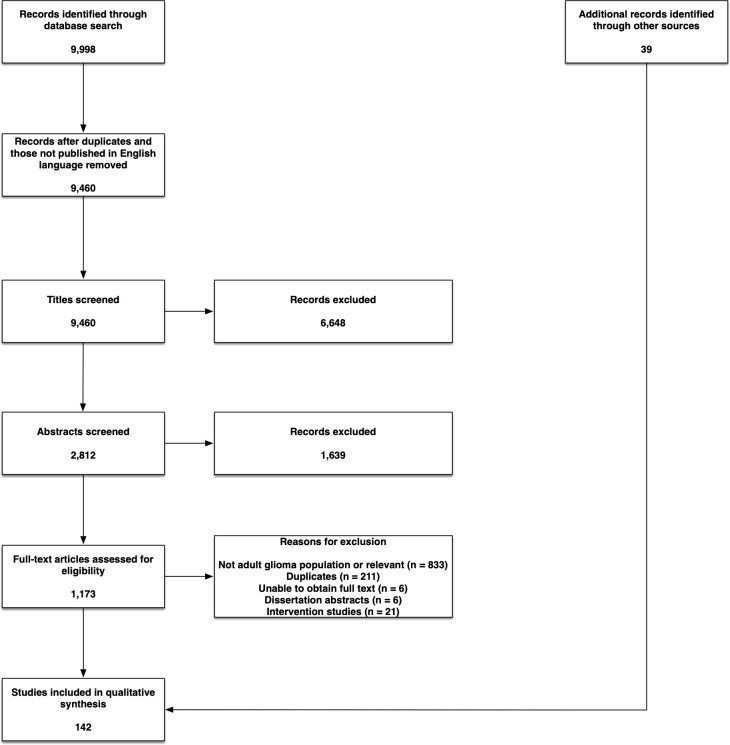
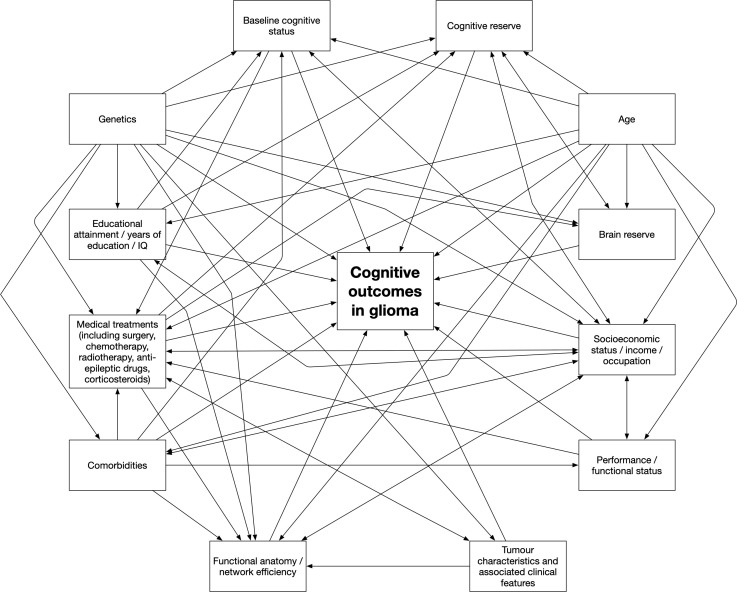
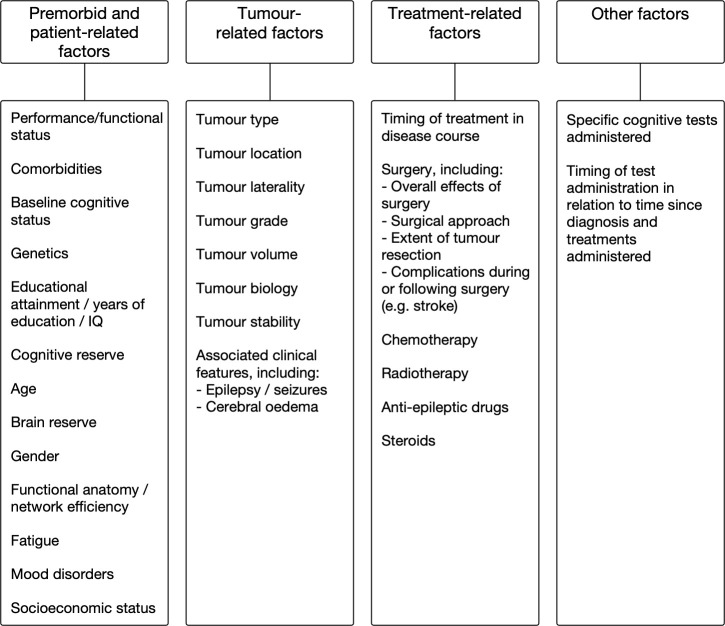
People with brain tumors, including those previously treated, are commonly affected by a range of neurocognitive impairments involving executive function, memory, attention, and social/emotional functioning. Several factors are postulated to underlie this relationship, but evidence relating to many of these factors is conflicting and does not fully explain the variation in cognitive outcomes seen in the literature and in clinical practice. To address this, we performed a systematic literature review to identify and describe the range of factors that can influence cognitive outcomes in adult patients with gliomas. A literature search was performed of Ovid MEDLINE, PsychINFO, and PsycTESTS from commencement until September 2021. Of 9,998 articles identified through the search strategy, and an additional 39 articles identified through other sources, 142 were included in our review. The results confirmed that multiple factors influence cognitive outcomes in patients with gliomas. The effects of tumor characteristics (including location) and treatments administered are some of the most studied variables but the evidence for these is conflicting, which may be the result of methodological and study population differences. Tumor location and laterality overall appear to influence cognitive outcomes, and detection of such an effect is contingent upon administration of appropriate cognitive tests. Surgery appears to have an overall initial deleterious effect on cognition with a recovery in most cases over several months. A large body of evidence supports the adverse effects of radiotherapy on cognition, but the role of chemotherapy is less clear. To contrast, baseline cognitive status appears to be a consistent factor that influences cognitive outcomes, with worse baseline cognition at diagnosis/pre-treatment correlated with worse long-term outcomes. Similarly, much evidence indicates that anti-epileptic drugs have a negative effect on cognition and genetics also appear to have a role. Evidence regarding the effect of age on cognitive outcomes in glioma patients is conflicting, and there is insufficient evidence for gender and fatigue. Cognitive reserve, brain reserve, socioeconomic status, and several other variables discussed in this review, and their influence on cognition and recovery, have not been well-studied in the context of gliomas and are areas for focus in future research.
https://www.crd.york.ac.uk/prospero/, identifier CRD42017072976.
患有脑肿瘤的人,包括那些之前接受过治疗的人,通常会受到一系列神经认知障碍的影响,这些障碍涉及执行功能、记忆、注意力以及社交/情感功能。有几个因素被认为是这种关系的基础,但与其中许多因素相关的证据相互矛盾,并且不能完全解释文献和临床实践中所见认知结果的差异。为了解决这个问题,我们进行了一项系统的文献综述,以识别和描述可能影响成年胶质瘤患者认知结果的一系列因素。从开始到2021年9月,我们对Ovid MEDLINE、PsychINFO和PsycTESTS进行了文献检索。通过检索策略识别出9998篇文章,通过其他来源又识别出39篇文章,其中142篇被纳入我们的综述。结果证实,多种因素会影响胶质瘤患者的认知结果。肿瘤特征(包括位置)和所接受治疗的影响是研究最多的一些变量,但相关证据相互矛盾,这可能是方法和研究人群差异的结果。肿瘤位置和偏侧性总体上似乎会影响认知结果,而这种影响的检测取决于是否进行了适当的认知测试。手术似乎总体上对认知有初始有害影响,但在大多数情况下,几个月后会恢复。大量证据支持放疗对认知的不利影响,但化疗的作用尚不清楚。相比之下,基线认知状态似乎是影响认知结果的一个一致因素,诊断/治疗前较差的基线认知与较差的长期结果相关。同样,许多证据表明抗癫痫药物对认知有负面影响,遗传学似乎也有作用。关于年龄对胶质瘤患者认知结果影响的证据相互矛盾,关于性别和疲劳的证据不足。认知储备、脑储备、社会经济地位以及本综述中讨论的其他几个变量,以及它们对认知和恢复的影响,在胶质瘤背景下尚未得到充分研究,是未来研究的重点领域。