Li Yanlin, Jia Xiaohui, Du Yonghao, Mao Ziyang, Zhang Yajuan, Shen Yuan, Sun Hong, Liu Mengjie, Niu Gang, Wang Jun, Hu Jie, Jiao Min, Guo Hui
Department of Medical Oncology, First Affiliated Hospital of Xi'an Jiaotong University, Xi'an, China.
Department of Radiology, First Affiliated Hospital of Xi'an Jiaotong University, Xi'an, China.
Front Oncol. 2022 Aug 12;12:827199. doi: 10.3389/fonc.2022.827199. eCollection 2022.
Checkpoint inhibitor pneumonitis (CIP) is a common serious adverse event caused by immune checkpoint inhibitors (ICIs), and severe CIP can be life-threatening. We aimed to investigate the role of peripheral blood cells in diagnosis, prediction, and prognosis evaluation for all and severe CIP.
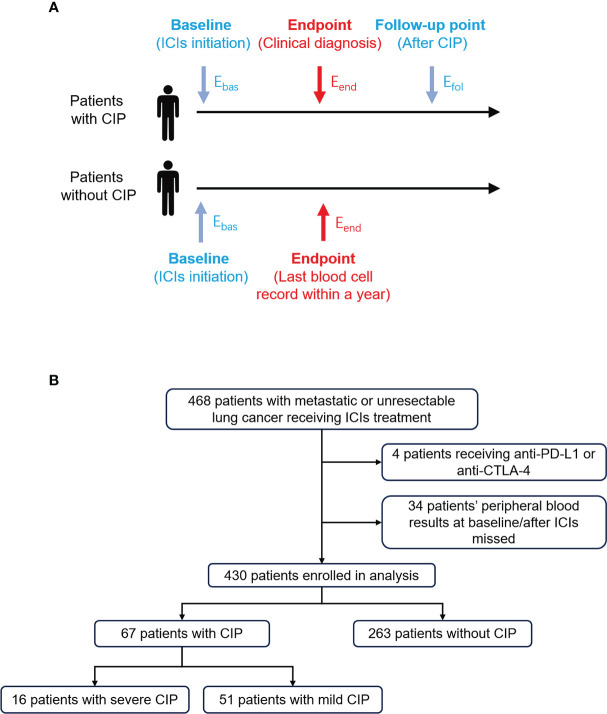
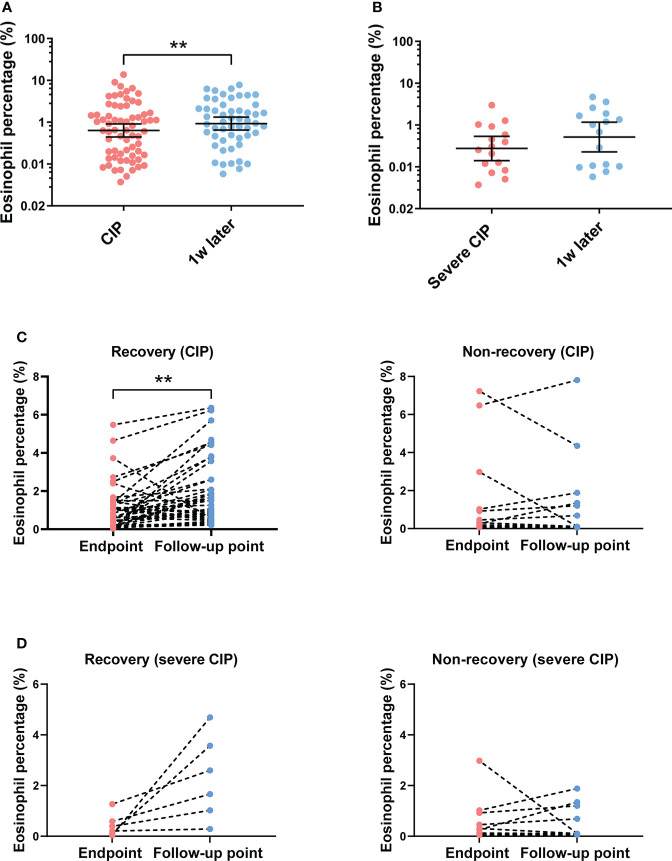
Patients with lung cancer receiving ICIs were enrolled in this retrospective study. Baseline was defined as the time of ICI initiation, endpoint was defined as the time of clinical diagnosis of CIP or the last ICI treatment, and follow-up point was defined as 1 week after CIP. Eosinophil percentages at baseline, endpoint, and follow-up point were shortened to " ", " and " ", respectively.
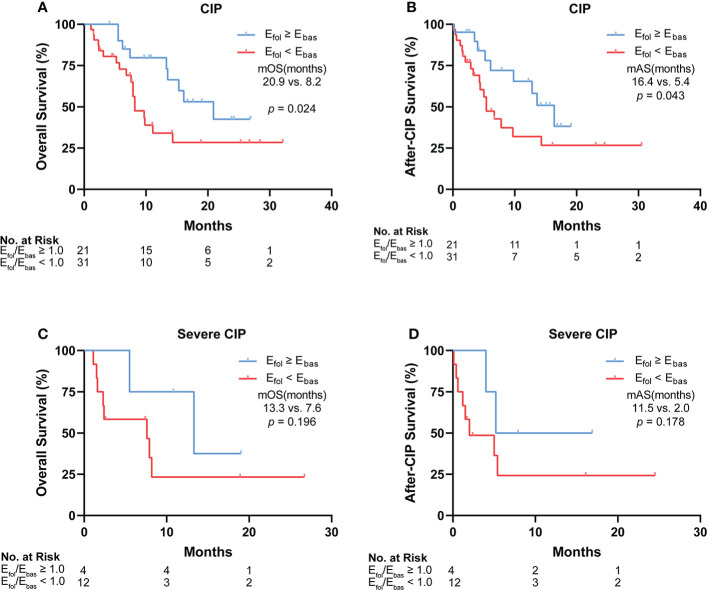
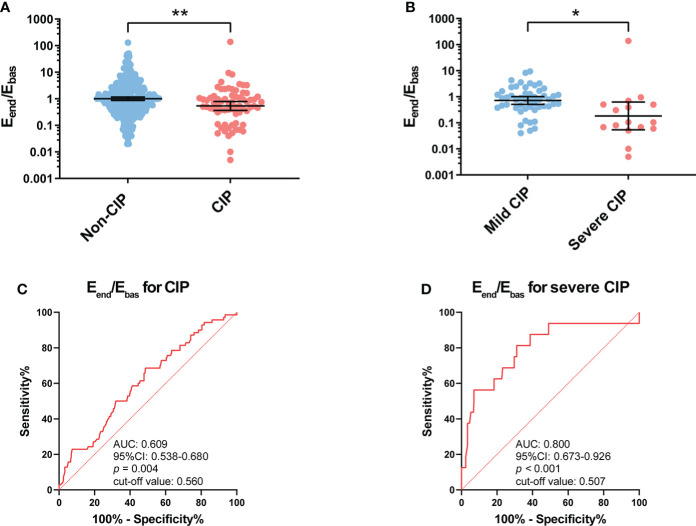
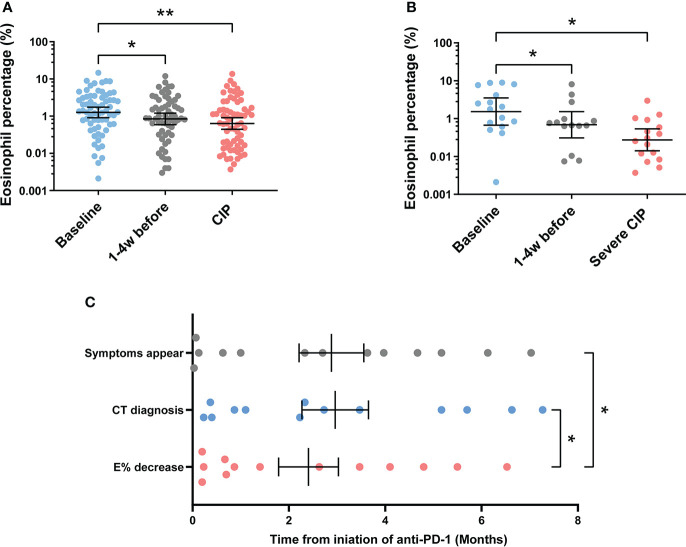
Among 430 patients included, the incidence of CIP was 15.6%, and severe CIP was 3.7%. The / value was lower in patients with CIP ( = 0.001), especially severe CIP ( = 0.036). Receiver operating characteristic curves revealed that / could serve as a biomarker to diagnose CIP ( = 0.004) and severe CIP ( < 0.001). For severe CIP, the eosinophil percentage declined before the symptoms appeared and CT diagnosis. The eosinophil percentage significantly elevated at the follow-up point in the recovery group but not in the non-recovery group. The CIP patients with / ≥1.0 had significantly prolonged overall survival ( = 0.024) and after-CIP survival (AS) ( = 0.043). The same results were found in severe CIP but without a statistical difference.
Eosinophil percentage was associated with the diagnosis, prediction, and prognosis of CIP and severe CIP.
检查点抑制剂肺炎(CIP)是由免疫检查点抑制剂(ICI)引起的常见严重不良事件,严重的CIP可能危及生命。我们旨在研究外周血细胞在所有CIP和严重CIP的诊断、预测及预后评估中的作用。
本回顾性研究纳入了接受ICI治疗的肺癌患者。基线定义为ICI开始使用的时间,终点定义为CIP临床诊断时间或最后一次ICI治疗时间,随访点定义为CIP发生后1周。基线、终点及随访点的嗜酸性粒细胞百分比分别简称为“ ”、“ ”和“ ”。
在纳入的430例患者中,CIP的发生率为15.6%,严重CIP的发生率为3.7%。CIP患者的 / 值较低( = 0.001),尤其是严重CIP患者( = 0.036)。受试者工作特征曲线显示, / 可作为诊断CIP( = 0.004)和严重CIP( < 0.001)的生物标志物。对于严重CIP,在症状出现和CT诊断之前嗜酸性粒细胞百分比下降。恢复组在随访点嗜酸性粒细胞百分比显著升高,而非恢复组则未升高。 / ≥1.0的CIP患者总生存期( = 0.024)和CIP后生存期(AS)( = 0.043)显著延长。严重CIP患者也有相同结果,但无统计学差异。
嗜酸性粒细胞百分比与CIP和严重CIP的诊断、预测及预后相关。