School of International Pharmaceutical Business, China Pharmaceutical University, Nanjing, China.
Center for Pharmacoeconomics and Outcomes Research of China Pharmaceutical University, Nanjing, China.
Front Public Health. 2022 Aug 12;10:952378. doi: 10.3389/fpubh.2022.952378. eCollection 2022.
This study aimed to evaluate the cost-effectiveness of the colorectal cancer screening in China, and that when the screening was implemented in a specific region.
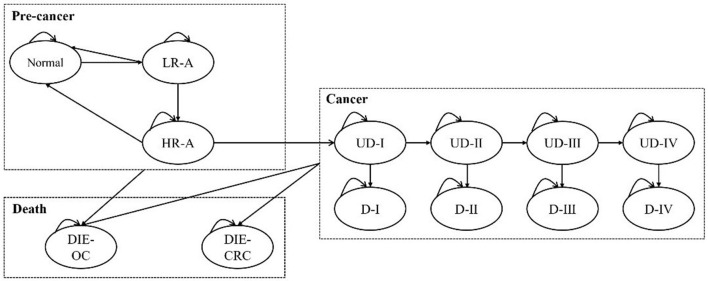
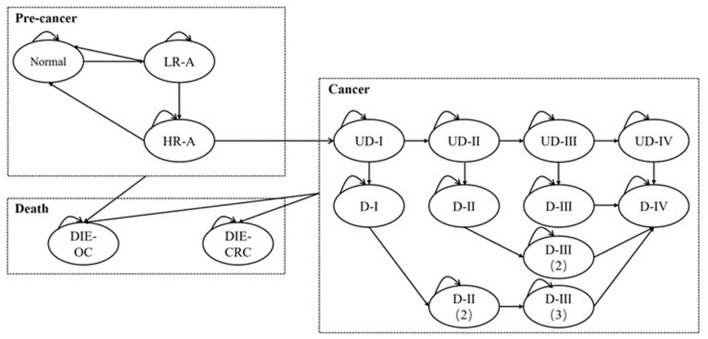
A 13-state Markov model was established to compare four screening protocols, including annual fecal immunochemical testing (FIT1), biennial fecal immunochemical testing (FIT2), electronic colonoscopy every 10 years (e-CSPY10), and electronic colonoscopy every 5 years (e-CSPY5), with no screening from the perspective of Chinese healthcare system. The model simulated the health states of a cohort of 100,000 average-risk individuals aging from 50 to 75. Additionally, scenarios including the implementation in a specific region, starting from 40, and incompletely successful treatment of cancer were also analyzed.
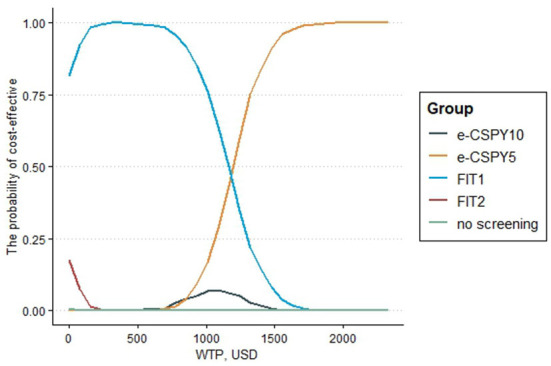
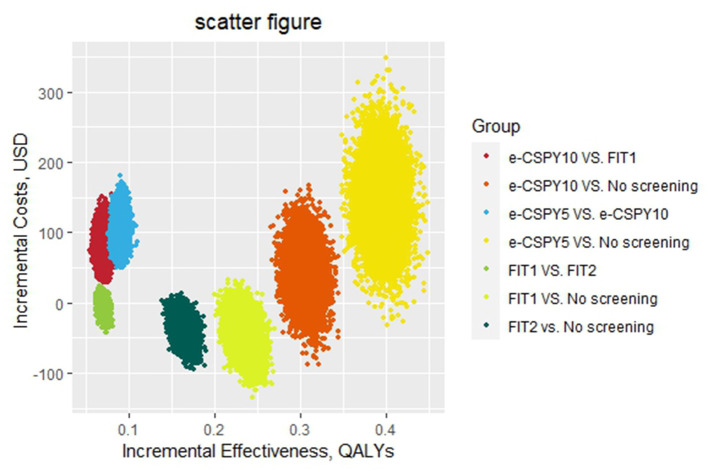
Annual and biennial FIT could save 8.13USD (US Dollar) and 44.96USD per person, and increase 0.0705QALYs (Quality-Adjusted Life Years) and 0.2341 QALYs compared with no screening, respectively. Annual FIT could decrease costs by 36.81USD per person and increase 0.1637 QALYs in comparison to biennial FIT. The results showed that both annual and biennial FIT for screening were dominant over no screening, and annual FIT was dominant over biennial FIT. The ICER (Incremental Cost-Effectiveness Ratio) for e-CSPY10 were 1183.51USD/QALY and 536.66USD/QALY compared with FIT1 and FIT2. The ICER for e-CSPY5 were 1158.16USD/QALY and 770.85USD/QALY compared with FIT1 and FIT2. And the ICER for e-CSPY5 relative to e-CSPY10 was 358.71USD/QALY. All the ICER values were lower than the economic threshold of 2021 Chinese GDP (Gross Domestic Product) per capita in 2021(12554.42USD).
It is worthwhile to popularize CRC screening in mainland China, as FIT always saving costs and colonoscopy is cost-effective. Regions with high income can take electronic colonoscopy every 10 years, or even every 5 years into consideration when determining the specific strategies.
本研究旨在评估中国结直肠癌筛查的成本效益,以及在特定地区实施筛查时的成本效益。
采用 13 状态 Markov 模型,从中国医疗保健系统的角度,比较了四种筛查方案,包括每年一次粪便免疫化学检测(FIT1)、每两年一次粪便免疫化学检测(FIT2)、每 10 年一次电子结肠镜检查(e-CSPY10)和每 5 年一次电子结肠镜检查(e-CSPY5),不进行筛查。该模型模拟了一组 100,000 名平均风险个体从 50 岁到 75 岁的健康状况。此外,还分析了在特定地区实施筛查、从 40 岁开始以及癌症治疗不完全成功的情况。
与不筛查相比,每年和每两年一次的 FIT 可分别节省 8.13 美元(美元)和 44.96 美元/人,并分别增加 0.0705QALYs(质量调整生命年)和 0.2341 QALYs。与每两年一次的 FIT 相比,每年的 FIT 可降低 36.81 美元/人的成本,并增加 0.1637 QALYs。结果表明,每年和每两年一次的 FIT 筛查均优于不筛查,且每年的 FIT 筛查优于每两年一次的 FIT 筛查。与 FIT1 和 FIT2 相比,e-CSPY10 的增量成本效益比(ICER)分别为 1183.51 美元/QALY 和 536.66 美元/QALY。与 FIT1 和 FIT2 相比,e-CSPY5 的 ICER 分别为 1158.16 美元/QALY 和 770.85 美元/QALY。e-CSPY5 相对于 e-CSPY10 的 ICER 为 358.71 美元/QALY。所有的 ICER 值都低于 2021 年中国 GDP(人均)的经济阈值(2021 年为 12554.42 美元)。
在中国大陆推广 CRC 筛查是值得的,因为 FIT 总是节省成本,结肠镜检查具有成本效益。收入较高的地区在确定具体策略时,可以考虑每 10 年或每 5 年进行一次电子结肠镜检查。