Hua Jin-Chao, Xu Xiao-Min, Xu Zhen-Gui, Xue Yuan, Xu Jin-Jing, Hu Jing-Hua, Wu Yuanqing, Chen Yu-Chen
Department of Otolaryngology, Nanjing Pukou Central Hospital, Pukou Branch Hospital of Jiangsu Province Hospital, Nanjing, China.
Department of Radiology, Nanjing First Hospital, Nanjing Medical University, Nanjing, China.
Front Aging Neurosci. 2022 Aug 11;14:964349. doi: 10.3389/fnagi.2022.964349. eCollection 2022.
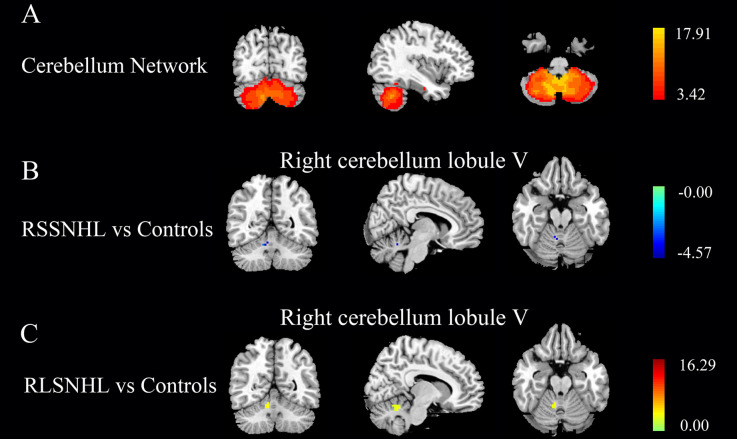
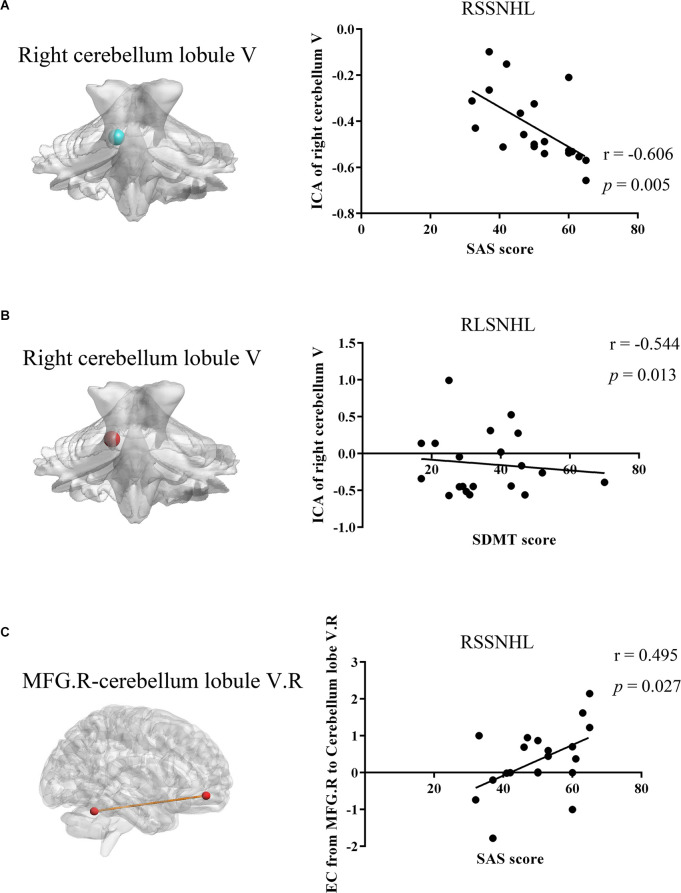
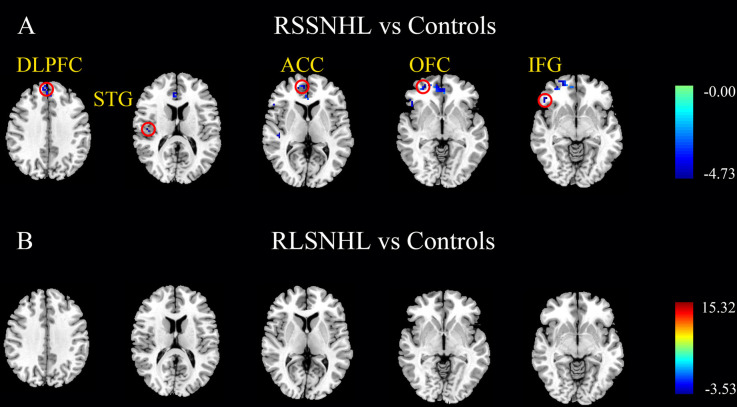
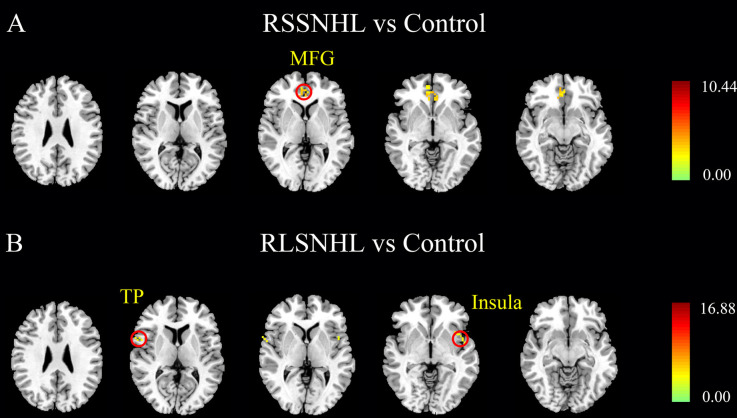
Sudden sensorineural hearing loss (SSNHL) is a common otology emergency and some SSNHL will develop into a long-term hearing loss (LSNHL). However, whether SSNHL and LSNHL have similar psychiatric patterns remains unknown, as well as the neural substrates. Increasing evidence has proved that the cerebellar network plays a vital role in hearing, cognition processing, and emotion control. Thus, we recruited 20 right SSNHL (RSSNHL), 20 right LSNHL (RLSNHL), and 24 well-matched healthy controls to explore the cerebellar patterns among the three groups. Every participant underwent pure tone audiometry tests, neuropsychological evaluations, and MRI scanning. Independent component analysis (ICA) was carried out on the MRI data and the cerebellar network was extracted. Granger causality analysis (GCA) was conducted using the significant cerebellar region as a seed. Pearson's correlation analysis was computed between imaging characteristics and clinical features. ICA found the effect of group on right cerebellum lobule V for the cerebellar network. Then, we found decreased outflow from right cerebellum lobule V to right middle orbitofrontal cortex, inferior frontal gyrus, anterior cingulate cortex, superior temporal gyrus, and dorsal lateral prefrontal cortex in RSSNHL group in GCA analysis. No significance was found in RLSNHL subjects. Additionally, the RSSNHL group showed increased effective connectivity from the right middle frontal gyrus (MFG) and the RLSNHL group showed increased effective connectivity from the right insula and temporal pole to the right cerebellum lobule V. Moreover, connections between right cerebellum lobule V and mean time series of the cerebellar network was negatively correlated with anxiety score in RSSNHL and negatively correlated with depression scores in RLSNHL. Effective connectivity from right MFG to right cerebellum lobule V could predict anxiety status in RSSNHL subjects. Our results may prove potential imaging biomarkers and treatment targets for hearing loss in future work.
突发性感音神经性听力损失(SSNHL)是一种常见的耳科急症,部分SSNHL会发展为长期听力损失(LSNHL)。然而,SSNHL和LSNHL是否具有相似的精神模式以及神经基质尚不清楚。越来越多的证据表明,小脑网络在听力、认知处理和情绪控制中起着至关重要的作用。因此,我们招募了20例右侧SSNHL(RSSNHL)患者、20例右侧LSNHL(RLSNHL)患者和24例匹配良好的健康对照者,以探究三组之间的小脑模式。每位参与者均接受了纯音听力测试、神经心理学评估和MRI扫描。对MRI数据进行独立成分分析(ICA)并提取小脑网络。以显著的小脑区域为种子进行格兰杰因果分析(GCA)。计算成像特征与临床特征之间的皮尔逊相关性分析。ICA发现,对于小脑网络,组别对右侧小脑V叶有影响。然后,我们发现在GCA分析中,RSSNHL组从右侧小脑V叶到右侧眶额中回、额下回、前扣带回皮质、颞上回和背外侧前额叶皮质的传出减少。在RLSNHL受试者中未发现显著差异。此外,RSSNHL组显示右侧额中回(MFG)的有效连接增加,RLSNHL组显示右侧岛叶和颞极到右侧小脑V叶的有效连接增加。此外,右侧小脑V叶与小脑网络平均时间序列之间的连接在RSSNHL中与焦虑评分呈负相关,在RLSNHL中与抑郁评分呈负相关。从右侧MFG到右侧小脑V叶的有效连接可以预测RSSNHL受试者的焦虑状态。我们的结果可能为未来工作中听力损失的潜在成像生物标志物和治疗靶点提供依据。