Zhang Yisen, Peng Qichen, Zhou Yangyang, Wang Chao, Zhang Longhui, Yang Xinjian, Mu Shiqing
Department of Interventional Neuroradiology, Beijing Neurosurgical Institute, Beijing Tiantan Hospital, Capital Medical University, Beijing, China.
Front Neurol. 2022 Aug 11;13:914878. doi: 10.3389/fneur.2022.914878. eCollection 2022.
Vertebrobasilar dissecting aneurysms (VBDAs) with an intramural hematoma (IMH) usually cause symptoms because of mass effect and grow in size over time. Clinical outcomes are generally poor.
This study aimed to examine outcomes of reconstructive endovascular treatment (EVT) in patients with VBDAs with IMH. Safety and effectiveness were compared between flow diverters (FDs) and conventional stents.
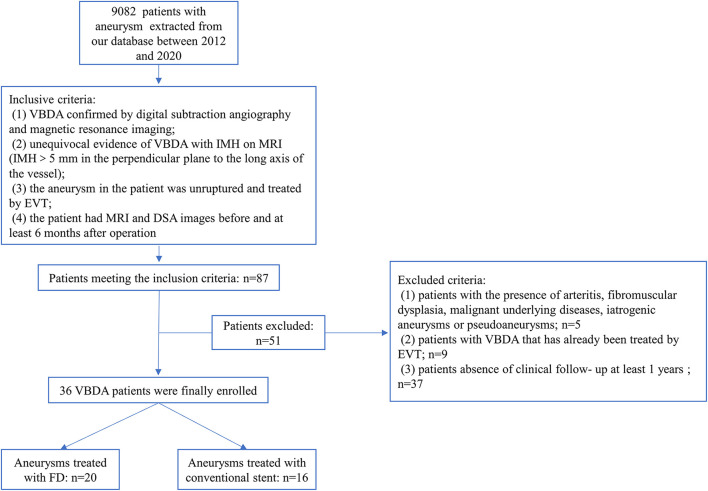
We retrospectively analyzed the clinical and radiological data of 36 VBDAs with IMH in 36 patients who underwent EVT with either FDs or conventional stents from January 2012 to December 2020 at our institution.
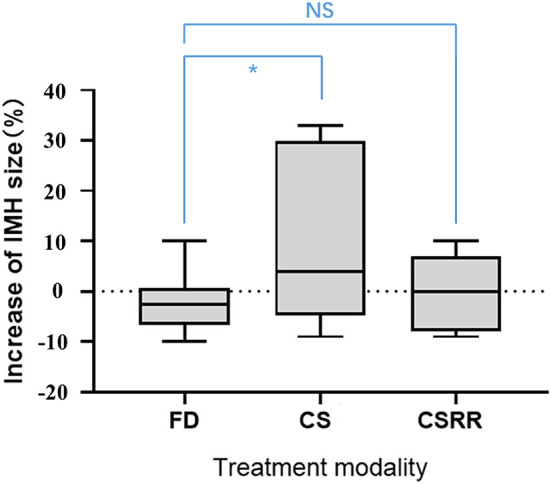
Among the 36 study patients, 20 were treated with FDs and 16 with conventional stents. Incidence of procedure-related complications did not significantly differ between the two stents. IMH growth occurred after EVT in a significantly higher proportion of conventional stent group aneurysms (zero vs. 31.3% [5/16]; = 0.012). Among the five aneurysms with IMHs that grew, all recurred. Change in IMH size after EVT was significantly lower in the FD group (-2.7 vs. +8.1%, p = 0.036). However, after the recurrent aneurysms were removed from the conventional stent group, change in IMH size did not significantly differ between the two groups (-2.7 vs. +1.0%, = 0.332). The proportion of patients who experienced an improvement in mRS score after EVT was significantly higher in the FD group (60 vs. 25%, = 0.036).
IMHs in VBDAs stop growing after successful reconstructive EVT. Although both FD and conventional stent treatment are effective, FD treatment may be superior based on clinical outcomes and effect on IMH size.
伴有壁内血肿(IMH)的椎基底动脉夹层动脉瘤(VBDAs)通常因占位效应引起症状,且会随时间推移而增大。临床预后通常较差。
本研究旨在探讨伴有IMH的VBDAs患者行血管内重建治疗(EVT)的疗效。比较血流导向装置(FDs)与传统支架的安全性和有效性。
我们回顾性分析了2012年1月至2020年12月在我院接受FDs或传统支架EVT治疗的36例伴有IMH的VBDAs患者的临床和影像学资料。
36例研究患者中,20例接受FDs治疗,16例接受传统支架治疗。两种支架的手术相关并发症发生率无显著差异。传统支架组动脉瘤在EVT后IMH增大的比例显著更高(0 vs. 31.3% [5/16];P = 0.012)。在5例IMH增大的动脉瘤中,全部复发。EVT后FD组IMH大小的变化显著更低(-2.7% vs. +8.1%,P = 0.036)。然而,在将传统支架组复发的动脉瘤排除后,两组间IMH大小的变化无显著差异(-2.7% vs. +1.0%,P = 0.332)。EVT后改良Rankin量表(mRS)评分改善的患者比例在FD组显著更高(60% vs. 25%,P = 0.036)。
成功的血管内重建治疗后,VBDAs中的IMHs停止生长。虽然FD和传统支架治疗均有效,但基于临床疗效和对IMH大小的影响,FD治疗可能更具优势。