Moreira A, Bernardo C, Ramos C, Aguiar P, Alves da Costa F
Medical Oncology Department, Portuguese Oncology Institute of Lisbon Francisco Gentil, Lisbon, Portugal.
National School of Public Health, Nova University Lisbon, Lisbon, Portugal.
Front Pharmacol. 2022 Aug 10;13:909948. doi: 10.3389/fphar.2022.909948. eCollection 2022.
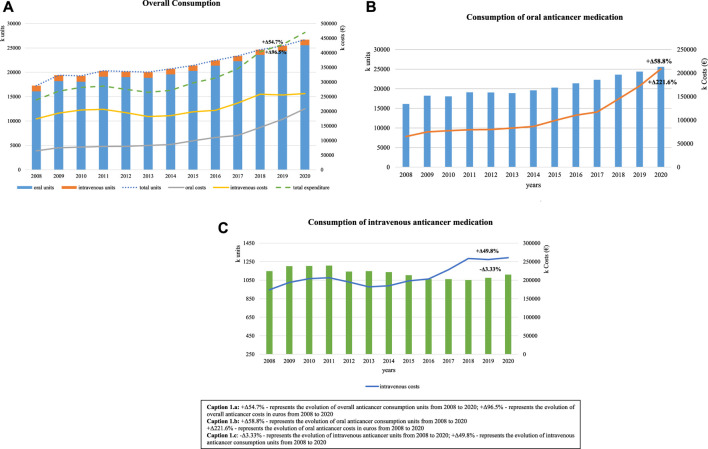
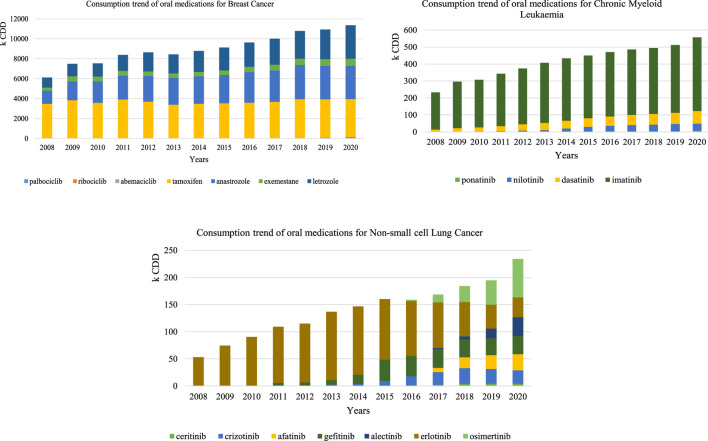
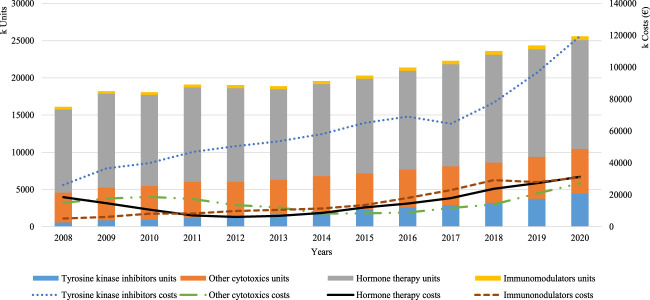
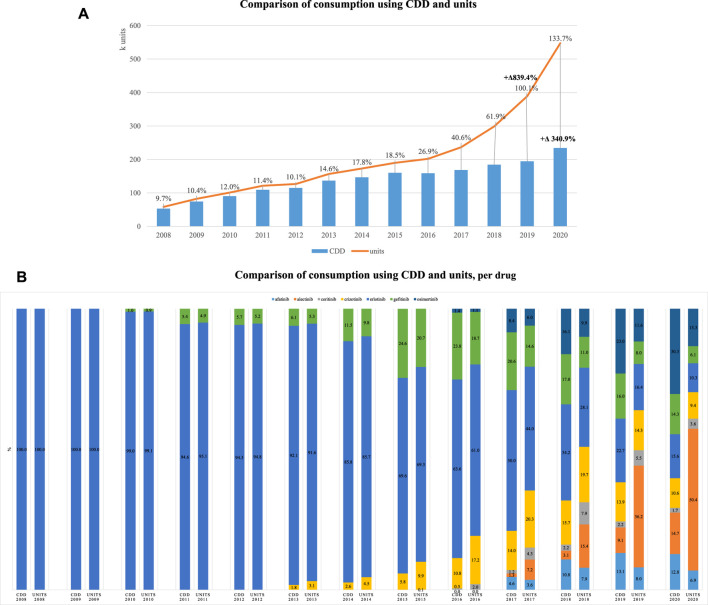
Systemic cancer therapy has traditionally been administered using an intravenous (IV) route, implying patients' frequent visits to hospitals to access to their therapy. If we consider the actual pipeline in oncology, oral chemotherapy will be the main component of cancer treatment in the next few years. This shift in the administration route requires different care models in order to guarantee treatment efficacy and safety. To analyze time trends in oral chemotherapy consumption in Portugal. Oral chemotherapy consumption over a 13-year period (2008-2020) was analyzed, considering dispensed units by the administration route with respective costs, resorting to the drug regulatory agency (INFARMED I.P.) database. Oral consumption patterns were further explored using common daily doses (CDD) for three conditions, including chronic myeloid leukemia (CML), non-small-cell lung cancer (NSCLC), and breast cancer (BC), to adjust for the effect of varying doses. Data were analyzed descriptively resorting to Microsoft Office Excel 2010. Overall chemotherapy consumption increased +Δ54.7%, with the highest contribution in units observed in oral forms (+Δ58.8%). The total expenditure increased +Δ96.5%, and despite the increase in oral forms (+Δ221.6%), intravenous forms continued to be the major cost driver, with an important contribution from immunotherapy. Much of the increase was led by the approval of 40 new IV and 48 new oral cancer medications with higher costs introduced in the market. Using CDD as an alternative metric to units had varying impacts by indication. The observed increases seemed to focus on specific cancer sites with varying effect; in CML, there was a 2.39-fold increase, compared to 4.41 for NSCLC and 1.86 for BC. However, for BC, two distinct sub-patterns were observed for hormone therapy (increasing 1.83) and for the novel tyrosine kinase inhibitors (increasing 40.8). The growing use of oral chemotherapy is obvious and calls for investments in supporting patients in managing medication adherence and adverse events. The shifts in the healthcare system are complex and need to be prioritized. Our data suggest that priority could be attributed to cancer sites driving innovation, namely, advanced breast cancer.
传统上,全身性癌症治疗是通过静脉注射(IV)途径进行的,这意味着患者需要频繁前往医院接受治疗。如果我们考虑肿瘤学的实际研发流程,口服化疗将在未来几年成为癌症治疗的主要组成部分。给药途径的这种转变需要不同的护理模式,以确保治疗效果和安全性。为了分析葡萄牙口服化疗药物的使用时间趋势。利用药品监管机构(INFARMED I.P.)数据库,分析了13年期间(2008 - 2020年)口服化疗药物的使用情况,考虑按给药途径划分的配药单位及其各自成本。针对慢性髓性白血病(CML)、非小细胞肺癌(NSCLC)和乳腺癌(BC)三种病症,使用常用日剂量(CDD)进一步探究口服用药模式,以调整不同剂量的影响。使用Microsoft Office Excel 2010对数据进行描述性分析。总体化疗药物使用量增加了+Δ54.7%,口服剂型的配药单位增长贡献最高(+Δ58.8%)。总支出增加了+Δ96.5%,尽管口服剂型有所增加(+Δ221.6%),但静脉注射剂型仍然是主要的成本驱动因素,免疫疗法也有重要贡献。增加的部分主要是由于40种新的静脉注射和48种新的口服癌症药物获批上市,这些药物成本更高。使用CDD作为配药单位的替代指标,不同适应症的影响各不相同。观察到的增长似乎集中在特定癌症部位,效果各异;在CML中,增长了2.39倍,NSCLC为4.41倍,BC为1.86倍。然而,对于BC,激素疗法(增长1.83)和新型酪氨酸激酶抑制剂(增长40.8)呈现出两种不同的子模式。口服化疗药物使用的增加显而易见,需要投资支持患者管理药物依从性和不良事件。医疗保健系统的转变很复杂,需要确定优先事项。我们的数据表明,优先事项可以归因于推动创新的癌症部位,即晚期乳腺癌。