Toscano Carolina, Lopes Patrícia, Ramos Cláudia, Baptista Joana
Psychology Research Center (CIPsi), School of Psychology, University of Minho, Braga, Portugal.
Centro de Investigação e de Intervenção Social (CIS-IUL), Instituto Universitário de Lisboa (Iscte-IUL), Avenida das Forças Armadas, 1649-026 Lisbon, Portugal.
Child Indic Res. 2023;16(1):69-85. doi: 10.1007/s12187-022-09964-y. Epub 2022 Aug 24.
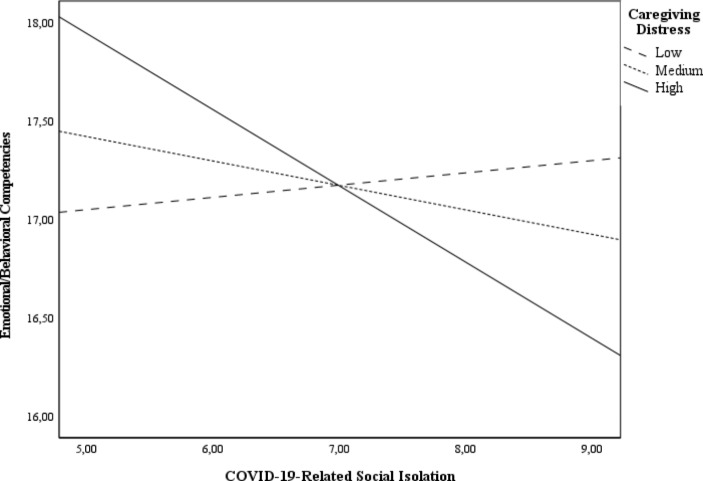
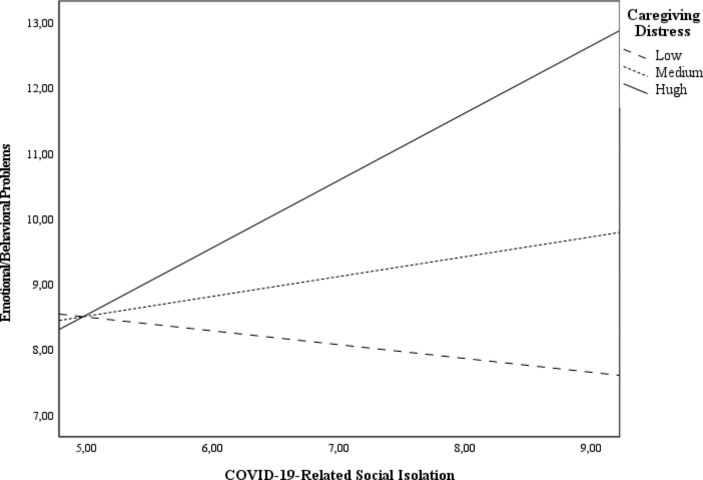
The COVID-19 pandemic has led to significant changes in the lives of families with young children. The present study aimed to explore whether child social isolation due to the COVID-19 crisis was associated with toddlers' emotional and behavioral health (EBH) and whether this association was moderated by caregiving distress, during the second mandatory lockdown in Portugal. Participants included 315 toddlers and their primary caregivers. Caregivers were invited to complete a set of questionnaires in order to report about toddlers' social isolation from other significant family members, other children, and activities outside the house, and to provide ratings of caregiving distress and toddlers' EBH. Family socioeconomic factors, including stressors resulted from the pandemic, were also measured. Significant interaction effects, independent of child sex and sociodemographic factors, between COVID-19-related social isolation and caregiving distress emerged in the prediction of toddlers' EBH: COVID-19-related social isolation was found to be a significant predictor of both emotional/behavioral competencies and problems, but only among toddlers exposed to higher levels of caregiving distress. This study evidences the negative impact of the COVID-19 crisis on the functioning of Portuguese families and toddlers' EBH. It emphasizes the importance for policies to consider the implications of the COVID-19 crisis for young children, and to provide psychosocial support to families in order to reduce caregiving distress and, thus, prevent children's mental health problems.
新冠疫情给有幼儿的家庭生活带来了重大变化。本研究旨在探讨在葡萄牙第二次强制封锁期间,因新冠危机导致的儿童社会隔离是否与幼儿的情绪和行为健康(EBH)相关,以及这种关联是否会受到照顾压力的调节。研究参与者包括315名幼儿及其主要照顾者。邀请照顾者完成一系列问卷,以报告幼儿与其他重要家庭成员、其他儿童以及户外其他活动的社会隔离情况,并对照顾压力和幼儿的情绪和行为健康进行评分。还测量了家庭社会经济因素,包括疫情导致的压力源。在预测幼儿的情绪和行为健康方面,出现了与儿童性别和社会人口因素无关的新冠相关社会隔离与照顾压力之间的显著交互作用:新冠相关社会隔离被发现是情绪/行为能力和问题的重要预测因素,但仅在面临较高照顾压力水平的幼儿中如此。本研究证明了新冠危机对葡萄牙家庭功能和幼儿情绪和行为健康的负面影响。它强调政策考虑新冠危机对幼儿的影响并为家庭提供心理社会支持以减轻照顾压力从而预防儿童心理健康问题的重要性。