Department of Psychology, Education and Child studies, Erasmus School of Social and Behavioral Sciences, Erasmus University Rotterdam, Rotterdam, The Netherlands.
Faculty of Behavioral and Social Sciences, Leiden Consortium Individual Development, Leiden University, Leiden, The Netherlands.
Sci Rep. 2021 Feb 3;11(1):2971. doi: 10.1038/s41598-021-81720-8.
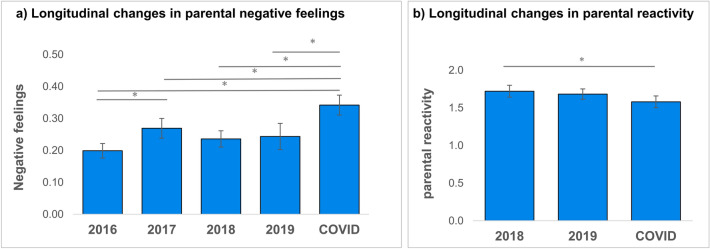
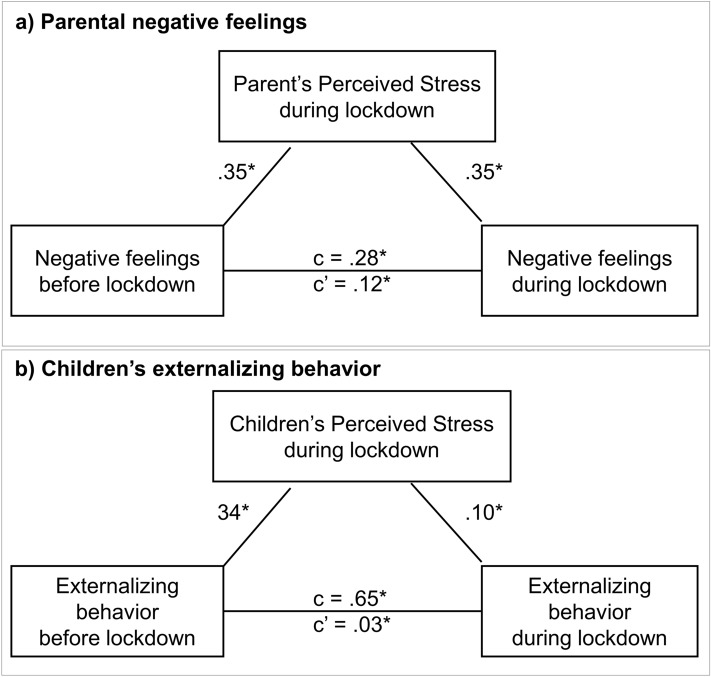
Dealing with a COVID-19 lockdown may have negative effects on children, but at the same time might facilitate parent-child bonding. Perceived stress may influence the direction of these effects. Using a longitudinal twin design, we investigated how perceived stress influenced lockdown induced changes in wellbeing of parents and children. A total of 106 parents and 151 children (10-13-year-olds) filled in questionnaires during lockdown and data were combined with data of previous years. We report a significant increase in parental negative feelings (anxiety, depression, hostility and interpersonal sensitivity). Longitudinal child measures showed a gradual decrease in internalizing and externalizing behavior, which seemed decelerated by the COVID-19 lockdown. Changes in parental negative feelings and children's externalizing behavior were mediated by perceived stress: higher scores prior to the lockdown were related to more stress during the lockdown, which in turn was associated with an increase in parental negative feelings and children's' externalizing behavior. Perceived stress in parents and children was associated with negative coping strategies. Additionally, children's stress levels were influenced by prior and current parental overreactivity. These results suggest that children in families with negative coping strategies and (a history of) parental overreactivity might be at risk for negative consequences of the lockdown.
应对 COVID-19 封锁可能对儿童产生负面影响,但同时也可能促进亲子关系。感知到的压力可能会影响这些影响的方向。我们使用纵向双胞胎设计,研究了感知压力如何影响封锁引起的父母和孩子幸福感的变化。共有 106 名父母和 151 名儿童(10-13 岁)在封锁期间填写了问卷,数据与前几年的数据相结合。我们报告称,父母的负面感受(焦虑、抑郁、敌意和人际关系敏感)显著增加。纵向儿童测量显示,内化和外化行为逐渐减少,而 COVID-19 封锁似乎减缓了这种减少。父母负面感受的变化和儿童的外化行为是由感知压力介导的:封锁前的分数较高与封锁期间的压力较大有关,而压力较大又与父母负面感受的增加和儿童的外化行为有关。父母和孩子的感知压力与消极应对策略有关。此外,孩子的压力水平受到先前和当前父母过度反应的影响。这些结果表明,具有消极应对策略和(以往)父母过度反应的家庭中的儿童可能面临封锁的负面影响的风险。