Santhakumar Vinothini, Manuel Mascarenhas Nahren
Department of Chemistry, Sacred Heart College (Affiliated to Thiruvalluvar University, Vellore), Tirupattur District, 635601 Tamilnadu, India.
J Struct Biol X. 2022 Aug 10;6:100071. doi: 10.1016/j.yjsbx.2022.100071. eCollection 2022.
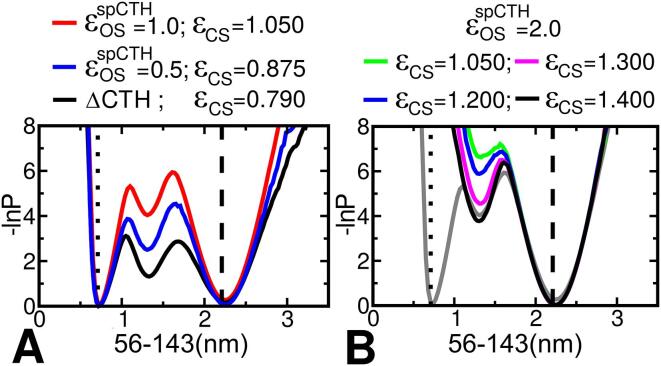
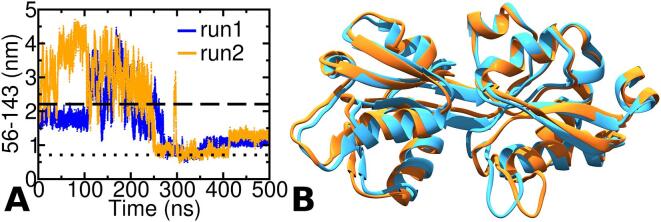
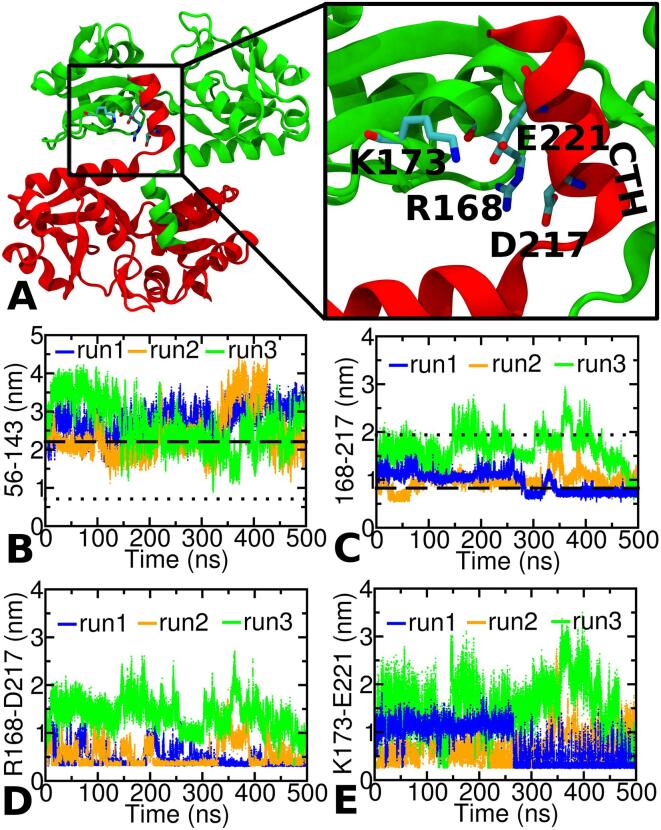
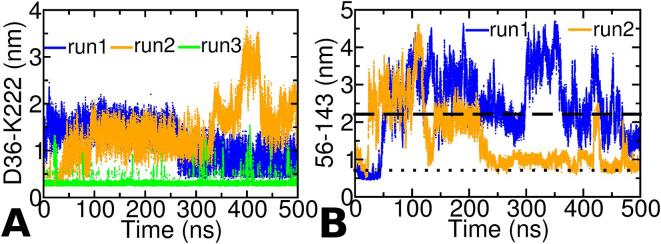
The arginine binding protein (TmArgBP) is a periplasmic binding protein that has a short helix at the C-terminal end (CTH), which is swapped between the two chains. We apply a coarse-grained structure-based model (SBM) and all-atom MD simulation on this protein to understand the mechanism and the role of CTH in the conformational transition. When the results of SBM simulations of TmArgBP in the presence and absence of CTH are compared, we find that CTH is strategically located at the back of the binding pocket restraining the open-state conformation thereby disengaging access to the closed-state. We also ran all-atom MD simulations of open-state TmArgBP with and without CTH and discovered that in the absence of CTH the protein could reach the closed-state within 250 ns, while in its presence, the protein remained predominantly in its open-state conformation. In the simulation started from unliganded closed-state conformation without CTH, the protein exhibited multiple transitions between the two states, suggesting CTH as an essential structural element to stabilize the open-state conformation. In another simulation that began with an unliganded closed-state conformation with CTH, the protein was able to access the open-state. In this simulation the CTH was observed to reorient itself to interact with the protein emphasizing its role in assisting the conformational change. Based on our findings, we believe that CTH not only acts as a structural element that constraints the protein in its open-state but it may also guide the protein back to its open-state conformation upon ligand unbinding.
精氨酸结合蛋白(TmArgBP)是一种周质结合蛋白,其C末端(CTH)有一个短螺旋,该螺旋在两条链之间进行交换。我们对该蛋白应用粗粒度基于结构的模型(SBM)和全原子分子动力学模拟,以了解CTH在构象转变中的机制和作用。当比较存在和不存在CTH时TmArgBP的SBM模拟结果时,我们发现CTH策略性地位于结合口袋的后部,限制开放状态构象,从而阻止进入封闭状态。我们还对有和没有CTH的开放状态TmArgBP进行了全原子分子动力学模拟,发现没有CTH时,该蛋白可在250纳秒内达到封闭状态,而在有CTH时,该蛋白主要保持开放状态构象。在从无配体封闭状态构象开始且没有CTH的模拟中,该蛋白在两种状态之间表现出多次转变,表明CTH是稳定开放状态构象的重要结构元件。在另一个从有CTH的无配体封闭状态构象开始的模拟中,该蛋白能够进入开放状态。在这个模拟中,观察到CTH重新定向自身与蛋白相互作用,强调了其在协助构象变化中的作用。基于我们的发现,我们认为CTH不仅作为一种结构元件将蛋白限制在开放状态,而且在配体解离后可能还会引导蛋白回到开放状态构象。