Strobl Maria R, Vollmann Ute, Eckl-Dorna Julia, Radakovics Astrid, Ibl Verena, Schnurer Madeleine, Brenner Martin, Dermendjiev Georgi, Weckwerth Wolfram, Neumüller Michael, Frommlet Florian, Demir Hilal, Bublin Merima, Müller Christian, Bohle Barbara
Institute of Pathophysiology and Allergy Research, Center for Pathophysiology, Infectiology and Immunology, Medical University of Vienna, Wien, Austria.
Department of Otorhinolaryngology, Medical University of Vienna, Vienna, Austria.
Clin Transl Allergy. 2022 Aug;12(8):e12186. doi: 10.1002/clt2.12186.
Birch pollen-related apple allergy is the most frequent IgE-mediated food allergy in Central-Northern Europe with Mal d 1 as major allergen. Its concentration in apples varies with the cultivar and storage time. Year-round appealing, hypoallergenic cultivars still are needed to satisfy the nutritional needs of affected individuals. We characterized three promising cultivars by multidisciplinary in vitro assays including long-term storage and by clinical challenges of allergic individuals before and after the birch pollen season.
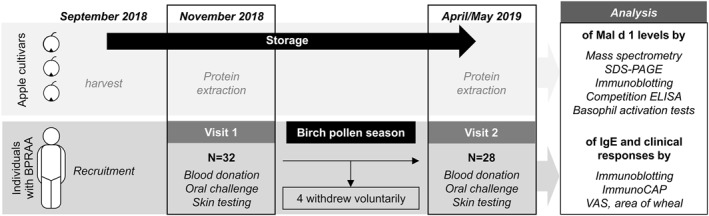
Proteins were extracted from fruits of 'Santana', 'Golden Delicious' (GD), and three genuine cultivars in November 2018 and April 2019. Mal d 1-levels were analysed by mass spectrometry, SDS-PAGE, immunoblotting, competitive ELISA, and basophil activation tests. Twenty-eight allergic individuals underwent single-blinded open food challenges and skin testing with the cultivars and birch pollen in November 2018 and May 2019. Allergen-specific IgE-levels were determined.
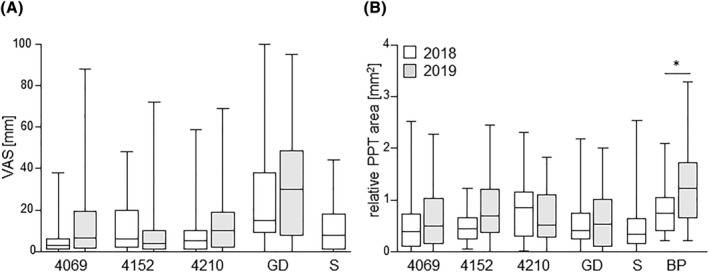
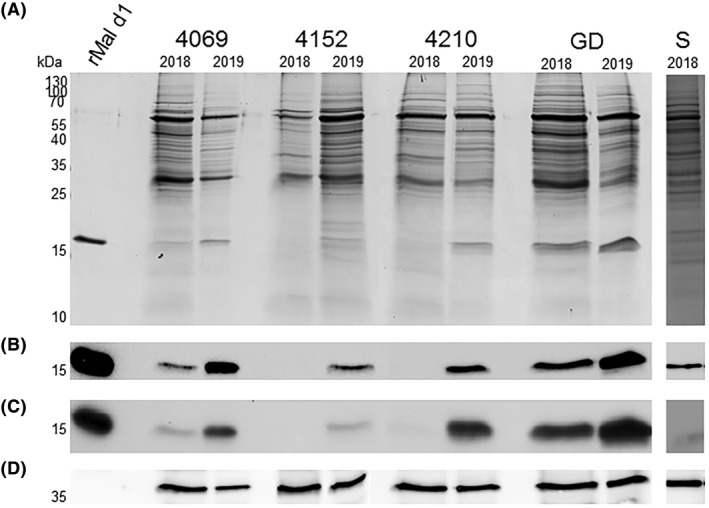
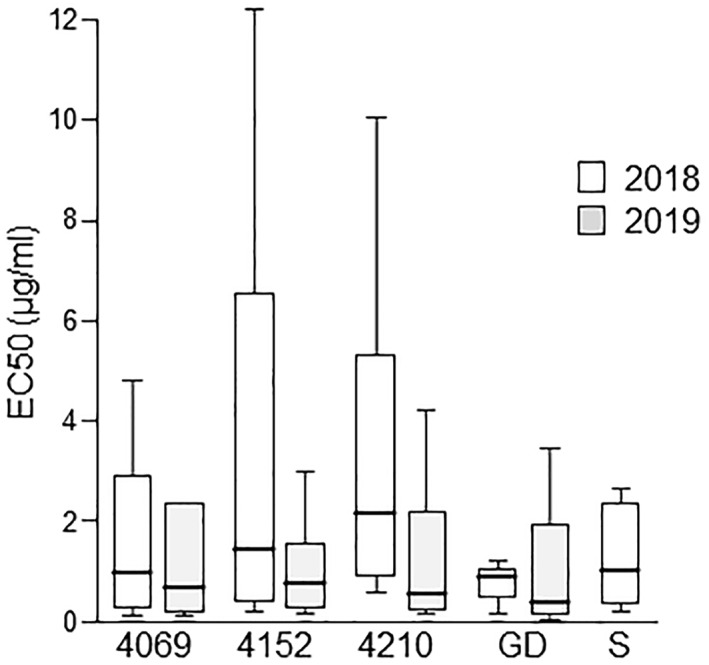
After storage all cultivars except 'Santana' were of appealing appearance and taste. Their Mal d 1 content had increased, also reflected by significantly amplified basophil activation and stronger reactions in clinical challenges. Besides, individuals showed boosted reactivity after pollen exposure indicated by enhanced allergen-specific IgE-levels and skin reactions to birch pollen. Still, all cultivars remained significantly less allergenic than GD and comparable to Santana in November 2018 in all assessments except for skin testing.
Combined expertise in pomology and allergology identified promising new cultivars for allergic consumers. The evaluation of hypoallergenic apples should incorporate long-term storage and birch pollen exposure. Basophil activation tests may be suitable in the selection of promising cultivars for oral challenges.
桦树花粉相关的苹果过敏是北欧和中欧最常见的IgE介导的食物过敏,主要过敏原是Mal d 1。其在苹果中的浓度因品种和储存时间而异。仍需要全年都有吸引力的低过敏性品种来满足受影响个体的营养需求。我们通过多学科体外试验(包括长期储存)以及在桦树花粉季节前后对过敏个体进行临床激发试验,对三个有前景的品种进行了特征分析。
2018年11月和2019年4月从“桑塔纳”、“金冠”(GD)和三个纯正品种的果实中提取蛋白质。通过质谱分析、SDS-PAGE、免疫印迹、竞争性ELISA和嗜碱性粒细胞活化试验分析Mal d 1水平。2018年11月和2019年5月,28名过敏个体对这些品种和桦树花粉进行了单盲开放食物激发试验和皮肤试验。测定了过敏原特异性IgE水平。
储存后,除“桑塔纳”外,所有品种的外观和口感都很吸引人。它们的Mal d 1含量增加,嗜碱性粒细胞活化显著增强以及临床激发试验中反应更强也反映了这一点。此外,花粉暴露后个体的反应性增强,表现为过敏原特异性IgE水平升高和对桦树花粉的皮肤反应增强。不过,在所有评估中(皮肤试验除外),所有品种的致敏性仍明显低于GD,且与2018年11月的桑塔纳相当。
果树学和过敏学方面的综合专业知识为过敏消费者确定了有前景的新品种。低过敏性苹果的评估应包括长期储存和桦树花粉暴露。嗜碱性粒细胞活化试验可能适合用于选择有前景的口服激发试验品种。