Division of Population Sciences, Dana-Farber Cancer Institute, Boston, Massachusetts, United States of America.
Department of Epidemiology, Harvard T. H. Chan School of Public Health, Boston, Massachusetts, United States of America.
PLoS One. 2022 Aug 29;17(8):e0273735. doi: 10.1371/journal.pone.0273735. eCollection 2022.
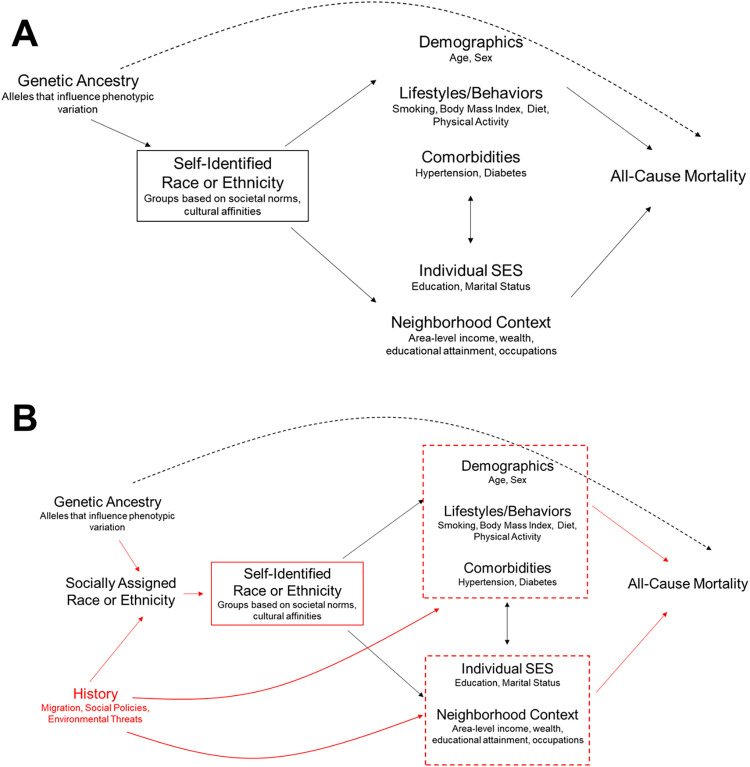
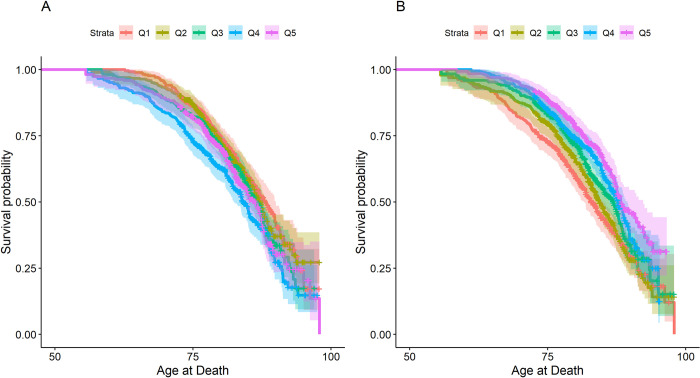
Self-identified race/ethnicity is a correlate of both genetic ancestry and socioeconomic factors, both of which may contribute to racial disparities in mortality. Investigators often hold a priori assumptions, rarely made explicit, regarding the relative importance of these factors. We studied 2,239 self-identified African Americans (SIAA) from the Prostate, Lung, Colorectal and Ovarian screening trial enrolled from 1993-1998 and followed prospectively until 2019 or until death, whichever came first. Percent African genetic ancestry was estimated using the GRAF-Pop distance-based method. A neighborhood socioeconomic status (nSES) index was estimated using census tract measures of income, housing, and employment and linked to participant residence in 2012. We used Directed Acyclic Graphs (DAGs) to represent causal models favoring (1) biomedical and (2) social causes of mortality. Hazard ratios were estimated using Cox models adjusted for sociodemographic, behavioral, and neighborhood covariates guided by each DAG. 901 deaths occurred over 40,767 person-years of follow-up. In unadjusted (biomedical) models, a 10% increase in percent African ancestry was associated with a 7% higher rate of all-cause mortality (HR: 1.07, 95% CI: 1.02, 1.12). This effect was attenuated in covariate adjusted (social) models (aHR: 1.01, 95% CI: 0.96, 1.06). Mortality was lower comparing participants in the highest to lowest nSES quintile following adjustment for covariates and ancestry (aHR: 0.74, 95% CI: 0.57, 0.98, Ptrend = 0.017). Higher African ancestry and lower nSES were associated with higher mortality, but African ancestry was not associated with mortality following covariate adjustment. Socioeconomic factors may be more important drivers of mortality in African Americans.
自我认定的种族/民族是遗传血统和社会经济因素的相关因素,这两个因素都可能导致死亡率的种族差异。研究人员通常持有先验假设,但很少明确说明这些因素的相对重要性。我们研究了 1993 年至 1998 年期间参加前列腺癌、肺癌、结直肠癌和卵巢筛查试验的 2239 名自我认定的非裔美国人(SIAA),并进行了前瞻性随访,直到 2019 年或死亡,以先到者为准。使用基于 GRAF-Pop 距离的方法估计非洲遗传血统的百分比。使用收入、住房和就业的普查区指标来估计邻里社会经济地位(nSES)指数,并将其与 2012 年参与者的居住地联系起来。我们使用有向无环图(DAG)来表示有利于(1)生物医学和(2)社会原因导致死亡率的因果模型。使用 Cox 模型估计风险比,该模型根据每个 DAG 调整了社会人口统计学、行为和邻里因素。在 40767 人年的随访期间,发生了 901 例死亡。在未调整(生物医学)模型中,非洲血统百分比增加 10%与全因死亡率增加 7%相关(HR:1.07,95%CI:1.02,1.12)。在调整了协变量和血统的(社会)模型中,这种影响减弱(aHR:1.01,95%CI:0.96,1.06)。在调整了协变量和血统后,与最低 nSES 五分位组相比,处于最高 nSES 五分位组的参与者死亡率较低(aHR:0.74,95%CI:0.57,0.98,Ptrend=0.017)。较高的非洲血统和较低的 nSES 与较高的死亡率相关,但在调整了协变量后,非洲血统与死亡率无关。社会经济因素可能是非裔美国人死亡率的更重要驱动因素。