
社区劣势、非洲遗传血统、癌症亚型与乳腺癌幸存者的死亡率。
Neighborhood Disadvantage, African Genetic Ancestry, Cancer Subtype, and Mortality Among Breast Cancer Survivors.
机构信息
Cancer Epidemiology and Health Outcomes, Rutgers Cancer Institute of New Jersey, New Brunswick.
Department of Medicine, Rutgers Robert Wood Johnson Medical School, New Brunswick, New Jersey.
出版信息
JAMA Netw Open. 2023 Aug 1;6(8):e2331295. doi: 10.1001/jamanetworkopen.2023.31295.
IMPORTANCE
Racial disparities in breast cancer (BC) survival arise from multilevel causes, which may exert influence at different stages of BC progression. Clarifying the importance of genetic and social factors could help prioritize interventions.
OBJECTIVE
To jointly examine associations between African genetic ancestry, social environment, and mortality from any cause and BC in Black BC survivors.
DESIGN, SETTING, AND PARTICIPANTS: This population-based cohort study enrolled self-identified Black women aged 20 to 75 years with histologically confirmed BC from June 2005 to May 2019 and followed them up until death or censoring in September 2021. Participants lived in 10 New Jersey counties. Data were analyzed between December 2022 and April 2023.
EXPOSURES
A neighborhood socioeconomic status (nSES) index composed of census tract measures (education, income, wealth, employment status, and occupation) was linked to residential addresses at diagnosis. Percentage African ancestry was estimated using the ADMIXTURE program.
MAIN OUTCOMES AND MEASURES
Sequentially adjusted (age adjusted: age and interview year; fully adjusted: age adjusted with individual SES, lifestyle factors, and comorbidities) logistic regression models were fit to estimate associations with tumor subtypes (estrogen receptor-negative [ER-] vs estrogen receptor-positive [ER+]; triple-negative breast cancer [TNBC] vs luminal A), and Cox models were fit for associations with all-cause mortality (ACM) and breast cancer-specific mortality (BCSM). Models for BCSM were fit using Fine-Gray competing risks models, and robust standard errors were used to account for census tract-level clustering.
RESULTS
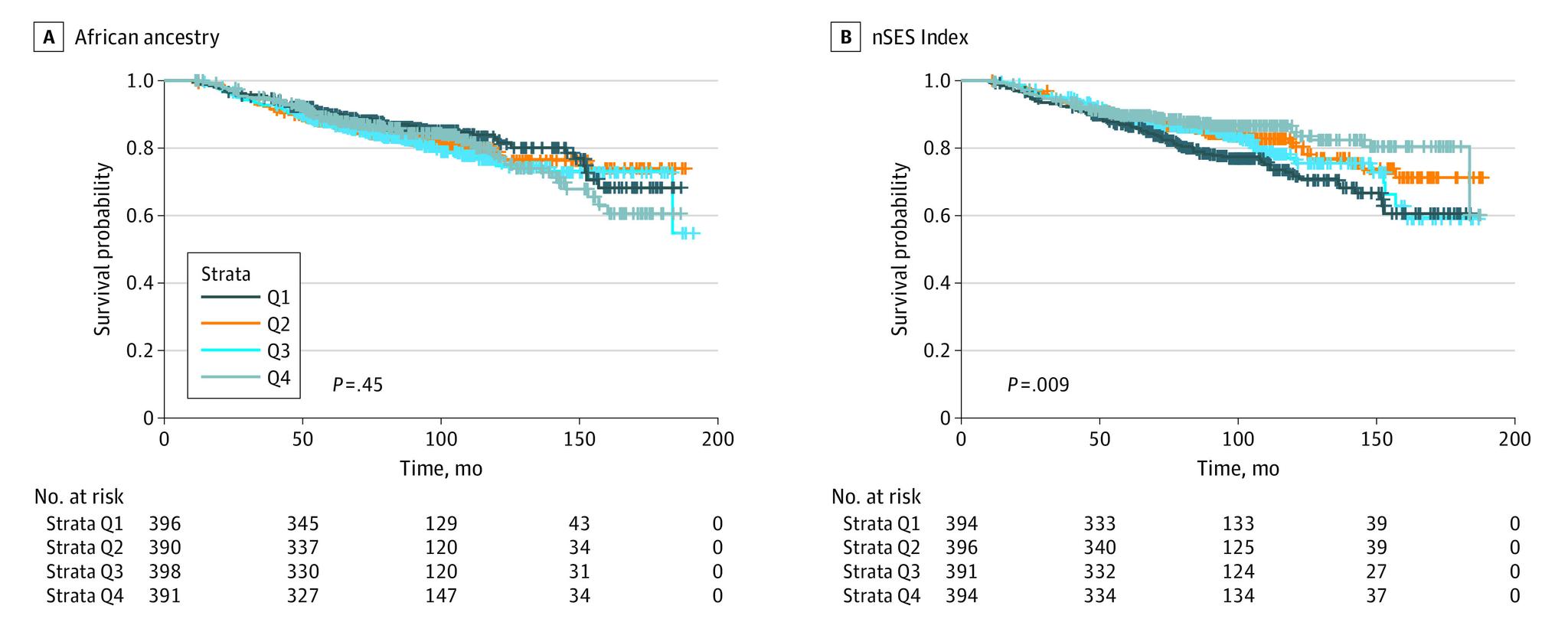
Among 1575 participants, median (IQR) African ancestry was 85% (76%-90%), and median (IQR) age was 55 (46-63) years. A 10-percentage point increase in African ancestry was associated with higher odds of ER- vs ER+ (adjusted odds ratio [aOR], 1.08; 95% CI, 0.98-1.18) and TNBC vs luminal (aOR, 1.15; 95% CI, 1.02-1.31) tumors, but not with ACM or BCSM. A 1-IQR increase in nSES was associated with lower ACM (adjusted hazard ratio [aHR], 0.76; 95% CI, 0.63-0.93), and the HR for BCSM was less than 1 but not statistically significant (aHR, 0.81; 95% CI, 0.62-1.04) in age-adjusted models, but associations attenuated following further adjustment for potential mediators (individual SES, lifestyles, comorbidities).
CONCLUSIONS AND RELEVANCE
In this cohort study of Black female BC survivors, higher African ancestry was associated with aggressive tumor subtypes. Compared with genetic ancestry, mediating pathways related to social environments may be more important for survival in these patients.
重要性
乳腺癌(BC)生存中的种族差异源于多层次的原因,这些原因可能在 BC 进展的不同阶段产生影响。阐明遗传和社会因素的重要性有助于确定干预措施的优先次序。
目的
联合研究非洲遗传血统、社会环境与任何原因导致的死亡率以及黑人 BC 幸存者的 BC 之间的关系。
设计、地点和参与者:本基于人群的队列研究纳入了 2005 年 6 月至 2019 年 5 月期间自我认定为黑人、年龄在 20 至 75 岁之间、经组织学证实患有 BC 的女性,并对其进行了随访,直至 2021 年 9 月死亡或截止。参与者居住在新泽西州的 10 个县。数据于 2022 年 12 月至 2023 年 4 月间进行了分析。
暴露因素
一个由人口普查区指标(教育、收入、财富、就业状况和职业)组成的邻里社会经济地位(nSES)指数与诊断时的居住地址相关联。使用 ADMIXTURE 程序估计非洲血统的百分比。
主要结果和测量
使用逐步调整的(年龄调整:年龄和访谈年份;完全调整:年龄调整与个体 SES、生活方式因素和合并症)逻辑回归模型来估计与肿瘤亚型(雌激素受体阴性[ER-]与雌激素受体阳性[ER+];三阴性乳腺癌[TNBC]与 luminal A)的关联,并使用 Cox 模型来估计与全因死亡率(ACM)和乳腺癌特异性死亡率(BCSM)的关联。BCSM 的模型使用 Fine-Gray 竞争风险模型进行拟合,并使用稳健标准误差来考虑普查区层面的聚类。
结果
在 1575 名参与者中,中位数(IQR)的非洲血统为 85%(76%-90%),中位数(IQR)年龄为 55(46-63)岁。非洲血统每增加 10 个百分点,与 ER-相比,ER+(调整后的优势比[aOR],1.08;95%CI,0.98-1.18)和 TNBC 与 luminal(aOR,1.15;95%CI,1.02-1.31)肿瘤的几率更高,但与 ACM 或 BCSM 无关。nSES 每增加一个 IQR,ACM 的几率就会降低(调整后的危险比[aHR],0.76;95%CI,0.63-0.93),在年龄调整模型中,BCSM 的 HR 小于 1 但无统计学意义(aHR,0.81;95%CI,0.62-1.04),但在进一步调整潜在中介因素(个体 SES、生活方式、合并症)后,关联减弱。
结论和相关性
在这项针对黑人 BC 幸存者的队列研究中,较高的非洲血统与侵袭性肿瘤亚型有关。与遗传血统相比,与社会环境相关的中介途径可能对这些患者的生存更为重要。
 Zotero 插件