Bren School of Environmental Science and Management, University of California, Santa Barbara, CA, 93106.
Proc Natl Acad Sci U S A. 2022 Sep 6;119(36):e2118539119. doi: 10.1073/pnas.2118539119. Epub 2022 Aug 29.
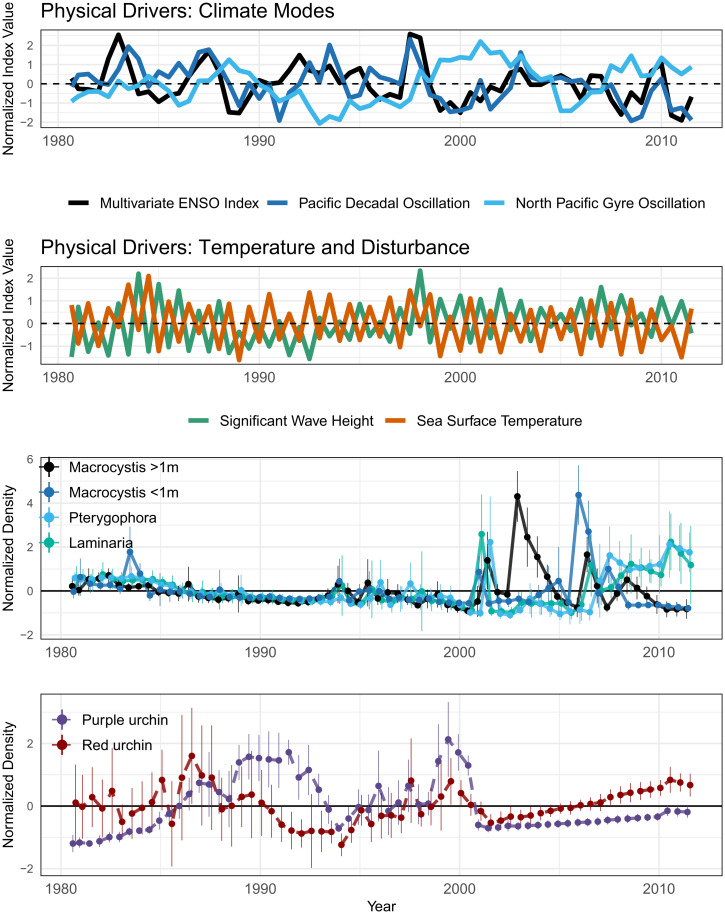
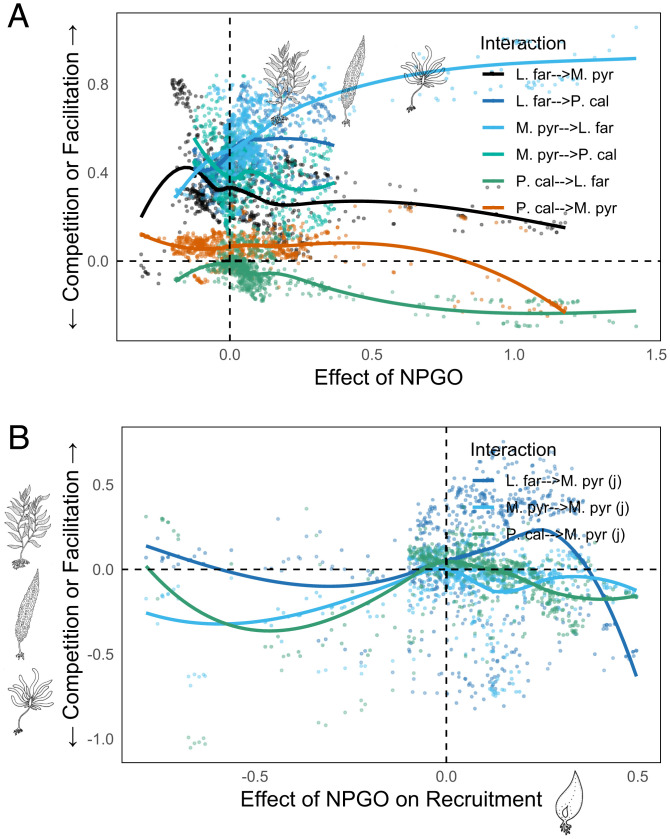
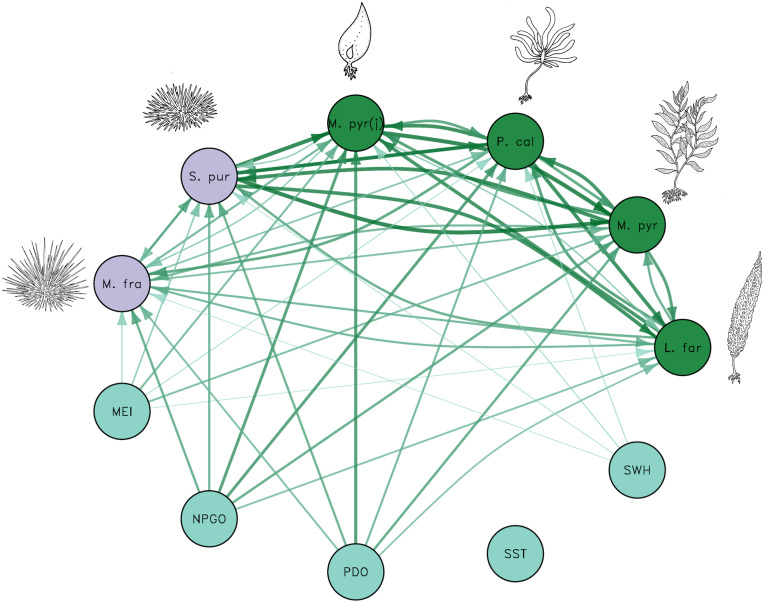
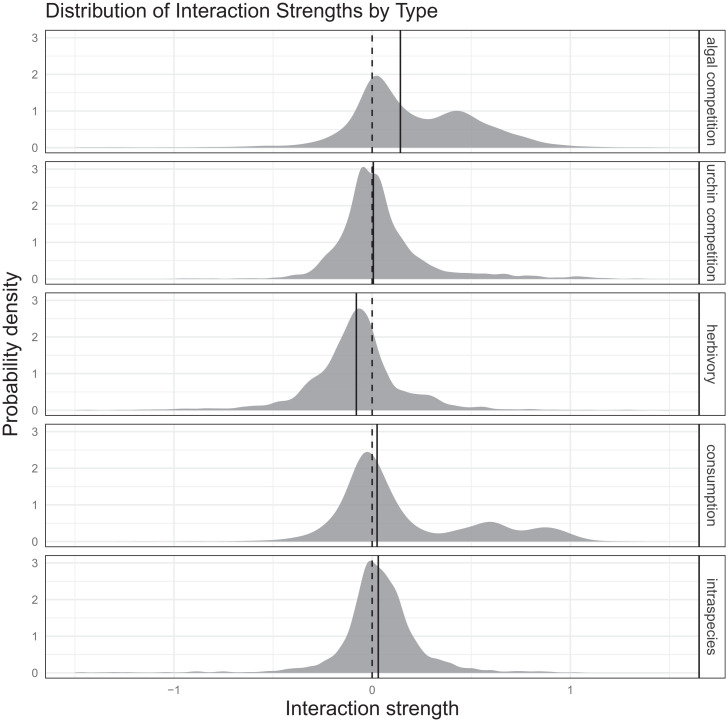
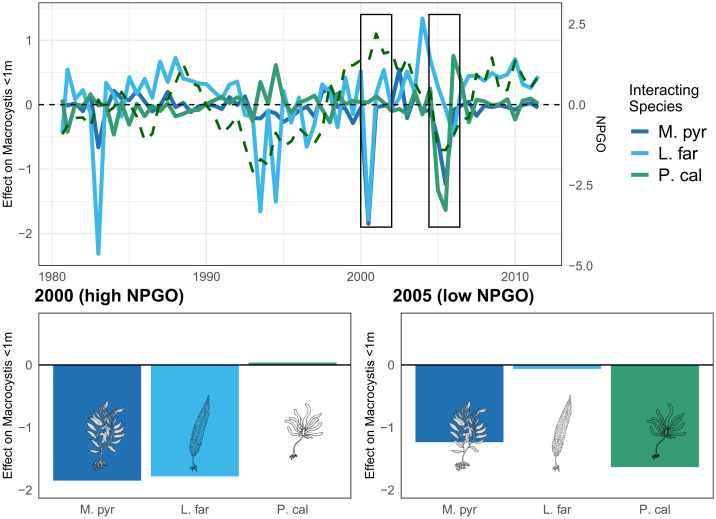
Ecological interactions are not uniform across time and can vary with environmental conditions. Yet, interactions among species are often measured with short-term controlled experiments whose outcomes can depend greatly on the particular environmental conditions under which they are performed. As an alternative, we use empirical dynamic modeling to estimate species interactions across a wide range of environmental conditions directly from existing long-term monitoring data. In our case study from a southern California kelp forest, we test whether interactions between multiple kelp and sea urchin species can be reliably reconstructed from time-series data and whether those interactions vary predictably in strength and direction across observed fluctuations in temperature, disturbance, and low-frequency oceanographic regimes. We show that environmental context greatly alters the strength and direction of species interactions. In particular, the state of the North Pacific Gyre Oscillation seems to drive the competitive balance between kelp species, asserting bottom-up control on kelp ecosystem dynamics. We show the importance of specifically studying variation in interaction strength, rather than mean interaction outcomes, when trying to understand the dynamics of complex ecosystems. The significant context dependency in species interactions found in this study argues for a greater utilization of long-term data and empirical dynamic modeling in studies of the dynamics of other ecosystems.
生态相互作用不是在所有时间都均匀的,并且可能会随环境条件而变化。然而,物种之间的相互作用通常是通过短期的控制实验来测量的,其结果很大程度上取决于实验进行时特定的环境条件。作为替代方法,我们使用经验动态建模来直接从现有的长期监测数据中估算在广泛的环境条件下的物种相互作用。在我们对加利福尼亚南部海藻林的案例研究中,我们检验了是否可以从时间序列数据中可靠地重建多种海藻和海胆物种之间的相互作用,以及这些相互作用在观察到的温度波动、干扰和低频海洋学状态下是否会以可预测的方式在强度和方向上发生变化。我们发现,环境背景极大地改变了物种相互作用的强度和方向。特别是,北太平洋旋流振荡的状态似乎控制了海藻物种之间的竞争平衡,对海藻生态系统的动态施加了自上而下的控制。我们表明,在试图理解复杂生态系统的动态时,专门研究相互作用强度的变化而不是平均相互作用结果是很重要的。在这项研究中发现的物种相互作用的显著背景依赖性,呼吁在其他生态系统的动态研究中更多地利用长期数据和经验动态建模。