Medical Research Council Population Health Research Unit, Clinical Trial Service Unit and Epidemiological Studies Unit, Nuffield Department of Population Health, University of Oxford, Oxford, UK; Institute of Cardiovascular & Medical Sciences, BHF Glasgow Cardiovascular Research Centre, University of Glasgow, Glasgow, UK.
Institute of Cardiovascular & Medical Sciences, BHF Glasgow Cardiovascular Research Centre, University of Glasgow, Glasgow, UK.
J Card Fail. 2022 Nov;28(11):1628-1641. doi: 10.1016/j.cardfail.2022.08.005. Epub 2022 Aug 28.
Bioimpedance-based estimates of fluid overload have been widely studied and systematically reviewed in populations of those undergoing dialysis, but data from populations with heart failure or nondialysis chronic kidney disease (CKD) have not.
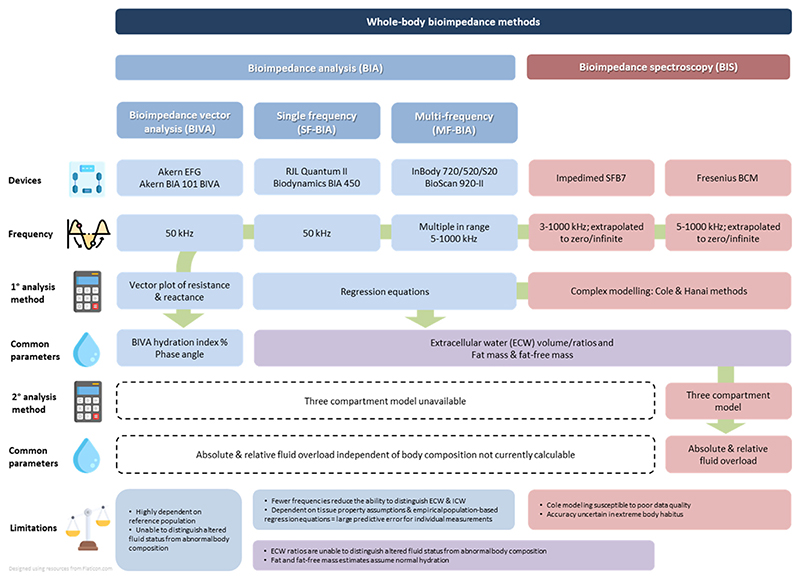
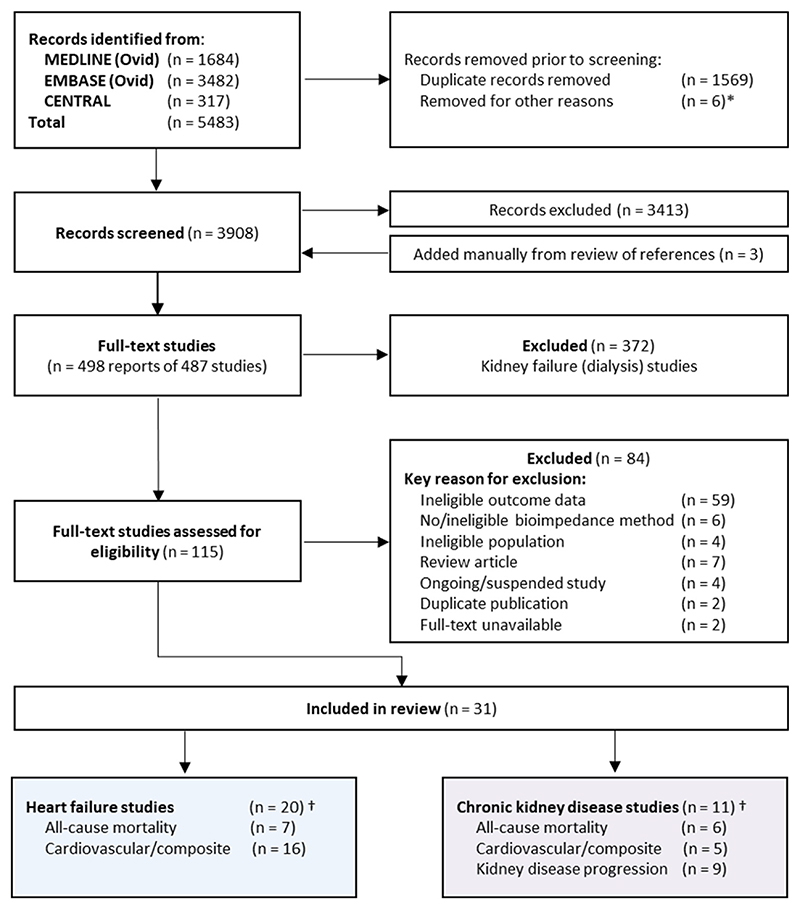
We conducted a systematic review of studies using whole-body bioimpedance from populations with heart failure and nondialysis CKD that reported associations with mortality, cardiovascular outcomes and/or CKD progression. We searched MEDLINE, Embase databases and the Cochrane CENTRAL registry from inception to March 14, 2022. We identified 31 eligible studies: 20 heart failure and 11 CKD cohorts, with 2 studies including over 1000 participants. A wide range of various bioimpedance methods were used across the studies (heart failure: 8 parameters; CKD: 6). Studies generally reported positive associations, but between-study differences in bioimpedance methods, fluid overload exposure definitions and modeling approaches precluded meta-analysis. The largest identified study was in nondialysis CKD (Chronic Renal Insufficiency Cohort, 3751 participants), which reported adjusted hazard ratios (95% confidence intervals) for phase angle < 5.59 vs ≥ 6.4 of 2.02 (1.67-2.43) for all-cause mortality; 1.80 (1.46-2.23) for heart failure events; and 1.78 (1.56-2.04) for CKD progression.
Bioimpedance indices of fluid overload are associated with risk of important cardiorenal outcomes in heart failure and CKD. Facilitation of more widespread use of bioimpedance requires consensus on the optimum device, standardized analytical methods and larger studies, including more detailed characterization of cardiac and renal phenotypes.
基于生物阻抗的液体过载估计已在接受透析的人群中进行了广泛的研究和系统评价,但心力衰竭或非透析慢性肾脏病(CKD)人群的数据尚未进行。
我们对使用全身生物阻抗技术评估心力衰竭和非透析 CKD 人群的研究进行了系统评价,这些研究报告了与死亡率、心血管结局和/或 CKD 进展相关的结果。我们检索了 MEDLINE、Embase 数据库和 Cochrane CENTRAL 注册库,检索时间截至 2022 年 3 月 14 日。我们共确定了 31 项符合条件的研究:20 项心力衰竭研究和 11 项 CKD 队列研究,其中 2 项研究纳入了超过 1000 名参与者。研究中使用了各种生物阻抗方法(心力衰竭:8 项参数;CKD:6 项参数)。研究普遍报告了阳性关联,但由于生物阻抗方法、液体过载暴露定义和建模方法的差异,无法进行荟萃分析。最大的研究是在非透析 CKD 中进行的(慢性肾功能不全队列,3751 名参与者),该研究报告了相位角<5.59 与≥6.4 时所有原因死亡率的调整后的危险比(95%置信区间)分别为 2.02(1.67-2.43);心力衰竭事件的 1.80(1.46-2.23);以及 CKD 进展的 1.78(1.56-2.04)。
生物阻抗指数与心力衰竭和 CKD 重要的心脏肾脏结局风险相关。为了更广泛地应用生物阻抗技术,需要在最佳设备、标准化分析方法和更大规模的研究方面达成共识,包括对心脏和肾脏表型进行更详细的描述。