Broegelmann Research Laboratory, University of Bergen, Bergen, Norway.
Faculty of Biochemistry, Biophysics and Biotechnology, Jagiellonian University, Krakow, Poland.
J Am Soc Nephrol. 2022 Oct;33(10):1841-1856. doi: 10.1681/ASN.2022010013. Epub 2022 Aug 29.
Bleeding diatheses, common among patients with ESKD, can lead to serious complications, particularly during invasive procedures. Chronic urea overload significantly increases cyanate concentrations in patients with ESKD, leading to carbamylation, an irreversible modification of proteins and peptides.
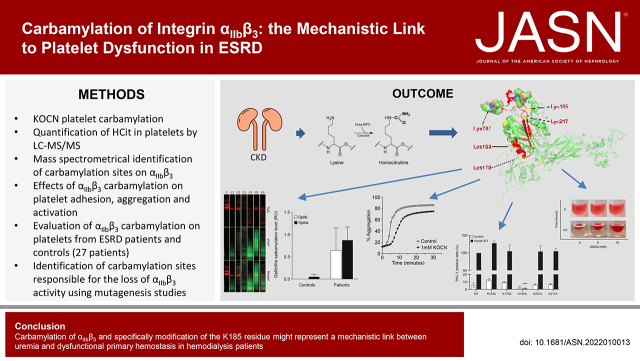
To investigate carbamylation as a potential mechanistic link between uremia and platelet dysfunction in ESKD, we used liquid chromatography-tandem mass spectrometry (HPLC-MS/MS) to quantify total homocitrulline, and biotin-conjugated phenylglyoxal labeling and Western blot to detect carbamylated integrin (a receptor required for platelet aggregation). Flow cytometry was used to study activation of isolated platelets and platelet-rich plasma. In a transient transfection system, we tested activity and fibrinogen binding of different mutated forms of the receptor. We assessed platelet adhesion and aggregation in microplate assays.
Carbamylation inhibited platelet activation, adhesion, and aggregation. Patients on hemodialysis exhibited significantly reduced activation of compared with healthy controls. We found significant carbamylation of both subunits of on platelets from patients receiving hemodialysis versus only minor modification in controls. In the transient transfection system, modification of lysine 185 in the subunit was associated with loss of receptor activity and fibrinogen binding. Supplementation of free amino acids, which was shown to protect plasma proteins from carbamylation-induced damage in patients on hemodialysis, prevented loss of activity .
Carbamylation of -specifically modification of the K185 residue-might represent a mechanistic link between uremia and dysfunctional primary hemostasis in patients on hemodialysis. The observation that free amino acids prevented the carbamylation-induced loss of activity suggests amino acid administration during dialysis may help to normalize platelet function.
出血倾向是 ESKD 患者的常见病症,可能导致严重并发症,尤其是在侵入性操作期间。慢性尿素超负荷会显著增加 ESKD 患者氰酸盐的浓度,导致氨甲酰化,这是蛋白质和肽的一种不可逆修饰。
为了研究氨甲酰化是否是尿毒症和 ESKD 血小板功能障碍之间的潜在机制联系,我们使用液相色谱-串联质谱(HPLC-MS/MS)来定量总同型瓜氨酸,并使用生物素缀合的苯甲酰甘氨酸标记和 Western blot 检测氨甲酰化整合素(血小板聚集所必需的受体)。我们使用流式细胞术研究分离血小板和富含血小板的血浆的激活。在瞬时转染系统中,我们测试了不同突变形式受体的活性和纤维蛋白原结合。我们在微孔板测定中评估了血小板黏附和聚集。
氨甲酰化抑制了血小板的激活、黏附和聚集。与健康对照组相比,血液透析患者的 激活明显降低。我们发现血液透析患者血小板上的 两个亚基都发生了显著的氨甲酰化,而对照组只有轻微的修饰。在瞬时转染系统中, 亚基赖氨酸 185 的修饰与受体活性和纤维蛋白原结合的丧失有关。补充游离氨基酸可防止血液透析患者血浆蛋白发生氨甲酰化损伤,从而防止 活性丧失。
特异性的赖氨酸 185 残基的氨甲酰化可能是血液透析患者尿毒症和功能失调性初级止血之间的机制联系。游离氨基酸可防止氨甲酰化诱导的 活性丧失的观察结果表明,在透析期间给予氨基酸可能有助于使血小板功能正常化。