Fishbane Steven, Wen Warren, Munera Catherine, Lin Rong, Bagal Sukirti, McCafferty Kieran, Menzaghi Frédérique, Goncalves Joana
Department of Medicine, Donald and Barbara Zucker School of Medicine at Hofstra/Northwell, Great Neck, NY.
Cara Therapeutics, Stamford, CT.
Kidney Med. 2022 Jun 28;4(8):100513. doi: 10.1016/j.xkme.2022.100513. eCollection 2022 Aug.
RATIONALE & OBJECTIVE: We report a pooled safety analysis of intravenous difelikefalin in participants with moderate to severe chronic kidney disease-associated pruritus (CKD-aP) treated by hemodialysis in 4 phase 3 clinical studies.
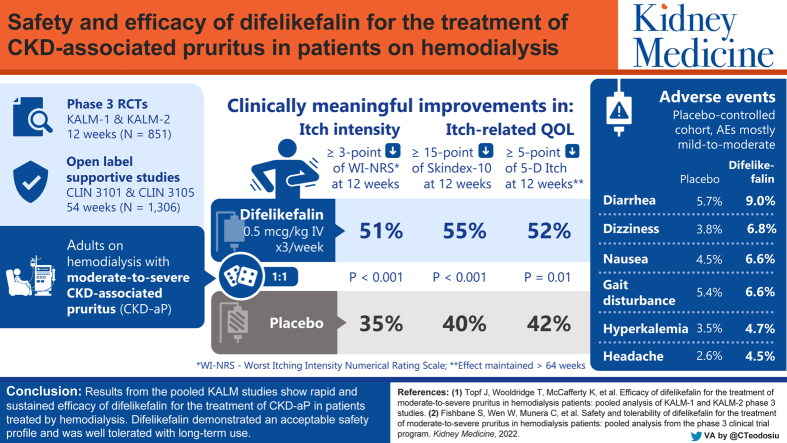
KALM-1 and KALM-2 were randomized, double-blind, placebo-controlled, pivotal phase 3 studies; CLIN3101 (52 weeks) and CLIN3105 (12 weeks) were open-label studies.
SETTING & PARTICIPANTS: Adults with moderate to severe CKD-aP treated by hemodialysis in North America, Europe, and the Asia-Pacific region.
At least 1 intravenous placebo or difelikefalin dose of 0.5 mcg/kg for up to 64 weeks.
Safety.
Safety analyses were conducted with 848 participants in the placebo-controlled cohort (424 participants each in the difelikefalin and placebo groups) and in 1,306 participants in the all-difelikefalin-exposure cohort. In the placebo-controlled cohort, the most commonly reported treatment-emergent adverse events (TEAEs), occurring in ≥2% of participants receiving difelikefalin and with a ≥1% higher incidence than placebo, were diarrhea (9.0% and 5.7%, respectively); dizziness (6.8% and 3.8%, respectively); nausea (6.6% and 4.5%, respectively); gait disturbances, including falls (6.6% and 5.4%, respectively), hyperkalemia (4.7% and 3.5%, respectively); headache (4.5% and 2.6%, respectively); somnolence (4.2% and 2.4%, respectively); and mental status changes (3.3% and 1.4%, respectively). These were mostly mild or moderate, with few leading to discontinuation. Incidence rates of TEAEs, serious TEAEs, and discontinuations because of TEAEs did not increase with long-term exposure. Three participants (0.7%) in the difelikefalin group and 5 participants (1.2%) in the placebo group died during the study.
Pooled data from studies with different designs.
Intravenous difelikefalin demonstrated an acceptable safety profile, was generally well tolerated with long-term use, and may address the unmet treatment need for patients with CKD-aP treated by hemodialysis.
Cara Therapeutics, Inc.
KALM-1 is registered as NCT03422653, KALM-2 as NCT03636269, CLIN3101 as NCT03281538, and CLIN3105 as NCT03998163.
我们在4项3期临床研究中,对接受血液透析治疗的中重度慢性肾脏病相关性瘙痒(CKD-aP)患者静脉注射地夫可法林进行了汇总安全性分析。
KALM-1和KALM-2是随机、双盲、安慰剂对照的关键3期研究;CLIN3101(52周)和CLIN3105(12周)是开放标签研究。
北美、欧洲和亚太地区接受血液透析治疗的中重度CKD-aP成人患者。
至少1次静脉注射安慰剂或0.5 mcg/kg的地夫可法林剂量,最长64周。
安全性。
对安慰剂对照队列中的848名参与者(地夫可法林组和安慰剂组各424名参与者)以及所有接受地夫可法林治疗队列中的1306名参与者进行了安全性分析。在安慰剂对照队列中,最常报告的治疗中出现的不良事件(TEAE),在接受地夫可法林治疗且发生率≥2%且比安慰剂组高≥1%的参与者中出现的有:腹泻(分别为9.0%和5.7%);头晕(分别为6.8%和3.8%);恶心(分别为6.6%和4.5%);步态障碍,包括跌倒(分别为6.6%和5.4%)、高钾血症(分别为4.7%和3.5%);头痛(分别为4.5%和2.6%);嗜睡(分别为4.2%和2.4%);以及精神状态改变(分别为3.3%和1.4%)。这些大多为轻度或中度,很少导致停药。TEAE、严重TEAE以及因TEAE停药的发生率并未随长期暴露而增加。地夫可法林组有3名参与者(0.7%)和安慰剂组有5名参与者(1.2%)在研究期间死亡。
来自不同设计研究的汇总数据。
静脉注射地夫可法林显示出可接受的安全性,长期使用总体耐受性良好,可能满足接受血液透析治疗的CKD-aP患者未得到满足的治疗需求。
卡拉治疗公司
KALM-1注册为NCT03422653,KALM-2注册为NCT03636269,CLIN3101注册为NCT03281538,CLIN3105注册为NCT03998163。