Demir Halit Batuhan, Korucuk Ebubekir, Miftari Almir, Turk Yigit
Department of General Surgery, Ege University, İzmir, TUR.
Cureus. 2022 Jul 26;14(7):e27270. doi: 10.7759/cureus.27270. eCollection 2022 Jul.
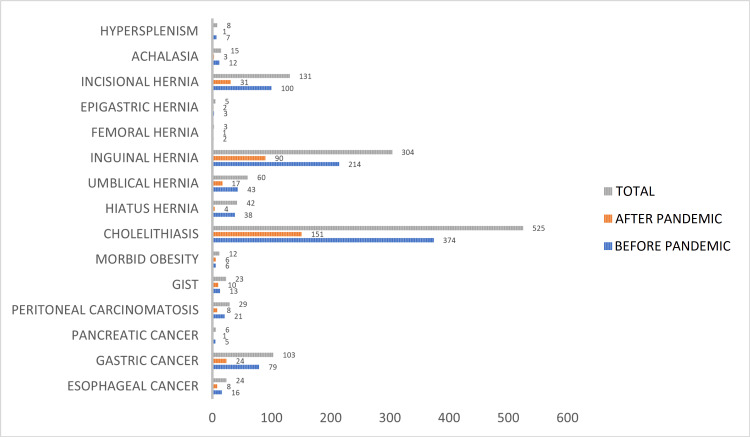
Background As the coronavirus disease 2019 (COVID-19) pandemic started, some restrictions were imposed throughout the country. The pandemic caused disruption, reduction, and even a halt in health services worldwide. During this period, the number of procedures performed in surgical clinics decreased due to the interruption of services and the restriction in patient admissions. Methodology In this study, we aimed to evaluate the effect of the pandemic on the number of surgeries performed in our clinic during the pre- and post-pandemic period by evaluating the following elective surgeries conducted between September 2018 and September 2021: upper gastrointestinal system, abdominal wall hernia, gallbladder surgeries, and kidney transplantation. Results A significant decrease was observed in the number of operations before and after the pandemic in our clinic. Conclusions In our opinion, both the Ministry of Health and healthcare institutions should increase the necessary precautions, organize the planning and programming in hospitals, and increase efforts in protecting healthcare workers and patients by increasing surgical practices and ensuring that the healthcare services we provide reach the numbers noted during the pre-pandemic period.
背景 随着2019年冠状病毒病(COVID-19)大流行的开始,全国实施了一些限制措施。这场大流行导致全球卫生服务中断、减少甚至停止。在此期间,由于服务中断和患者入院受限,外科诊所进行的手术数量减少。方法 在本研究中,我们旨在通过评估2018年9月至2021年9月期间进行的以下择期手术,来评估大流行对我们诊所在大流行前和大流行后期间进行的手术数量的影响:上胃肠道系统手术、腹壁疝手术、胆囊手术和肾移植手术。结果 我们诊所大流行前后的手术数量显著减少。结论 我们认为,卫生部和医疗机构都应加强必要的预防措施,在医院组织规划和方案制定,并通过增加手术操作以及确保我们提供的医疗服务达到大流行前记录的数量,加大保护医护人员和患者的力度。