Department of Clinical Physiology and Nuclear Medicine, Skåne University Hospital, Malmö, Sweden.
Wallenberg Centre for Molecular Medicine, Lund University, Lund, Sweden.
Clin Physiol Funct Imaging. 2022 Nov;42(6):443-452. doi: 10.1111/cpf.12785. Epub 2022 Sep 9.
Positron emission tomography-computed tomography (PET-CT) using prostate-specific membrane antigen (PSMA) ligands is a method for imaging prostate cancer. A recent tracer, F-PSMA-1007, offers advantages concerning production and biokinetics compared to the standard tracer ( Ga-PSMA-11). Until now, radiation dosimetry data for this ligand was limited to the material of three healthy volunteers. The purpose of this study is to study the biokinetics and dosimetry of F-PSMA-1007.
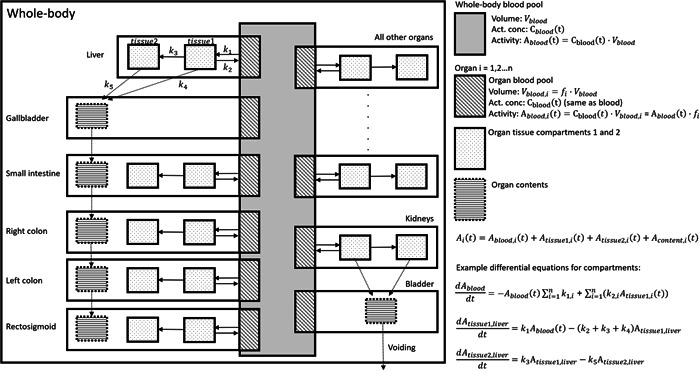
Twelve patients with prostate cancer were injected with 4 MBq/kg F-PSMA-1007. Eight PET-CT scans with concomitant blood sampling were performed up to 330 min after injection. Urine was collected until the following morning. Volumes of interest for radiation-sensitive organs and organs with high uptake of F-PSMA-1007 were drawn in the PET images. A biokinetic compartment model was developed using activity data from PET images and blood and urine samples. Time-activity curves and time-integrated activity coefficients for all delineated organs were calculated. The software IDAC-dose 2.1 was used to calculate the absorbed and effective doses.
High concentrations of activity were noted in the liver, kidneys, parts of the small intestine, spleen, salivary glands, and lacrimal glands. The elimination through urine was 8% of injected activity in 20 h. The highest absorbed doses coefficients were in the lacrimal glands, kidneys, salivary glands, liver, and spleen (98-66 µGy/MBq). The effective dose coefficient was 25 µSv/MBq.
The effective dose of F-PSMA-1007 is 6.0-8.0 mSv for a typical patient weighing 80 kg injected with 3-4 MBq/kg.
正电子发射断层扫描-计算机断层扫描(PET-CT)使用前列腺特异性膜抗原(PSMA)配体是一种用于成像前列腺癌的方法。一种最近的示踪剂 F-PSMA-1007,与标准示踪剂(Ga-PSMA-11)相比,在生产和生物动力学方面具有优势。到目前为止,这种配体的辐射剂量学数据仅限于三名健康志愿者的材料。本研究的目的是研究 F-PSMA-1007 的生物动力学和剂量学。
12 例前列腺癌患者注射 4MBq/kg F-PSMA-1007。注射后至 330 分钟进行 8 次 PET-CT 扫描并同时进行血液取样。收集尿液直至次日早晨。在 PET 图像中绘制放射性敏感器官和高摄取 F-PSMA-1007 的器官的感兴趣容积。使用来自 PET 图像和血液及尿液样本的活性数据开发生物动力学房室模型。计算所有勾画器官的时间-活性曲线和时间积分活性系数。使用 IDAC-dose 2.1 软件计算吸收剂量和有效剂量。
肝脏、肾脏、部分小肠、脾脏、唾液腺和泪腺的活性浓度很高。在 20 小时内,通过尿液排泄的放射性活度为 8%。吸收剂量系数最高的器官是泪腺、肾脏、唾液腺、肝脏和脾脏(98-66µGy/MBq)。有效剂量系数为 25µSv/MBq。
对于典型体重为 80kg 的患者,注射 3-4MBq/kg 的 F-PSMA-1007 的有效剂量为 6.0-8.0mSv。