• 文献检索
  • 文档翻译
  • 深度研究
  • 学术资讯
  • Suppr Zotero 插件Zotero 插件
  • 邀请有礼
  • 套餐&价格
  • 历史记录
应用&插件
Suppr Zotero 插件Zotero 插件浏览器插件Mac 客户端Windows 客户端微信小程序
定价
高级版会员购买积分包购买API积分包
服务
文献检索文档翻译深度研究API 文档MCP 服务
关于我们
关于 Suppr公司介绍联系我们用户协议隐私条款
关注我们

Suppr 超能文献

核心技术专利:CN118964589B侵权必究
粤ICP备2023148730 号-1Suppr @ 2026

文献检索

告别复杂PubMed语法,用中文像聊天一样搜索,搜遍4000万医学文献。AI智能推荐,让科研检索更轻松。

立即免费搜索

文件翻译

保留排版,准确专业,支持PDF/Word/PPT等文件格式,支持 12+语言互译。

免费翻译文档

深度研究

AI帮你快速写综述,25分钟生成高质量综述,智能提取关键信息,辅助科研写作。

立即免费体验

理解日常驾驶中驾驶行为与幸福感之间的相互作用:基于现场研究的因果分析。

Understanding the Interactions Between Driving Behavior and Well-being in Daily Driving: Causal Analysis of a Field Study.

机构信息

Bosch IoT Lab, Institute of Technology Management, University of St Gallen, St Gallen, Switzerland.

出版信息

J Med Internet Res. 2022 Aug 30;24(8):e36314. doi: 10.2196/36314.

DOI:10.2196/36314
PMID:36040791
原文链接:https://pmc.ncbi.nlm.nih.gov/articles/PMC9472037/
Abstract

BACKGROUND

Investigating ways to improve well-being in everyday situations as a means of fostering mental health has gained substantial interest in recent years. For many people, the daily commute by car is a particularly straining situation of the day, and thus researchers have already designed various in-vehicle well-being interventions for a better commuting experience. Current research has validated such interventions but is limited to isolating effects in controlled experiments that are generally not representative of real-world driving conditions.

OBJECTIVE

The aim of the study is to identify cause-effect relationships between driving behavior and well-being in a real-world setting. This knowledge should contribute to a better understanding of when to trigger interventions.

METHODS

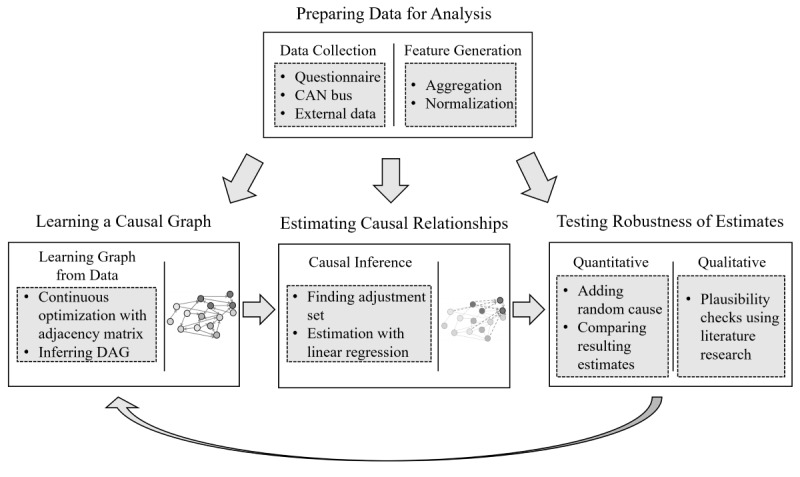
We conducted a field study in which we provided a demographically diverse sample of 10 commuters with a car for daily driving over a period of 4 months. Before and after each trip, the drivers had to fill out a questionnaire about their state of well-being, which was operationalized as arousal and valence. We equipped the cars with sensors that recorded driving behavior, such as sudden braking. We also captured trip-dependent factors, such as the length of the drive, and predetermined factors, such as the weather. We conducted a causal analysis based on a causal directed acyclic graph (DAG) to examine cause-effect relationships from the observational data and to isolate the causal chains between the examined variables. We did so by applying the backdoor criterion to the data-based graphical model. The hereby compiled adjustment set was used in a multiple regression to estimate the causal effects between the variables.

RESULTS

The causal analysis showed that a higher level of arousal before driving influences driving behavior. Higher arousal reduced the frequency of sudden events (P=.04) as well as the average speed (P=.001), while fostering active steering (P<.001). In turn, more frequent braking (P<.001) increased arousal after the drive, while a longer trip (P<.001) with a higher average speed (P<.001) reduced arousal. The prevalence of sunshine (P<.001) increased arousal and of occupants (P<.001) increased valence (P<.001) before and after driving.

CONCLUSIONS

The examination of cause-effect relationships unveiled significant interactions between well-being and driving. A low level of predriving arousal impairs driving behavior, which manifests itself in more frequent sudden events and less anticipatory driving. Driving has a stronger effect on arousal than on valence. In particular, monotonous driving situations at high speeds with low cognitive demand increase the risk of the driver becoming tired (low arousal), thus impairing driving behavior. By combining the identified causal chains, states of vulnerability can be inferred that may form the basis for timely delivered interventions to improve well-being while driving.
https://cdn.ncbi.nlm.nih.gov/pmc/blobs/a15c/9472037/b31492596074/jmir_v24i8e36314_fig3.jpg
https://cdn.ncbi.nlm.nih.gov/pmc/blobs/a15c/9472037/2a9b5da9da5c/jmir_v24i8e36314_fig1.jpg
https://cdn.ncbi.nlm.nih.gov/pmc/blobs/a15c/9472037/7227a63acf60/jmir_v24i8e36314_fig2.jpg
https://cdn.ncbi.nlm.nih.gov/pmc/blobs/a15c/9472037/b31492596074/jmir_v24i8e36314_fig3.jpg
https://cdn.ncbi.nlm.nih.gov/pmc/blobs/a15c/9472037/2a9b5da9da5c/jmir_v24i8e36314_fig1.jpg
https://cdn.ncbi.nlm.nih.gov/pmc/blobs/a15c/9472037/7227a63acf60/jmir_v24i8e36314_fig2.jpg
https://cdn.ncbi.nlm.nih.gov/pmc/blobs/a15c/9472037/b31492596074/jmir_v24i8e36314_fig3.jpg
摘要

背景

近年来,人们对研究如何改善日常生活中的幸福感以促进心理健康产生了浓厚的兴趣。对于许多人来说,每天开车上下班是一天中特别紧张的时刻,因此研究人员已经为改善通勤体验设计了各种车内幸福感干预措施。目前的研究已经验证了这些干预措施,但仅限于在一般不代表实际驾驶条件的对照实验中孤立地研究其效果。

目的

本研究旨在确定驾驶行为与现实环境中幸福感之间的因果关系。这一知识应有助于更好地了解何时触发干预措施。

方法

我们进行了一项现场研究,为 10 名通勤者提供了一辆汽车,让他们在 4 个月的时间内每天开车。在每次行程前后,司机都必须填写一份关于自己幸福感的问卷,幸福感的操作性定义是唤醒度和愉悦度。我们在车上安装了传感器,记录驾驶行为,如急刹车。我们还记录了与行程相关的因素,如驾驶时长,以及预定因素,如天气。我们进行了因果分析,基于有向无环图(DAG)来检查观测数据中的因果关系,并隔离检查变量之间的因果链。我们通过将后门准则应用于基于数据的图形模型来做到这一点。根据编译的调整集,在多元回归中估计了变量之间的因果效应。

结果

因果分析表明,驾驶前较高的唤醒水平会影响驾驶行为。较高的唤醒水平降低了急事件的频率(P=.04)和平均速度(P=.001),同时促进了主动转向(P<.001)。反之,更频繁的刹车(P<.001)会增加驾驶后的唤醒水平,而较长的行程(P<.001)和较高的平均速度(P<.001)会降低唤醒水平。阳光的出现频率(P<.001)增加了驾驶前后的唤醒水平,而乘客的存在(P<.001)增加了愉悦度(P<.001)。

结论

对因果关系的检查揭示了幸福感和驾驶之间的显著相互作用。低水平的预驾驶唤醒会损害驾驶行为,表现为更频繁的急事件和更少的预见性驾驶。驾驶对唤醒的影响大于对愉悦度的影响。特别是,在高速度下单调的驾驶情况,认知需求低,会增加驾驶员疲劳(唤醒水平低)的风险,从而损害驾驶行为。通过结合确定的因果链,可以推断出易损状态,这可能为及时提供改善驾驶幸福感的干预措施提供基础。

相似文献

1
Understanding the Interactions Between Driving Behavior and Well-being in Daily Driving: Causal Analysis of a Field Study.理解日常驾驶中驾驶行为与幸福感之间的相互作用:基于现场研究的因果分析。
J Med Internet Res. 2022 Aug 30;24(8):e36314. doi: 10.2196/36314.
2
How fleeting emotions affect hazard perception and steering while driving: the impact of image arousal and valence.情绪的短暂变化如何影响驾驶时的危险感知和转向:图像唤起和效价的影响。
Accid Anal Prev. 2012 Mar;45:222-9. doi: 10.1016/j.aap.2011.07.006. Epub 2011 Aug 6.
3
Driver Behavior During Overtaking Maneuvers from the 100-Car Naturalistic Driving Study.来自100辆汽车自然驾驶研究的超车操作过程中的驾驶员行为。
Traffic Inj Prev. 2015;16 Suppl 2:S176-81. doi: 10.1080/15389588.2015.1057281.
4
Evaluating In-Car Movements in the Design of Mindful Commute Interventions: Exploratory Study.在正念通勤干预设计中评估车内活动:探索性研究
J Med Internet Res. 2017 Dec 4;19(12):e372. doi: 10.2196/jmir.6983.
5
The restless mind while driving: drivers' thoughts behind the wheel.驾驶时躁动不安的大脑:驾驶员开车时的想法。
Accid Anal Prev. 2015 Mar;76:159-65. doi: 10.1016/j.aap.2015.01.005. Epub 2015 Feb 16.
6
Age and gender differences in time to collision at braking from the 100-Car Naturalistic Driving Study.来自100辆汽车自然驾驶研究的制动时碰撞时间的年龄和性别差异。
Traffic Inj Prev. 2014;15 Suppl 1:S15-20. doi: 10.1080/15389588.2014.928703.
7
Car drivers coping with hazardous events in real versus simulated situations: Declarative, behavioral and physiological data used to assess drivers' feeling of presence.驾驶员在真实与模拟环境下应对危险事件的比较:用于评估驾驶员存在感的数据(描述性、行为和生理)。
PLoS One. 2021 Feb 19;16(2):e0247373. doi: 10.1371/journal.pone.0247373. eCollection 2021.
8
Investigating the effects of driving environment and driver characteristics on drivers' compliance with speed limits.研究驾驶环境和驾驶员特征对驾驶员遵守速度限制的影响。
Traffic Inj Prev. 2021;22(3):201-206. doi: 10.1080/15389588.2021.1893699. Epub 2021 Mar 10.
9
Situational influences on response time and maneuver choice: Development of time-critical scenarios.情境对反应时间和机动选择的影响:时间关键型情景的开发。
Accid Anal Prev. 2019 Jan;122:48-62. doi: 10.1016/j.aap.2018.09.021. Epub 2018 Oct 8.
10
Effects of an integrated collision warning system on risk compensation behavior: An examination under naturalistic driving conditions.综合碰撞预警系统对风险补偿行为的影响:自然驾驶条件下的检验。
Accid Anal Prev. 2021 Dec;163:106450. doi: 10.1016/j.aap.2021.106450. Epub 2021 Oct 19.

引用本文的文献

1
Driving safety: Investigating the cognitive foundations of accident prevention.驾驶安全:探究事故预防的认知基础。
Heliyon. 2023 Oct 21;9(11):e21355. doi: 10.1016/j.heliyon.2023.e21355. eCollection 2023 Nov.

本文引用的文献

1
When Do Drivers Interact with In-Vehicle Well-being Interventions? An Exploratory Analysis of a Longitudinal Study on Public Roads.驾驶员何时与车内健康干预措施进行交互?一项关于公共道路的纵向研究的探索性分析。
Proc ACM Interact Mob Wearable Ubiquitous Technol. 2021 Mar;5(1). doi: 10.1145/3448116. Epub 2021 Mar 30.
2
Computer Mouse Movements as an Indicator of Work Stress: Longitudinal Observational Field Study.鼠标运动可作为工作压力指标:纵向观察现场研究。
J Med Internet Res. 2021 Apr 2;23(4):e27121. doi: 10.2196/27121.
3
The Causal Relationship Between Portal Usage and Self-Efficacious Health Information-Seeking Behaviors: Secondary Analysis of the Health Information National Trends Survey Data.
门户使用与自我效能感健康信息搜索行为之间的因果关系:健康信息国家趋势调查数据的二次分析。
J Med Internet Res. 2021 Jan 27;23(1):e17782. doi: 10.2196/17782.
4
Summarizing Complex Graphical Models of Multiple Chronic Conditions Using the Second Eigenvalue of Graph Laplacian: Algorithm Development and Validation.使用图拉普拉斯算子的第二特征值总结多种慢性病的复杂图形模型:算法开发与验证
JMIR Med Inform. 2020 Jun 17;8(6):e16372. doi: 10.2196/16372.
5
Is well-being associated with the quantity and quality of social interactions?幸福感与社交互动的数量和质量有关吗?
J Pers Soc Psychol. 2020 Dec;119(6):1478-1496. doi: 10.1037/pspp0000272. Epub 2019 Oct 24.
6
Threats to the Internal Validity of Experimental and Quasi-Experimental Research in Healthcare.医疗保健领域实验性和准实验性研究的内部效度面临的威胁。
J Health Care Chaplain. 2018 Jul-Sep;24(3):107-130. doi: 10.1080/08854726.2017.1421019. Epub 2018 Jan 24.
7
Evaluating In-Car Movements in the Design of Mindful Commute Interventions: Exploratory Study.在正念通勤干预设计中评估车内活动:探索性研究
J Med Internet Res. 2017 Dec 4;19(12):e372. doi: 10.2196/jmir.6983.
8
Global, regional, and national incidence, prevalence, and years lived with disability for 328 diseases and injuries for 195 countries, 1990-2016: a systematic analysis for the Global Burden of Disease Study 2016.全球、区域和国家发病率、患病率以及 195 个国家和地区 1990 年至 2016 年 328 种疾病和伤害导致的残疾年数:2016 年全球疾病负担研究的系统分析。
Lancet. 2017 Sep 16;390(10100):1211-1259. doi: 10.1016/S0140-6736(17)32154-2.
9
Prevention of Mental Health Disorders Using Internet- and Mobile-Based Interventions: A Narrative Review and Recommendations for Future Research.利用基于互联网和移动设备的干预措施预防心理健康障碍:一项叙述性综述及对未来研究的建议
Front Psychiatry. 2017 Aug 10;8:116. doi: 10.3389/fpsyt.2017.00116. eCollection 2017.
10
Commentary: The Limits of Risk Factors Revisited: Is It Time for a Causal Architecture Approach?评论:重新审视风险因素的局限性:是时候采用因果结构方法了吗?
Epidemiology. 2017 Jan;28(1):1-5. doi: 10.1097/EDE.0000000000000578.