Aix-Marseille University, University Mediterranean Center of Cardio-Oncology, Unit of Heart Failure and Valvular Heart Diseases, Department of Cardiology, North Hospital, Assistance Publique - Hôpitaux de Marseille, Centre for CardioVascular and Nutrition Research (C2VN), Inserm 1263, Inrae 1260, Marseille, France.
Sidney Kimmel Comprehensive Cancer Center, John Hopkins University, Baltimore, MD, USA.
Eur Heart J. 2022 Nov 7;43(42):4458-4468. doi: 10.1093/eurheartj/ehac456.
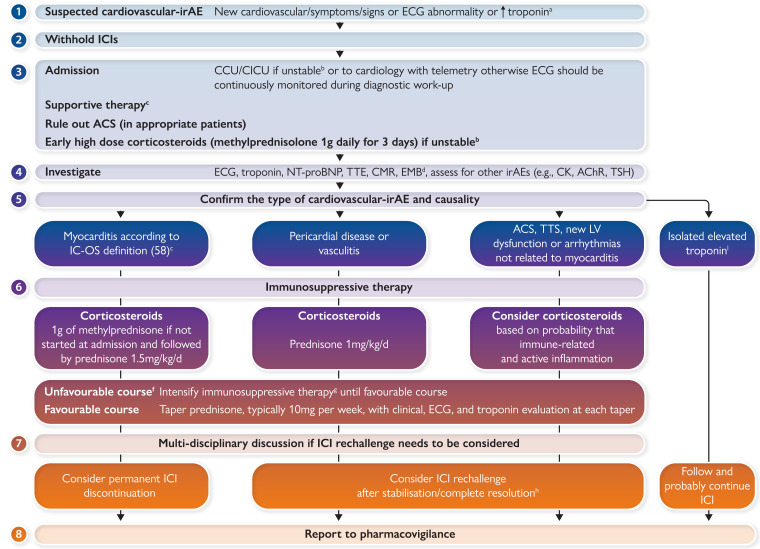
Over the last decade or so, there has been a paradigm shift in the oncologic care of patients with a range of solid tumour and haematologic malignancies, away from traditional cytotoxic chemotherapy and towards personalized cancer treatments, using both targeted therapy and immunotherapy. This shift has contributed to the remarkable and sustained increase in the number of cancer survivors and the longevity of patients with a cancer diagnosis. This review will focus on the cardiovascular effects of immune checkpoint inhibitors and will present a background on immune checkpoint inhibition for cancer, the epidemiology, potential mechanisms, the potential insights into cardiovascular biology, and a diagnostic and therapeutic approach to potential cases. Our understanding of the cardiovascular effects of immune checkpoint inhibitors needs to improve. However, the evolution necessarily needs to be rapid. Initial observations noted that immune checkpoint inhibitor therapy can lead to a fulminant myocarditis. Recent reports have expanded the effect of immune checkpoint inhibitor therapy on the cardiovascular system to include an increase in cardiac dysfunction without myocarditis, arrhythmias, venous thromboembolic disease, accelerated atherosclerosis, and atherosclerosis-related cardiovascular events. The association between immune checkpoint inhibitor therapy and an increase in these cardiovascular events is not only limited to events occurring within the first few weeks after starting therapy but can also include events that occur months to years after therapy. The latter observation is especially of relevance in those treated with adjuvant or neoadjuvant therapy. There needs to be a shift from recognition of an increase in cardiovascular events to currently approved immune checkpoint inhibitor therapies to understanding the mechanisms that lead to adverse cardiovascular effects, understanding who is at risk, and understanding what we can do about it.
在过去的十年左右,肿瘤患者的治疗模式发生了重大转变,从传统的细胞毒性化疗转向了针对多种实体瘤和血液恶性肿瘤的个体化癌症治疗,包括靶向治疗和免疫治疗。这种转变促成了癌症幸存者人数的显著增加和癌症患者的寿命延长。本综述将重点介绍免疫检查点抑制剂的心血管效应,并介绍癌症免疫检查点抑制的背景、流行病学、潜在机制、对心血管生物学的潜在认识以及潜在病例的诊断和治疗方法。我们对免疫检查点抑制剂心血管效应的认识需要提高。然而,这种演变必然需要迅速进行。最初的观察指出,免疫检查点抑制剂治疗可能导致暴发性心肌炎。最近的报告扩大了免疫检查点抑制剂治疗对心血管系统的影响,包括在没有心肌炎的情况下心脏功能障碍、心律失常、静脉血栓栓塞性疾病、动脉粥样硬化加速和与动脉粥样硬化相关的心血管事件增加。免疫检查点抑制剂治疗与这些心血管事件增加之间的关联不仅限于治疗开始后几周内发生的事件,还包括治疗后数月至数年内发生的事件。后一种观察结果在接受辅助或新辅助治疗的患者中尤为重要。需要从认识到心血管事件的增加转变为目前批准的免疫检查点抑制剂治疗,以了解导致不良心血管效应的机制,了解谁有风险,以及我们可以采取什么措施。