Faculty of Medicine Ramathibodi Hospital, Chakri Naruebodindra Medical Institute, Mahidol University, Samut Prakan, Thailand.
Department of Medicine, Nan Hospital, Nan, Thailand.
PLoS One. 2022 Aug 30;17(8):e0273678. doi: 10.1371/journal.pone.0273678. eCollection 2022.
Metformin-associated lactic acidosis (MALA) is a rare event but underrecognition may lead to unfavorable outcomes in type 2 diabetes patients. While many risk factors of MALA have been identified, how to reduce mortality from MALA is a matter of debate. This study aimed to explore the factors associated with 30-day mortality amongst MALA patients.
An observational study enrolled patients diagnosed with MALA between January 2014 and December 2017. MALA was defined by a history of metformin administration, metabolic acidosis (arterial blood gas pH <7.35 or HCO3 <15 mmol/L), and elevated plasma lactate level (>5 mmol/L). We examined risk factors including age, sex, underlying diseases, current medications, blood tests, disease severity, and dialysis data. Mortality status was identified from medical records or report on telephone.
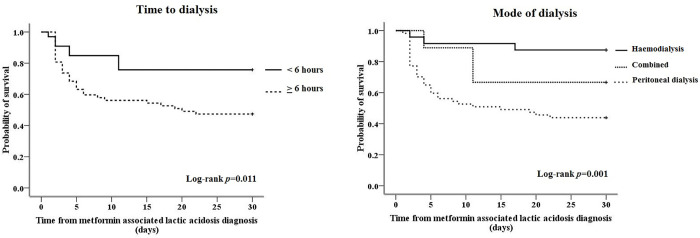
We included 105 MALA patients. Most patients (95.2%) were diagnosed acute kidney injury stage 3 according to KDIGO 2012 definition. The 30-day mortality rate was 36.2% and dialysis rate was 85.7%. The survivors had higher proportions of underlying chronic kidney disease, presence of metabolic acidosis, receiving renal replacement therapy within 6 hours, and haemodialysis, whereas the non-survivors had higher percentage of hypertension and disease severity. Lower APACHE II score (HR = 0.95; 95%CI, 0.91-0.99; p = 0.038), time to dialysis < 6 hours (0.31; 0.14-0.69; 0.004), and haemodialysis (0.20;0.06-0.67; 0.010) were associated with lower 30-day mortality, using multivariate Cox-regression analysis.
Mortality rate amongst patients with MALA was high. Early dialysis treatment within 6 hours after admission and haemodialysis were independently associated with lower 30-day mortality. The large scale, well-designed studies need to confirm these encouraging results.
二甲双胍相关乳酸酸中毒(MALA)是一种罕见的事件,但认识不足可能导致 2 型糖尿病患者的不良后果。虽然已经确定了许多 MALA 的危险因素,但如何降低 MALA 的死亡率仍存在争议。本研究旨在探讨与 MALA 患者 30 天死亡率相关的因素。
一项观察性研究纳入了 2014 年 1 月至 2017 年 12 月期间诊断为 MALA 的患者。MALA 的定义为使用二甲双胍治疗史、代谢性酸中毒(动脉血气 pH<7.35 或 HCO3<15mmol/L)和血浆乳酸水平升高(>5mmol/L)。我们检查了包括年龄、性别、基础疾病、当前用药、血液检查、疾病严重程度和透析数据在内的危险因素。通过病历或电话报告确定死亡率状态。
我们纳入了 105 例 MALA 患者。根据 KDIGO 2012 定义,大多数患者(95.2%)被诊断为急性肾损伤 3 期。30 天死亡率为 36.2%,透析率为 85.7%。存活者的基础慢性肾脏病比例较高,存在代谢性酸中毒,6 小时内接受肾脏替代治疗,以及血液透析,而非存活者的高血压和疾病严重程度较高。较低的 APACHE II 评分(HR=0.95;95%CI,0.91-0.99;p=0.038)、透析时间<6 小时(0.31;0.14-0.69;0.004)和血液透析(0.20;0.06-0.67;0.010)与 30 天死亡率较低相关,这是使用多变量 Cox 回归分析得出的结果。
MALA 患者的死亡率较高。入院后 6 小时内进行早期透析治疗和血液透析与较低的 30 天死亡率独立相关。需要进行大规模、精心设计的研究来证实这些令人鼓舞的结果。