Department of Rheumatology, Shanghai Jiao Tong University School of Medicine Affiliated Renji Hospital, Shanghai, Huangpu, China.
Department of Emergency and Critical Care Medicine, Shanghai Jiao Tong University School of Medicine Affiliated Renji Hospital, Shanghai, Huangpu, China.
Lupus Sci Med. 2022 Aug;9(1). doi: 10.1136/lupus-2022-000725.
To evaluate the risk of major infections and the relationship between major infections and mortality in patients with newly diagnosed SLE.
A newly diagnosed (<3 months) hospitalised Systemic Lupus Inception Cohort (hSLIC) in our centre during 1 January 2013 and 1 November 2020 was established. All patients were followed up for at least 1 year or until death. Patient baseline characteristics were collected. Major infection events were recorded during follow-up, which were defined as microbiological/clinical-based diagnosis treated with intravenous antimicrobials. The cohort was further divided into a training set and a testing set. Independent predictors of major infections were identified using multivariable logistic regression analysis. Kaplan-Meier survival analyses were conducted.
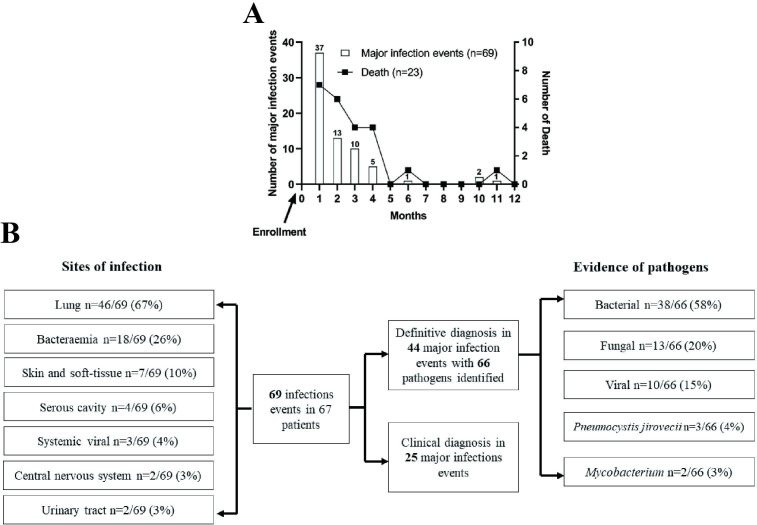
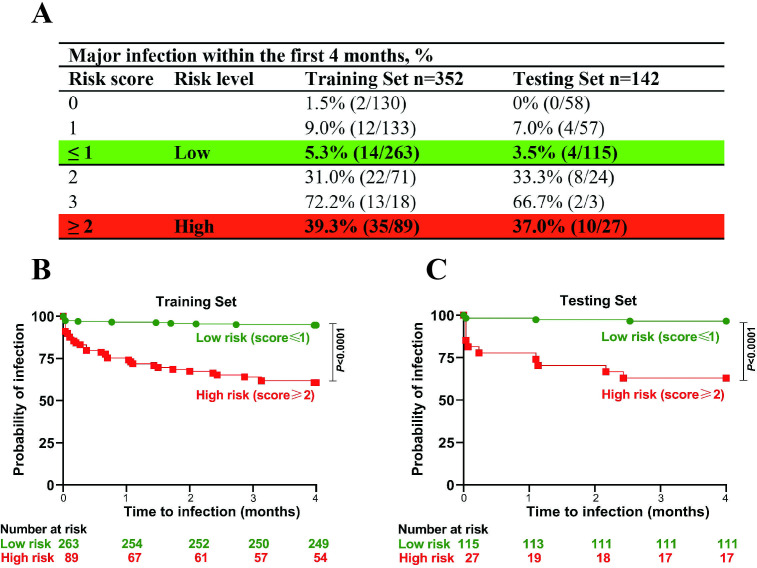
Among the 494 patients enrolled in the hSLIC cohort, there were 69 documented episodes of major infections during the first year of follow-up in 67 (14%) patients. The major infection events predominantly occurred within the first 4 months since enrolment (94%, 65/69) and were associated with all-cause mortality. After adjustments for glucocorticoid and immunosuppressant exposure, a prediction model based on SLE Disease Activity Index >10, peripheral lymphocyte count <0.8×10/L and serum creatinine >104 µmol/L was established to identify patients at low risk (3%-5%) or high risk (37%-39%) of major infections within the first 4 months.
Newly onset active SLE is susceptible to major infections, which is probably due to underlying profound immune disturbance. Identifying high-risk patients using an appropriate prediction tool might lead to better tailored management and better outcome.
评估新诊断的系统性红斑狼疮(SLE)患者发生重大感染的风险及其与死亡率的关系。
本研究纳入了 2013 年 1 月 1 日至 2020 年 11 月 1 日在我院新诊断(<3 个月)住院的系统性红斑狼疮起始队列(hSLIC)患者。所有患者的随访时间均至少为 1 年或直至死亡。收集患者的基线特征。在随访期间记录重大感染事件,其定义为经静脉使用抗生素治疗的微生物学/临床诊断的感染。该队列进一步分为训练集和测试集。使用多变量逻辑回归分析确定重大感染的独立预测因素。采用 Kaplan-Meier 生存分析。
在 hSLIC 队列的 494 例患者中,有 67 例(14%)患者在随访的第 1 年内发生了 69 次重大感染事件。重大感染事件主要发生在入组后 4 个月内(94%,65/69),并与全因死亡率相关。在校正糖皮质激素和免疫抑制剂暴露后,建立了一个基于系统性红斑狼疮疾病活动指数(SLEDAI)>10、外周淋巴细胞计数<0.8×10/L 和血清肌酐>104 μmol/L 的预测模型,以识别在前 4 个月内发生重大感染的低风险(3%-5%)或高风险(37%-39%)患者。
新诊断的活动期 SLE 易发生重大感染,这可能是由于潜在的严重免疫紊乱所致。使用适当的预测工具识别高危患者可能有助于制定更具针对性的管理策略并改善预后。