Johns Hopkins Bloomberg School of Public Health, Department of International Health, Baltimore, MD, USA.
India Health Action Trust, Lucknow, India.
Glob Health Sci Pract. 2022 Aug 30;10(4). doi: 10.9745/GHSP-D-21-00632.
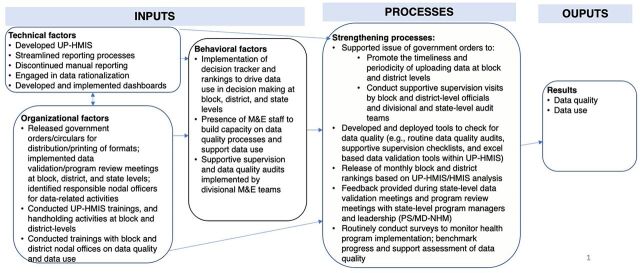
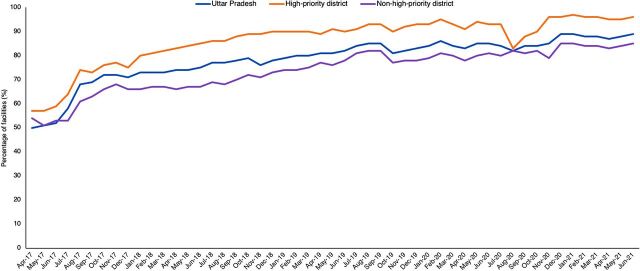
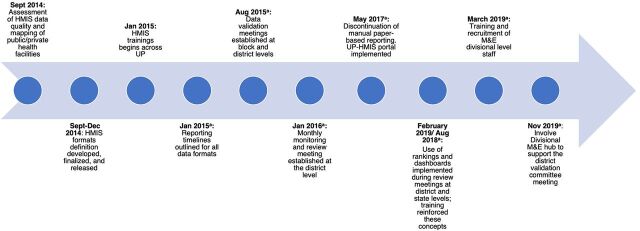
An effective health management information system (HMIS) that captures accurate, consistent, and relevant data in a timely fashion can enable better planning and monitoring of health programs and improved service delivery, in turn helping increase the impact of different interventions. In 2009, the Government of Uttar Pradesh (GOUP) implemented HMIS, India's national-level health information platform. However, key challenges, including difficulties in accessing the data through a web-based portal and its limited relevance to decision making and managerial needs, reduced its usability at the district and state levels. In 2015, with the support of the Uttar Pradesh Technical Support Unit, the GOUP created its own data platform, the Uttar Pradesh HMIS (UP-HMIS), to capture data elements missing from HMIS but important to UP decision makers. The UP-HMIS was redesigned to capture these data elements to holistically measure and monitor the performance of health programs and inform decision making at the district and state levels. In addition, the GOUP implemented complementary initiatives to improve data quality and data use processes. To improve HMIS data quality, the GOUP established data validation committee meetings at the block, district, and state levels. To promote the use of these validated data, in 2017, the GOUP developed and implemented the UP Health Dashboard, which ranks each of UP's 75 districts on a set of key HMIS priority health indicators. These policy guidelines have brought greater attention to UP-HMIS data quality and use; however, additional strengthening is required to improve the quality and use of HMIS data. There is a need to increase the overall capacity and understanding of HMIS data, not only for staff with specific data-related responsibilities but also for program managers and senior decision makers.
一个能够及时准确、一致、相关地捕获数据的高效健康管理信息系统(HMIS),可以帮助更好地规划和监测卫生项目,并改善服务交付,从而提高各项干预措施的效果。2009 年,北方邦政府(GOUP)实施了印度国家级卫生信息平台 HMIS。然而,包括通过基于网络的门户访问数据的困难以及其与决策和管理需求的相关性有限在内的关键挑战,降低了其在地区和邦级的可用性。2015 年,在北方邦技术支持股的支持下,GOUP 创建了自己的数据平台,即北方邦 HMIS(UP-HMIS),以捕获 HMIS 中缺失但对 UP 决策者很重要的数据元素。重新设计了 UP-HMIS 以捕获这些数据元素,从整体上衡量和监测卫生项目的绩效,并为地区和邦级的决策提供信息。此外,GOUP 还实施了配套举措来提高数据质量和数据使用流程。为了提高 HMIS 数据质量,GOUP 在邦、区和州各级设立了数据验证委员会会议。为了促进对这些经验证数据的使用,2017 年,GOUP 开发并实施了 UP 健康数据仪表盘,根据一套关键的 HMIS 优先卫生指标对 UP 的 75 个区进行排名。这些政策指南引起了对 UP-HMIS 数据质量和使用的更多关注;然而,还需要进一步加强,以提高 HMIS 数据的质量和使用。需要提高对 HMIS 数据的整体理解和能力,不仅针对具有特定数据相关职责的工作人员,还包括方案管理人员和高级决策者。