Functional Genomics Laboratory, Department of Psychiatry & Human Behavior, University of California, Irvine, CA, USA.
Department of Translational Genomics, Keck School of Medicine, University of Southern California, Health Sciences Campus, Los Angeles, CA, USA.
Transl Psychiatry. 2022 Aug 30;12(1):353. doi: 10.1038/s41398-022-02127-1.
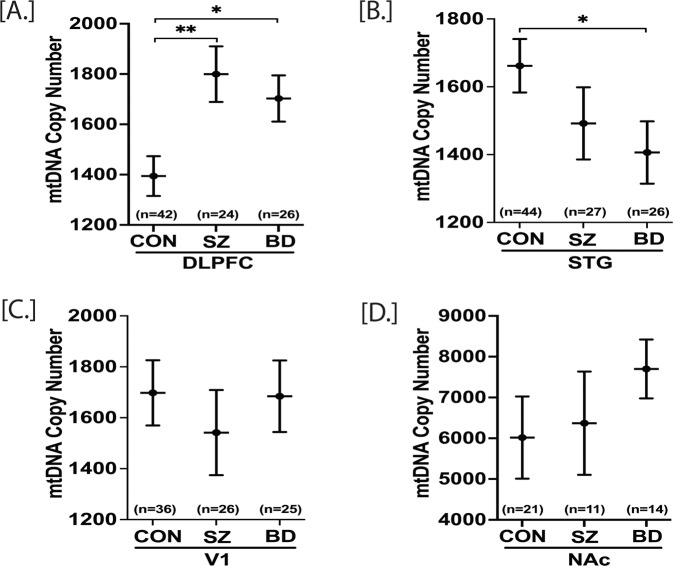
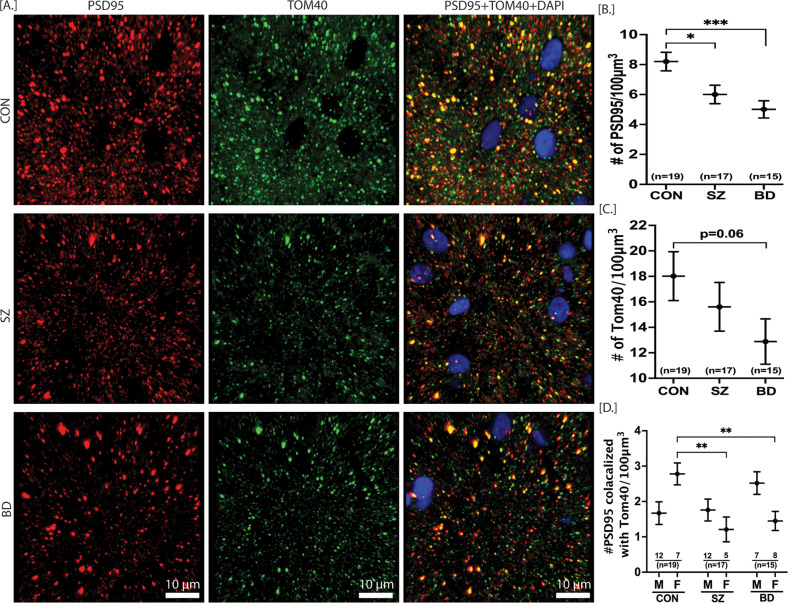
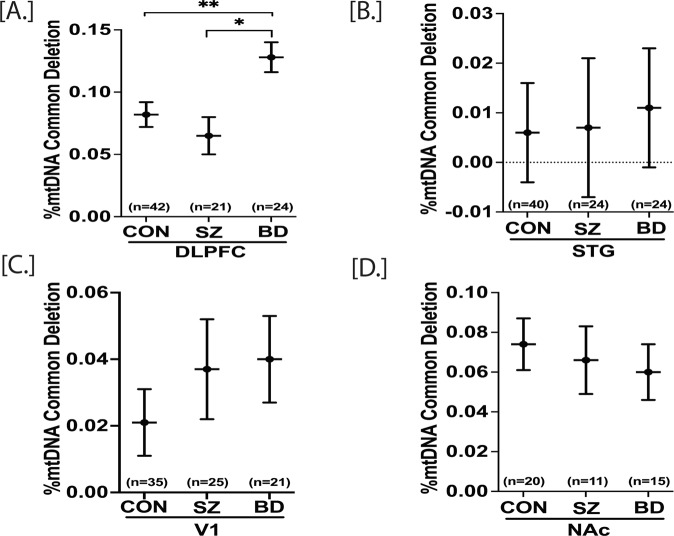
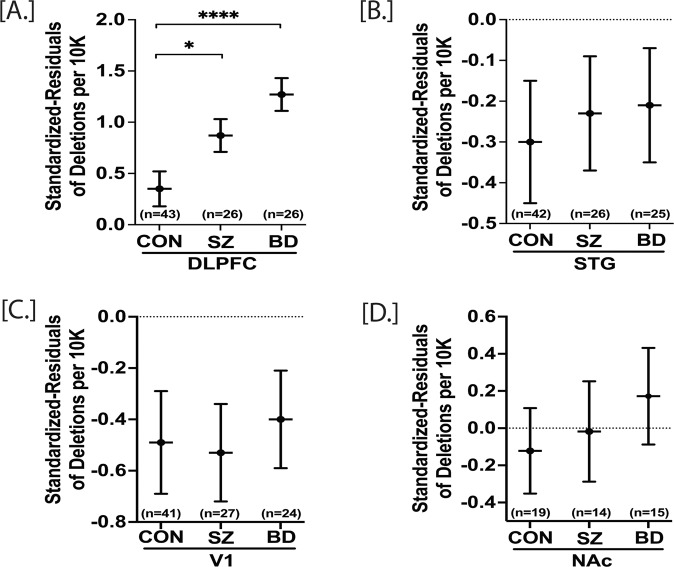
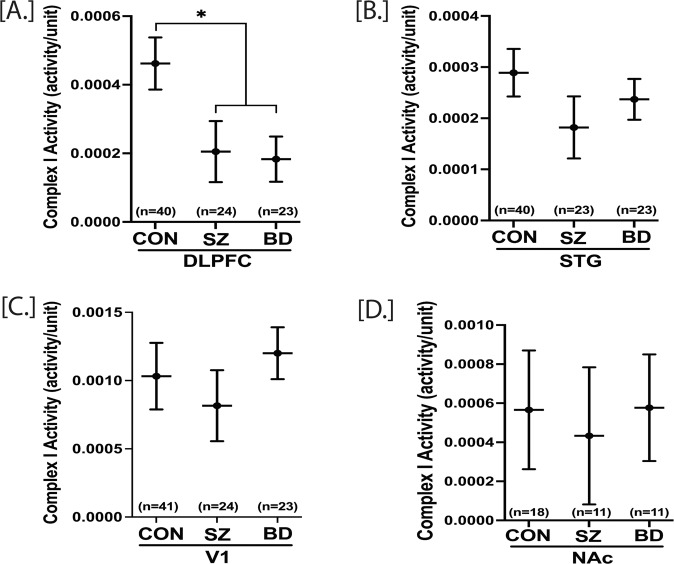
Mitochondrial dysfunction is a neurobiological phenomenon implicated in the pathophysiology of schizophrenia and bipolar disorder that can synergistically affect synaptic neurotransmission. We hypothesized that schizophrenia and bipolar disorder share molecular alterations at the mitochondrial and synaptic levels. Mitochondria DNA (mtDNA) copy number (CN), mtDNA common deletion (CD), mtDNA total deletion, complex I activity, synapse number, and synaptic mitochondria number were studied in the postmortem human dorsolateral prefrontal cortex (DLPFC), superior temporal gyrus (STG), primary visual cortex (V1), and nucleus accumbens (NAc) of controls (CON), and subjects with schizophrenia (SZ), and bipolar disorder (BD). The results showed (i) the mtDNA CN is significantly higher in DLPFC of both SZ and BD, decreased in the STG of BD, and unaltered in V1 and NAc of both SZ and BD; (ii) the mtDNA CD is significantly higher in DLPFC of BD while unaltered in STG, V1, and NAc of both SZ and BD; (iii) The total deletion burden is significantly higher in DLPFC in both SZ and BD while unaltered in STG, V1, and NAc of SZ and BD; (iv) Complex I activity is significantly lower in DLPFC of both SZ and BD, which is driven by the presence of medications, with no alteration in STG, V1, and NAc. In addition, complex I protein concentration, by ELISA, was decreased across three cortical regions of SZ and BD subjects; (v) The number of synapses is decreased in DLPFC of both SZ and BD, while the synaptic mitochondria number was significantly lower in female SZ and female BD compared to female controls. Overall, these findings will pave the way to understand better the pathophysiology of schizophrenia and bipolar disorder for therapeutic interventions.
线粒体功能障碍是一种神经生物学现象,与精神分裂症和双相情感障碍的病理生理学有关,可协同影响突触神经传递。我们假设精神分裂症和双相情感障碍在线粒体和突触水平上存在共同的分子改变。研究了线粒体 DNA(mtDNA)拷贝数(CN)、mtDNA 常见缺失(CD)、mtDNA 总缺失、复合物 I 活性、突触数量和突触线粒体数量在对照组(CON)和精神分裂症(SZ)、双相情感障碍(BD)患者死后的背外侧前额叶皮质(DLPFC)、上颞叶(STG)、初级视觉皮质(V1)和伏隔核(NAc)。结果显示:(i)SZ 和 BD 的 DLPFC 中的 mtDNA CN 显著升高,BD 的 STG 中降低,SZ 和 BD 的 V1 和 NAc 中未改变;(ii)BD 的 DLPFC 中 mtDNA CD 显著升高,而 SZ 和 BD 的 STG、V1 和 NAc 中未改变;(iii)SZ 和 BD 的 DLPFC 中总缺失负担显著增加,而 SZ 和 BD 的 STG、V1 和 NAc 中未改变;(iv)SZ 和 BD 的 DLPFC 中复合物 I 活性显著降低,这是由药物引起的,而 STG、V1 和 NAc 中没有改变。此外,通过 ELISA 测定,SZ 和 BD 三个皮质区域的复合物 I 蛋白浓度均降低;(v)SZ 和 BD 的 DLPFC 中的突触数量减少,而女性 SZ 和女性 BD 的突触线粒体数量明显低于女性对照。总的来说,这些发现将为治疗干预措施铺平理解精神分裂症和双相情感障碍病理生理学的道路。