Department of Psychiatry, University of Pittsburgh (all authors).
Am J Psychiatry. 2020 Dec 1;177(12):1140-1150. doi: 10.1176/appi.ajp.2020.19111210. Epub 2020 Oct 29.
The shared risk factors and clinical features in schizophrenia and bipolar disorder may be linked via mitochondrial dysfunction. However, the severity of mitochondrial dysfunction, and/or the specific mitochondrial functional pathways affected, may differ between diagnoses, especially at the level of individual cell types.
Transcriptomic profiling data for a gene set indexing mitochondrial functional pathways were obtained for dorsolateral prefrontal cortex (DLPFC) gray matter and layer 3 and layer 5 pyramidal neurons of subjects with schizophrenia or bipolar disorder. Analyses were conducted using a dual strategy: identification of differentially expressed genes (DEGs) and their functional pathway enrichment, and application of weighted gene coexpression network analysis. These analyses were repeated in monkeys chronically exposed to antipsychotic drugs to determine their effect on mitochondrial-related gene expression.
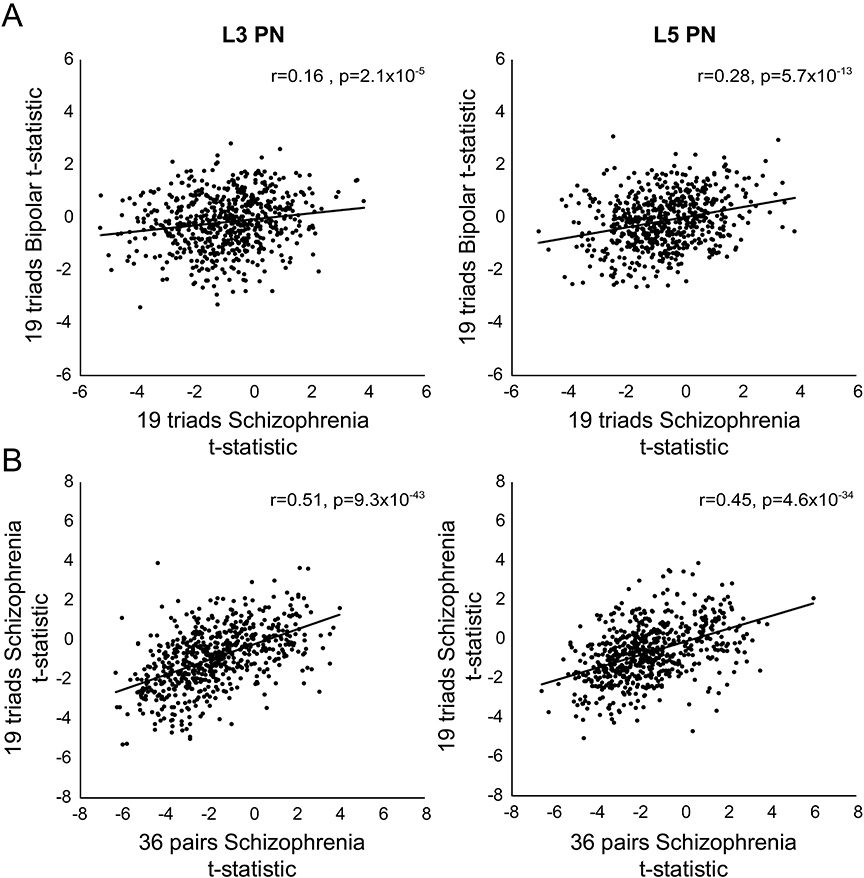
In DLPFC gray matter, 41% of mitochondrial-related genes were differentially expressed in the schizophrenia group, whereas 8% were differentially expressed in the bipolar group. In the schizophrenia group, 83% of DEGs showed lower expression, and these were significantly enriched for three functional pathways, each indexing energy production. DEGs in the bipolar disorder group were not enriched for functional pathways. This disease-related pattern of findings was also identified in pyramidal neurons. None of the gene expression alterations disrupted coexpression modules, and DEGs were not attributable to antipsychotic medications.
Schizophrenia and bipolar disorder do not appear to share similar mitochondrial alterations in the DLPFC. The selective and coordinated down-regulation of energy production genes in schizophrenia is consistent with the effects of chronic reductions in pyramidal neuron firing, and enhancement of this activity may serve as a therapeutic target.
精神分裂症和双相情感障碍的共同风险因素和临床特征可能与线粒体功能障碍有关。然而,线粒体功能障碍的严重程度和/或受影响的特定线粒体功能途径在不同的诊断中可能有所不同,尤其是在单个细胞类型的水平上。
获取了精神分裂症或双相情感障碍患者背外侧前额叶(DLPFC)灰质以及第 3 层和第 5 层锥体神经元的线粒体功能途径索引基因集的转录组谱数据。采用双重策略进行分析:差异表达基因(DEGs)及其功能途径富集的鉴定,以及加权基因共表达网络分析的应用。在慢性暴露于抗精神病药物的猴子中重复进行这些分析,以确定它们对与线粒体相关的基因表达的影响。
在 DLPFC 灰质中,41%的线粒体相关基因在精神分裂症组中差异表达,而 8%在双相情感障碍组中差异表达。在精神分裂症组中,83%的 DEGs 表达水平较低,这些基因显著富集于三个功能途径,每个途径都索引能量产生。双相情感障碍组的 DEGs 未富集于功能途径。在锥体神经元中也发现了这种与疾病相关的发现模式。基因表达改变没有破坏共表达模块,并且 DEGs 不是归因于抗精神病药物。
精神分裂症和双相情感障碍在 DLPFC 中似乎没有共享相似的线粒体改变。精神分裂症中能量产生基因的选择性和协调下调与锥体神经元放电慢性减少的影响一致,增强这种活动可能成为一种治疗靶点。