Department of Occupational Safety and Health, College of Public Health, China Medical University, Taichung, Taiwan.
Department of Public Health, College of Public Health, China Medical University, Taichung, Taiwan.
Mol Psychiatry. 2022 Dec;27(12):5244-5254. doi: 10.1038/s41380-022-01753-x. Epub 2022 Aug 30.
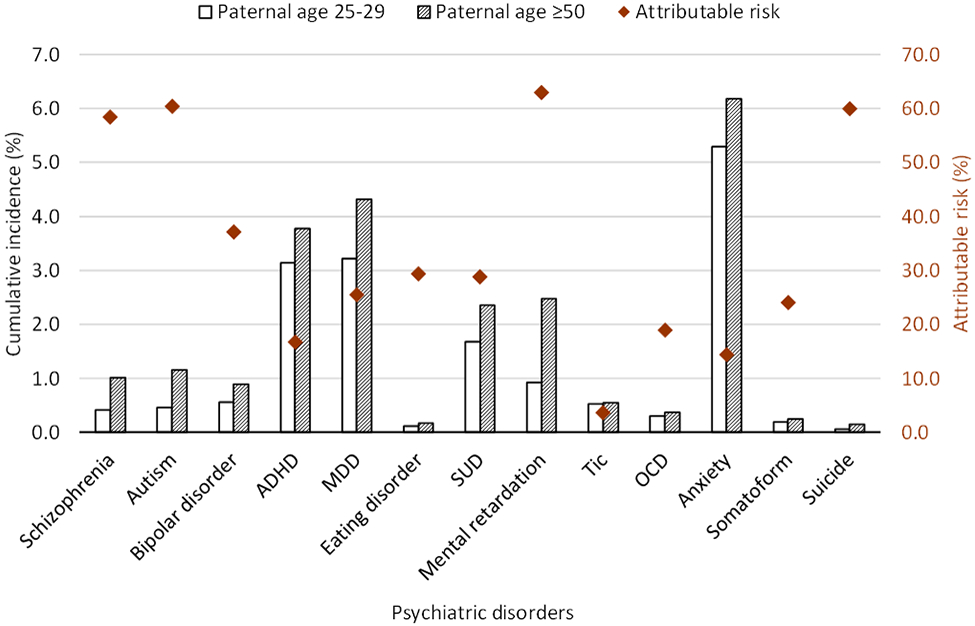
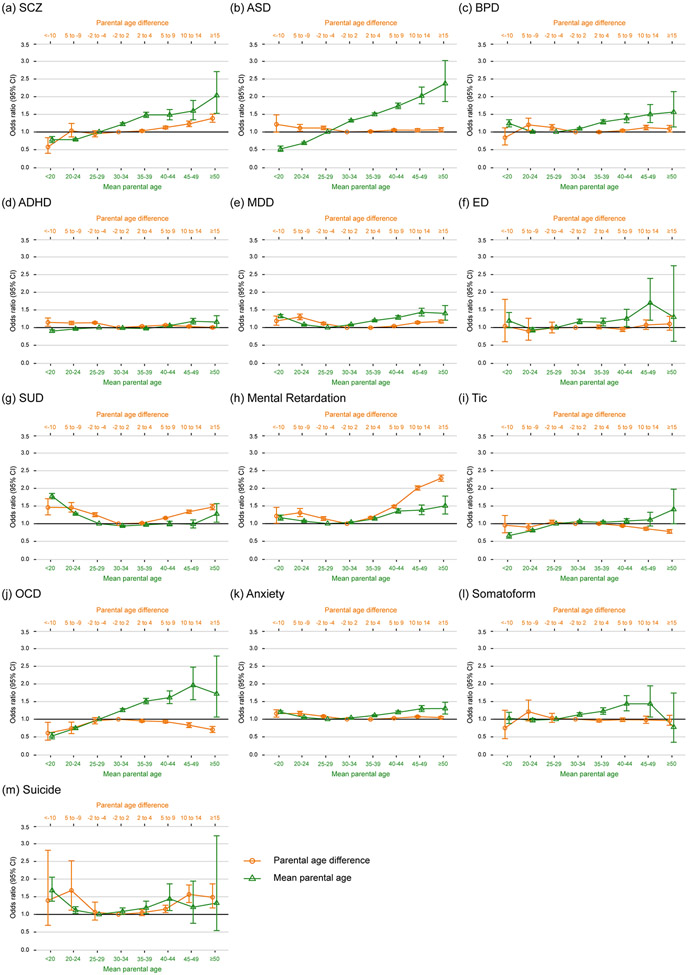
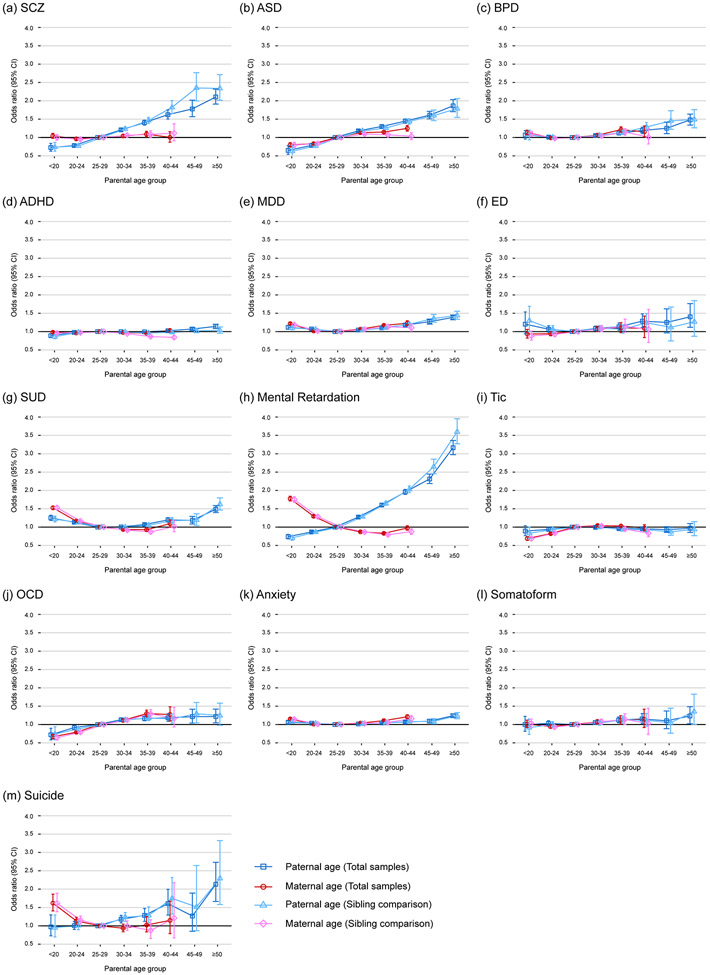
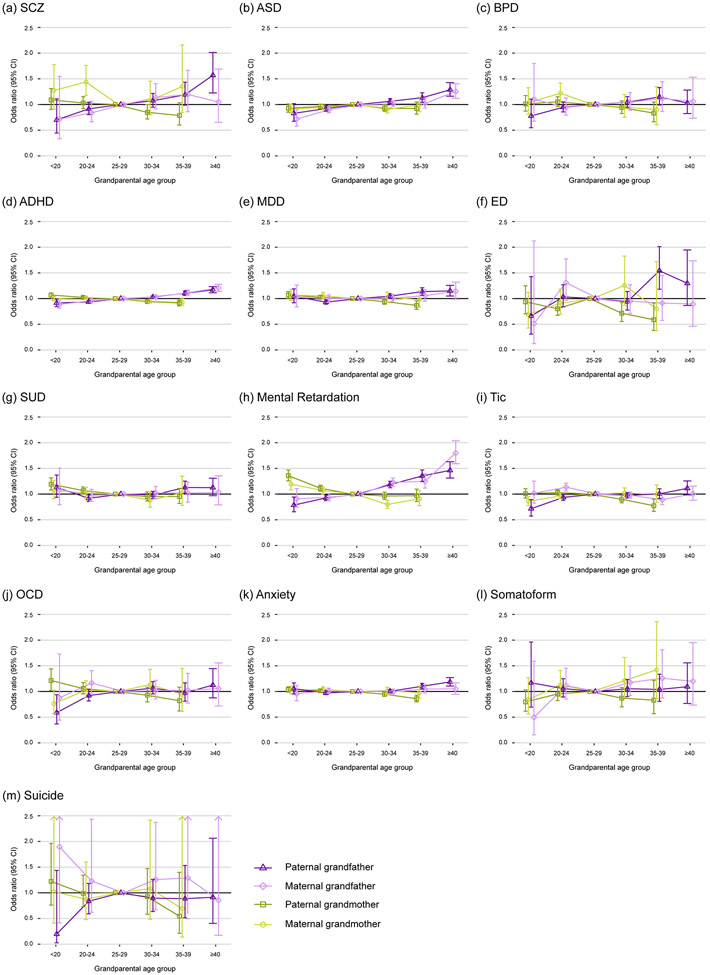
Although paternal age has been linked to certain psychiatric disorders, the nature of any causal relationship remains elusive. Here, we aimed to comprehensively assess the magnitude of a wide range of offspring's psychiatric risk conferred by paternal age, leveraging a pedigree inferred from covered-insurance relationship (accuracy >98%) in Taiwan's single-payer compulsory insurance program. We also examined whether there is an independent role of paternal age and explored the potential effect of parental age difference. A total cohort of 7,264,788 individuals born between 1980 and 2018 were included; 5,572,232 with sibling(s) were selected for sibling-comparison analyses and 1,368,942 and 1,044,420 children with information of paternal-grandparents and maternal-grandparents, respectively, were selected for multi-generation analyses. Using inpatient/outpatient claims data (1997-2018), we identified schizophrenia, autism, bipolar disorder (BPD), attention deficit-hyperactivity disorder (ADHD), major depressive disorder (MDD), eating disorder (ED), substance use disorder (SUD), mental retardation (MR), tic disorder, obsessive-compulsive disorder (OCD), anxiety, and somatoform disorder. We identified suicides using death certificates. Logistic regression analysis was used to estimate the paternal/maternal/grand-paternal age association with psychiatric risk in the offspring. The total cohort and sibling-comparison cohort resulted in similar estimates. Paternal age had a U-shaped relationship with offspring's MDD, ED, SUD, and anxiety. A very young maternal age (<20 years) was associated with markedly higher risk in offspring's SUD, MR, and suicide. Older paternal age (>25 years) was linearly associated with offspring's schizophrenia, autism, BPD, ADHD, MDD, ED, SUD, MR, OCD, anxiety, and suicide. Older grand-paternal age was linearly associated with offspring's schizophrenia, autism, ADHD, and MR. Dissimilar parental age was positively associated with offspring's ADHD, MDD, SUD, MR, anxiety, and suicide, and negatively associated with offspring's OCD. This comprehensive assessment provides solid evidence for the independent role of paternal age in psychiatric risk in the offspring and clarifies the significance of both early parenthood and delayed paternity.
尽管父亲年龄与某些精神疾病有关,但任何因果关系的性质仍难以捉摸。在这里,我们旨在通过利用台湾单一支付强制保险计划中推断出的涵盖保险关系的谱系(准确率> 98%),全面评估父亲年龄对广泛的后代精神疾病风险的影响。我们还检查了父亲年龄是否具有独立作用,并探讨了父母年龄差异的潜在影响。一个包含 1980 年至 2018 年之间出生的 7264788 个人的总队列被纳入研究;选择了 5572232 个有兄弟姐妹的个体进行同胞比较分析,分别选择了 1368942 个和 1044420 个有父/母/祖父祖母信息的儿童进行多代分析。使用住院/门诊报销数据(1997-2018 年),我们确定了精神分裂症、自闭症、双相情感障碍(BPD)、注意力缺陷多动障碍(ADHD)、重度抑郁症(MDD)、饮食障碍(ED)、物质使用障碍(SUD)、智力障碍(MR)、抽动障碍、强迫症(OCD)、焦虑症和躯体形式障碍。我们使用死亡证明识别自杀。使用逻辑回归分析来估计父亲/母亲/祖父年龄与后代的精神疾病风险之间的关联。总队列和同胞比较队列得出了相似的估计。父亲年龄与后代的 MDD、ED、SUD 和焦虑呈 U 形关系。母亲年龄很小(<20 岁)与后代的 SUD、MR 和自杀的风险显著增加有关。父亲年龄较大(>25 岁)与后代的精神分裂症、自闭症、BPD、ADHD、MDD、ED、SUD、MR、OCD、焦虑和自杀呈线性相关。祖父年龄较大与后代的精神分裂症、自闭症、ADHD 和 MR 呈线性相关。父母年龄差异与后代的 ADHD、MDD、SUD、MR、焦虑和自杀呈正相关,与后代的 OCD 呈负相关。这项综合评估为父亲年龄对后代精神疾病风险的独立作用提供了确凿证据,并阐明了早期生育和延迟生育的重要性。