McQuinn Sara, Belton Sarahjane, Staines Anthony, Sweeney Mary Rose
School of Nursing, Psychotherapy and Community Health, Faculty of Science and Health, Dublin City University, Dublin 9, Ireland.
School of Health and Human Performance, Faculty of Science and Health, Dublin City University, Glasnevin, Dublin 9, Ireland.
Pilot Feasibility Stud. 2022 Aug 30;8(1):194. doi: 10.1186/s40814-022-01149-2.
There is a critical need for interventions that can be feasibly implemented and are effective in successfully engaging adolescent females in physical activity (PA). A theory-based, peer-led, after-school PA intervention, the Girls Active Project (GAP), was codesigned with adolescent females. This study aimed to assess the feasibility of implementing and evaluating the GAP programme.
One single-sex, female-only, designated disadvantaged postprimary school (students aged 12-18) in Dublin, Ireland.
Mixed methods were applied with multiple stakeholders over a 12-week trial (March to May 2021). A single-arm study design was used to examine intervention: reach, dose, fidelity, acceptability, compatibility and context. Feasibility of using proposed self-reported outcome measures (moderate-to-vigorous PA levels, self-rated health, life satisfaction, PA self-efficacy and PA enjoyment) was also explored. Due to school closure resulting from the COVID-19 pandemic, the intervention was delivered both online and in person in the school setting.
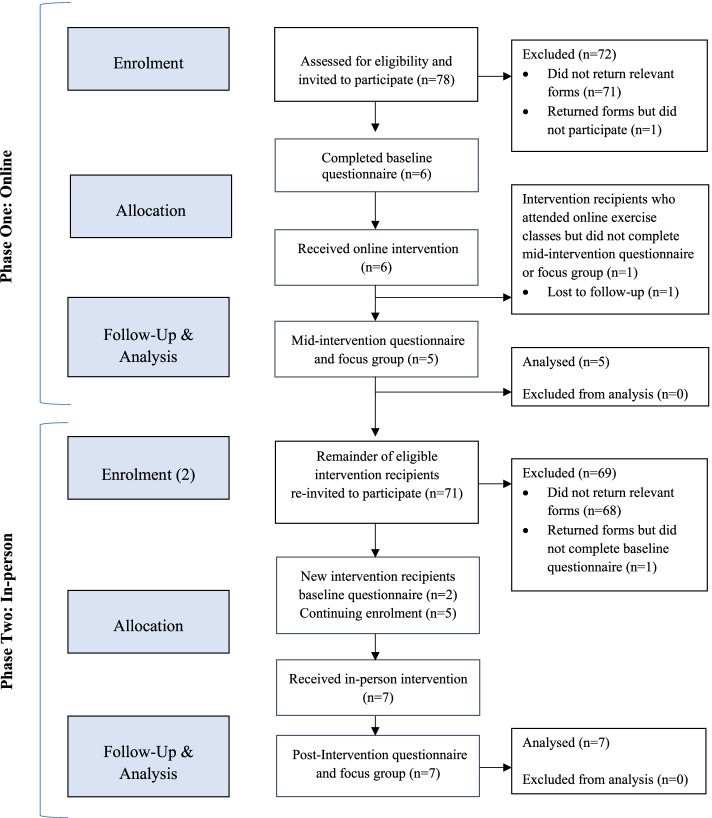
Eight exercise classes were peer delivered by project leaders (n = 6, students aged 15-17) to intervention recipients (students aged 13-14). Recruitment was low (n = 8, 10% of eligible students, mean age: 13.3 SD: 0.46), yet retention was high (n = 7/8, 88%). Attendance rates were satisfactory (68%), and the intervention was implemented with high fidelity (87%). Data completion rates suggested proposed self-reported outcome measures were deemed appropriate (≥ 95%), except for weight (50%) and height data (80%). Despite COVID-19 hindering intervention implementation, both quantitative and qualitative data suggested that stakeholders were satisfied and perceived the in-person delivered intervention to be compatible with the school setting. Recommended refinements included extending class duration, introducing different rewards, and boosting programme awareness.
Further thought must be given on how to increase recruitment. Overall, the in-person delivered after-school PA programme was well-received by stakeholders and shows promise as an intervention that can be feasibly implemented and evaluated. Suggested improvements to the GAP intervention programme are recommended, before continuing to a more robust evaluation.
10.17605/OSF.IO/75HWJ (prospectively registered, date of registration: 9th December 2020).
迫切需要能够切实可行地实施且能有效促使青春期女性参与体育活动(PA)的干预措施。“女孩积极项目”(GAP)是一项基于理论、由同伴主导的课后体育活动干预项目,是与青春期女性共同设计的。本研究旨在评估实施和评估GAP项目的可行性。
爱尔兰都柏林一所单一性别、只招收女生的指定弱势初中(学生年龄在12 - 18岁)。
在为期12周的试验(2021年3月至5月)中,对多个利益相关者采用了混合方法。采用单组研究设计来考察干预措施的覆盖范围、剂量、保真度、可接受性、兼容性和背景情况。还探讨了使用拟议的自我报告结果测量指标(中等至剧烈体育活动水平、自我健康评分、生活满意度、体育活动自我效能感和体育活动乐趣)的可行性。由于新冠疫情导致学校关闭,干预措施在学校环境中通过线上和线下两种方式进行。
项目负责人(n = 6,年龄在15 - 17岁的学生)向干预对象(年龄在13 - 14岁的学生)同伴授课八节体育课。招募人数较少(n = 8,占 eligible students的10%,平均年龄:13.3,标准差:0.46),但留存率较高(n = 7/8,88%)。出勤率令人满意(68%),干预措施的实施保真度较高(87%)。数据完成率表明,除体重(50%)和身高数据(80%)外,拟议的自我报告结果测量指标被认为是合适的(≥95%)。尽管新冠疫情阻碍了干预措施的实施,但定量和定性数据均表明利益相关者感到满意,并认为线下实施的干预措施与学校环境相兼容。建议的改进措施包括延长课程时长、引入不同奖励以及提高项目知名度。
必须进一步思考如何提高招募人数。总体而言,线下实施的课后体育活动项目受到利益相关者的好评,并显示出作为一种可以切实可行地实施和评估的干预措施的潜力。在继续进行更全面的评估之前,建议对GAP干预项目进行改进。
10.17605/OSF.IO/75HWJ(前瞻性注册,注册日期:2020年12月9日)。