Department of Epidemiology Johns Hopkins Bloomberg School of Public Health Baltimore MD.
Department of Medicine The University of Mississippi Medical Center Jackson MS.
J Am Heart Assoc. 2022 Sep 6;11(17):e025780. doi: 10.1161/JAHA.121.025780. Epub 2022 Aug 31.
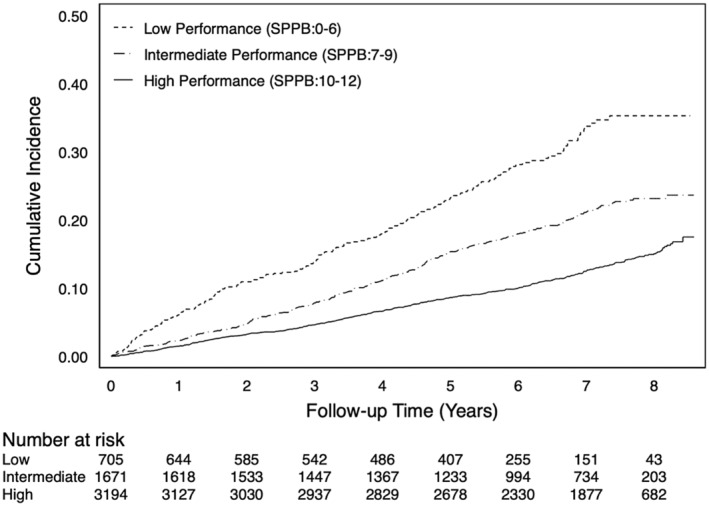
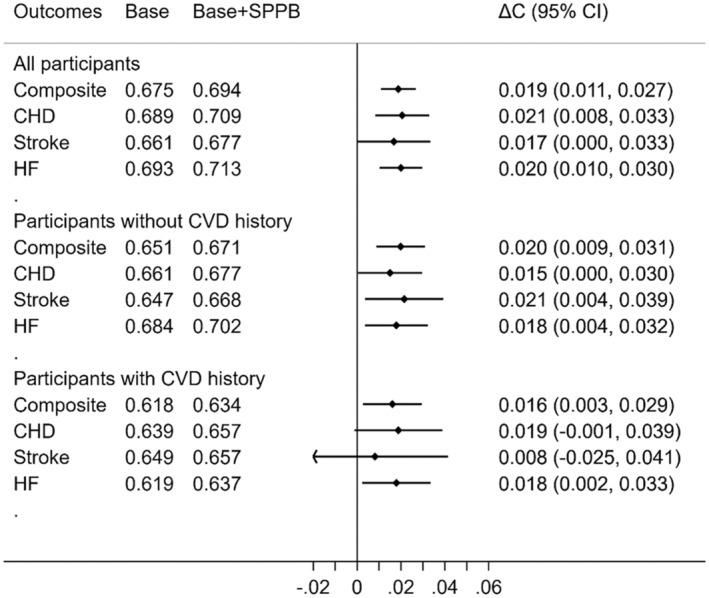
Background Reduced physical function, a representative phenotype of aging, has been associated with cardiovascular disease (CVD). However, few studies have comprehensively investigated its association with composite and individual CVD outcomes in community-dwelling older adults and its predictive value for CVD beyond traditional risk factors. Methods and Results We studied 5570 participants (mean age 75 [SD 5] years, female 58%, Black 22%) at visit 5 (2011-2013) of the ARIC (Atherosclerosis Risk in Communities) study. Physical function was evaluated with the Short Physical Performance Battery (SPPB), which incorporates a walk test, chair stands, and balance tests. The SPPB score was modeled categorically (low [0-6], intermediate [7-9], and high [10-12]) and continuously. We assessed the associations of SPPB score with subsequent composite (coronary heart disease, stroke, or heart failure) and individual CVD outcomes (components within composite outcome) using multivariable Cox models adjusting for major CVD risk factors and history of CVD. We also evaluated improvement in C-statistics by adding SPPB to traditional CVD risk factors in the Pooled Cohort Equation. Among the study participants, 13% had low, 30% intermediate, and 57% high SPPB scores. During a median follow-up of 7.0 (interquartile interval 5.3-7.8) years, there were 930 composite CVD events (386 coronary heart disease, 251 stroke, and 529 heart failure cases). The hazard ratios of composite CVD in low and intermediate versus high SPPB score were 1.47 (95% CI, 1.20-1.79) and 1.25 (95% CI, 1.07-1.46), respectively, after adjusting for potential confounders. Continuous SPPB score demonstrated independent associations with each CVD outcome. The associations were largely consistent across subgroups (including participants with prevalent CVD at baseline). The addition of SPPB to traditional CVD risk factors significantly improved the C-statistics of CVD outcomes (eg, ΔC-statistic 0.019 [95% CI, 0.011-0.027] for composite CVD). Conclusions Reduced physical function was independently associated with the risk of composite and individual CVD outcomes and improved their risk prediction beyond traditional risk factors in community-dwelling older adults. Although confirmatory studies are needed, our results suggest the potential usefulness of SPPB for classifying CVD risk in older adults.
身体机能下降是衰老的代表性表型,与心血管疾病(CVD)有关。然而,很少有研究全面调查其与社区老年人复合和个体 CVD 结局的关系,以及其对 CVD 的预测价值是否超过传统危险因素。
我们研究了 ARIC(社区动脉粥样硬化风险)研究中的 5570 名参与者(平均年龄 75[SD5]岁,女性 58%,黑人 22%)在第 5 次就诊时(2011-2013 年)。身体机能通过短体适能电池(SPPB)进行评估,该电池包含步行测试、椅子站立和平衡测试。SPPB 评分采用分类(低[0-6]、中[7-9]和高[10-12])和连续评分进行建模。我们使用多变量 Cox 模型,根据主要 CVD 危险因素和 CVD 病史,调整 SPPB 评分与随后的复合(冠心病、中风或心力衰竭)和个体 CVD 结局(复合结局中的组成部分)之间的关联。我们还评估了通过将 SPPB 添加到 Pooled Cohort Equation 中的传统 CVD 危险因素来提高 C 统计量。在研究参与者中,13%的人 SPPB 评分低,30%的人 SPPB 评分中等,57%的人 SPPB 评分高。在中位数为 7.0 年(四分位距 5.3-7.8 年)的随访期间,发生了 930 例复合 CVD 事件(386 例冠心病、251 例中风和 529 例心力衰竭)。在调整潜在混杂因素后,低和中 SPPB 评分与高 SPPB 评分相比,复合 CVD 的风险比分别为 1.47(95%CI,1.20-1.79)和 1.25(95%CI,1.07-1.46)。连续 SPPB 评分与每种 CVD 结局均呈独立相关。这些关联在亚组中基本一致(包括基线时患有 CVD 的参与者)。将 SPPB 添加到传统 CVD 危险因素中可显著提高 CVD 结局的 C 统计量(例如,复合 CVD 的 ΔC 统计量为 0.019[95%CI,0.011-0.027])。
身体机能下降与复合和个体 CVD 结局的风险独立相关,并在社区老年人中超越传统危险因素提高了其风险预测能力。尽管需要确证性研究,但我们的研究结果表明 SPPB 对老年人 CVD 风险分类具有潜在的用处。