a:1:{s:5:"en_US";s:17:"ULSS7 Pedemontana";}.
.
Acta Biomed. 2022 Aug 31;93(4):e2022210. doi: 10.23750/abm.v93i4.12772.
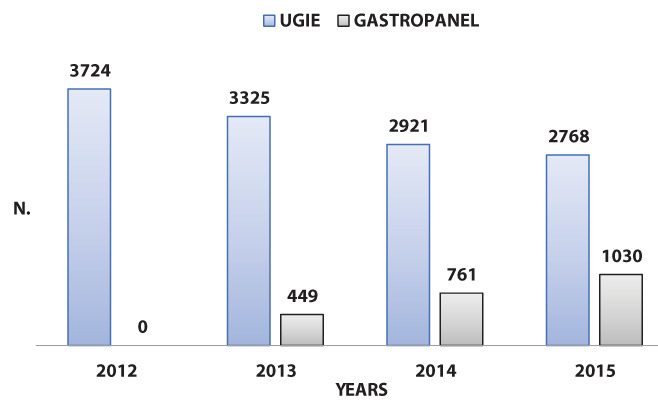
Background and aim Increasing the appropriateness of upper gastrointestinal endoscopy (UGIE) improves the quality of care while containing costs. The aim of this study was to improve the appropriateness of UGIE through a process involving evaluation of prescriptions and the use of a non-invasive alternative. Materials and methods A senior endoscopist evaluated the appropriateness of all outpatient referrals for UGIE and established the proper timing. Referrals were either accepted and programmed, canceled, or substituted by a non-invasive evaluation of gastric function, determining serum levels of gastrin-17 (G17), Pepsinogen I (PGI) and II (PGII), and antibodies against Helicobacter pylori. Results A total of 5102 requests for UGIE examinations were evaluated; 540 (10.4%) were inappropriate and had been prescribed for: gastroesophageal reflux disease (n=307), surveillance with erroneous timing (n=113), dyspepsia (n=66), other indications (n=20), and absence of written indication (n=34). Gastric function was evaluated in 282/540 patients; findings included normal values in 94 patients without proton-pump inhibitor therapy (PPI) and in 48 on PPI, active H pylori infection in 56, previous H pylori infection in 30, GERD in n=50, and atrophic gastritis in n=4. UGIE was performed in the latter 4 cases. Within 2 years (range 1-22 months) of the initial refusal, 105/504 patients underwent UGIE, with normal endoscopic findings in 71/105 (67.5%), and with no cases of cancer. Conclusions This strategy, based on a strict control of prescriptions, is effective to increase the appropriateness while containing public health costs. The use of gastric function testing improves patient selection for UGIE endoscopy.
提高上消化道内镜(UGIE)的适宜性可以提高医疗质量,同时控制成本。本研究的目的是通过评估处方和使用非侵入性替代方法来提高 UGIE 的适宜性。
一名资深内镜医生评估了所有门诊 UGIE 转介的适宜性,并确定了适当的时机。转介被接受并计划、取消或由胃功能的非侵入性评估替代,确定胃泌素-17(G17)、胃蛋白酶原 I(PGI)和 II(PGII)的血清水平以及幽门螺杆菌抗体。
共评估了 5102 例 UGIE 检查申请;540 例(10.4%)为不合适的处方,包括:胃食管反流病(n=307)、错误时间监测(n=113)、消化不良(n=66)、其他指征(n=20)和无书面指征(n=34)。282/540 例患者进行了胃功能评估;结果包括未接受质子泵抑制剂(PPI)治疗的 94 例和接受 PPI 治疗的 48 例患者的正常值、56 例活动性 H pylori 感染、30 例既往 H pylori 感染、50 例 GERD 和 4 例萎缩性胃炎。后 4 例进行了 UGIE。在最初拒绝后的 2 年内(范围 1-22 个月),504 例患者中有 105 例接受了 UGIE,其中 71/105(67.5%)内镜检查正常,无癌症病例。
基于严格控制处方的策略,可以提高适宜性,同时控制公共卫生成本。胃功能检测的使用可以改善 UGIE 内镜检查的患者选择。