School of Public Health and Community Medicine / Primary Health Care, Institute of Medicine, Box 454, SE-405 30 Gothenburg, Sweden.
Scand J Work Environ Health. 2022 Sep 1;48(6):435-445. doi: 10.5271/sjweh.4039. Epub 2022 Jun 8.
This study aimed to explore the relationship between psychosocial job stressors and suicidal behavior (fatal and non-fatal) among Swedish men while controlling for potential confounders.
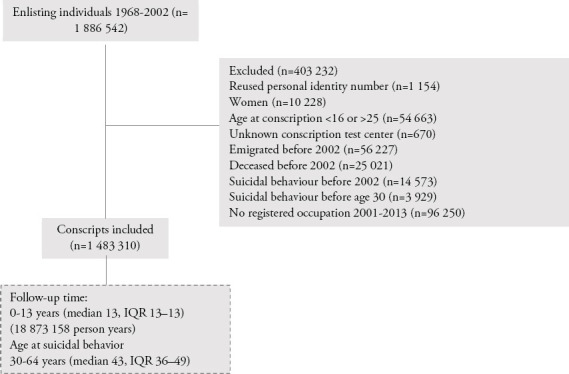
Population-based Swedish longitudinal cohort study of male conscripts without previous self-harm (N=1 483 310) enlisting 1968-2002. Conscription examinations included measures of IQ, stress resilience and psychiatric diagnoses. Job demand-control (JDC) exposure was assessed using the Swedish Job Exposure Matrix linked to specific occupations. Suicidal behavior among men aged 30-64 was identified in the National Hospital Register (non-fatal self-harm) and Swedish Cause of Death Register (suicide) during follow-up 2002-2014. Cox regression models were used to estimate associations between JDC category and suicidal behavior.
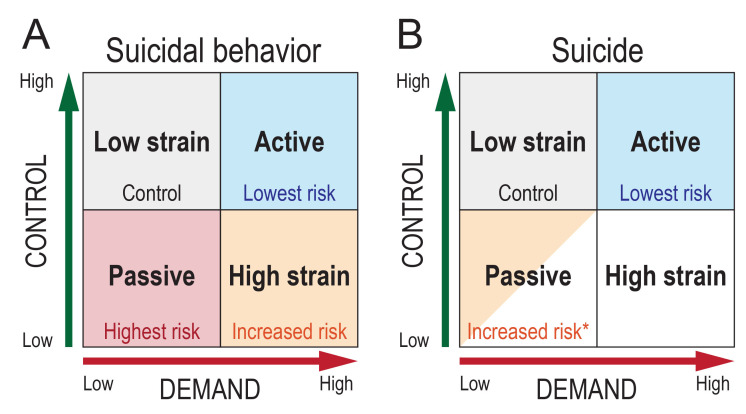
In fully adjusted models, passive jobs (low demand-low control) showed the highest risk of suicidal behavior [hazard ratio (HR) 1.33, 95% confidence interval (CI) 1.25-1.43] compared to those with low strain (low demand-high control), followed by high strain (high demand-low control) (HR 1.12, 95% Cl 1.03-1.22). A lower risk of suicidal behavior was found in the active category, where levels of both demand and control are high (HR 0.64, 95% Cl 0.60-0.70). Separate analyses for suicide as outcome revealed a lower risk of suicide in persons with active jobs (high demands-high control). The passive category showed a higher risk for suicide, but the association did not remain after adjustment for stress resilience and IQ.
These results show that psychosocial job stressors among men are associated with risk for suicidal behavior. Improving job control has the potential to decrease suicidal behavior for this group.
本研究旨在探讨瑞典男性的心理社会工作压力源与自杀行为(包括致命和非致命)之间的关系,同时控制潜在的混杂因素。
这是一项基于人群的瑞典纵向队列研究,纳入了 1968 年至 2002 年间无既往自残史的瑞典应征男性新兵(共 1483310 人)。征兵检查包括智商、压力弹性和精神科诊断的测量。使用与特定职业相关联的瑞典工作暴露矩阵评估工作需求控制(JDC)暴露情况。在随访期间(2002 年至 2014 年),通过国家医院登记处(非致命性自伤)和瑞典死因登记处(自杀)确定了 30-64 岁男性的自杀行为。使用 Cox 回归模型来估计 JDC 类别与自杀行为之间的关联。
在完全调整的模型中,与低压力(低需求-高控制)相比,被动工作(低需求-低控制)的自杀行为风险最高[风险比(HR)1.33,95%置信区间(CI)1.25-1.43],其次是高压力(高需求-低控制)(HR 1.12,95%CI 1.03-1.22)。在需求和控制水平均较高的积极类别中,自杀行为的风险较低(HR 0.64,95%CI 0.60-0.70)。针对自杀结局的单独分析显示,积极工作者(高需求-高控制)自杀的风险较低。而被动类别显示自杀风险较高,但在调整压力弹性和智商后,这种关联不再存在。
这些结果表明,男性的心理社会工作压力源与自杀行为的风险相关。改善工作控制有可能降低该人群的自杀行为风险。