Department of Epidemiology and Biostatistics, School of Public Health, University of Rwanda, Kigali, Rwanda.
Programme of Sociotherapy, Prison Fellowship Rwanda (PFR), Kigali, Rwanda.
BMC Endocr Disord. 2022 Aug 31;22(1):219. doi: 10.1186/s12902-022-01133-0.
Type 2 Diabetes Miletus (T2DM) is a public health burdens that alarmingly increases and leads to morbidity and mortality over the last decades globally. Its management is multifaceted and adherence to diabetic medications plays great roles in life of T2DM patients. But epidemiology on adherence and its associated factors remain unknown in Rwanda. Therefore, this study determined the extent of non-adherence and its predictors among T2DM patients seeking healthcare services at the Clinique Medicale la Fraternite.
A cross-sectional study among 200 adults' patients with T2DM receiving care in the Medicale la Fraternite clinic was investigated. Bivariate and multivariate logistic regression models were performed based on odds ratio employed to examine associated predictors of non-adherence. The cut-off value for all statistical significances tests were considered at p < 0.05 with 95% for the confidence intervals.
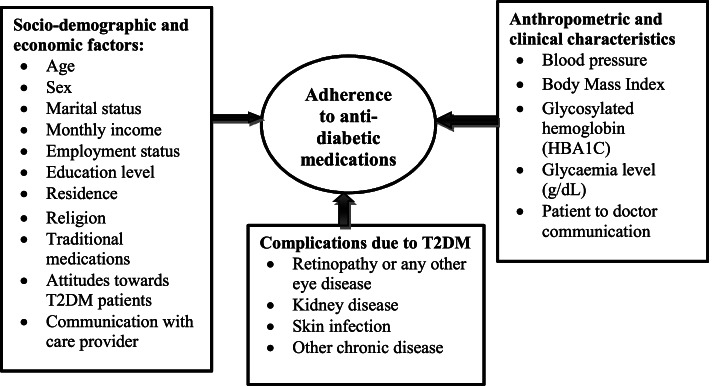
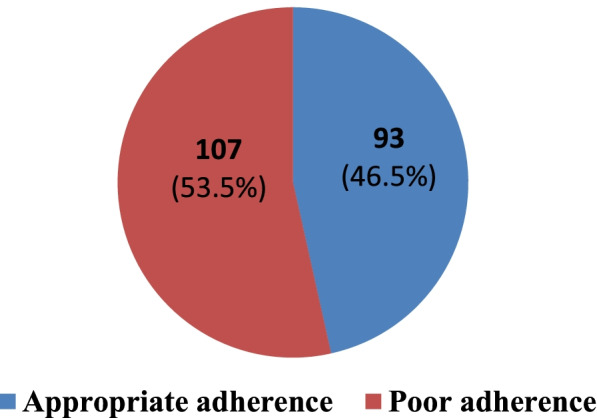
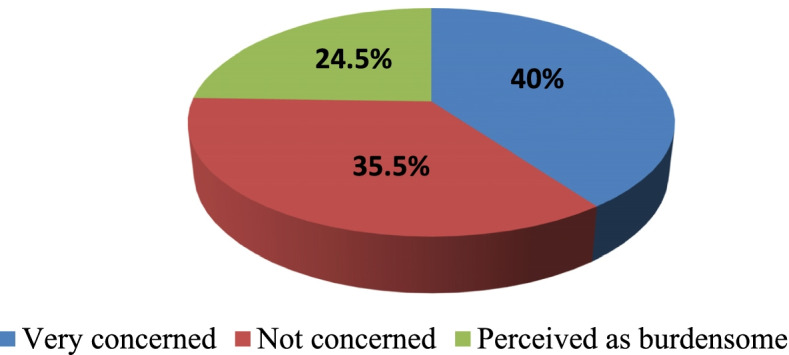
Overall, more than a half of T2DM patients (53.5%) had poor medication adherence. Being females [OR = 2.1, 95%CI(1.13-3.71), p = 0.002], consuming anti-diabetic drugs for 4-10 years [OR = 2.18, 95%CI(1.09-4.34), p = 0.027], experiencing poor communication with healthcare providers [OR = 2.4; 95%CI (1.36-4.25), p = 0.003] and being perceived as burden of the family [OR = 5.8; 95%CI(1.3-25.7), p < 0.021] had higher odds of non-adherence to anti-diabetic medications. Those with poor HbA1C [OR = 4.26; 95%CI(1.7-10.67), p = 0.002] had 4.26 times higher odds to be non-adherent compared to those with good HbA1C. Respondents with primary [OR = 3.56; 95%CI (1.12-11.28), p = 0.031] and secondary education [OR = 2.96; 95%CI (1.11-7.87), p = 0.03] were more likely to be non-adherent than those with informal education respectively. Those with normal BMI [OR = 5.17; 95%CI(1.63-16.37), p = 0.005] and those with overweight or obese [OR = 3.6; 95%CI (1.04-9.1), p < 0.02] had higher odds of being non-adherent than those with underweight.
Sex, glycaemia, communication with healthcare providers, education and gycosylated hemoglobin were the major predictors of non-adherence. Interventions for tackling this problem through bringing together efforts to stem this epidemic and controlling predictors of non-adherence are urgently recommended.
2 型糖尿病(T2DM)是一种公共卫生负担,在过去几十年中,全球范围内发病率和死亡率惊人地上升。其管理是多方面的,糖尿病患者对糖尿病药物的依从性起着重要作用。但是,卢旺达对依从性及其相关因素的流行病学仍不清楚。因此,本研究旨在确定在寻求医疗服务的 T2DM 患者中,不依从的程度及其预测因素。
对在 Medicale la Fraternite 诊所接受治疗的 200 名成年 T2DM 患者进行了横断面研究。根据比值比,采用双变量和多变量逻辑回归模型,对不依从的相关预测因素进行了检验。所有统计显著性检验的截止值均为 p<0.05,置信区间为 95%。
总体而言,超过一半的 T2DM 患者(53.5%)药物依从性差。女性[比值比(OR)=2.1,95%置信区间(CI)(1.13-3.71),p=0.002]、服用抗糖尿病药物 4-10 年[OR=2.18,95%CI(1.09-4.34),p=0.027]、与医疗保健提供者沟通不良[OR=2.4;95%CI(1.36-4.25),p=0.003]和被视为家庭负担[OR=5.8;95%CI(1.3-25.7),p<0.021]的患者,其抗糖尿病药物不依从的可能性更高。糖化血红蛋白(HbA1C)水平较差的患者[OR=4.26;95%CI(1.7-10.67),p=0.002]与 HbA1C 水平良好的患者相比,不依从的可能性高 4.26 倍。与未接受过正规教育的患者相比,具有小学[OR=3.56;95%CI(1.12-11.28),p=0.031]和中学[OR=2.96;95%CI(1.11-7.87),p=0.03]教育程度的患者更有可能不依从。与体重不足的患者相比,体重正常[OR=5.17;95%CI(1.63-16.37),p=0.005]和超重或肥胖[OR=3.6;95%CI(1.04-9.1),p<0.02]的患者不依从的可能性更高。
性别、血糖、与医疗保健提供者的沟通、教育和糖化血红蛋白是不依从的主要预测因素。迫切需要通过共同努力来应对这一问题,并控制不依从的预测因素,以遏制这一流行病。