The First Affiliated Hospital of Xi'an Medical University, Xi'an, China.
Heze Medical University, Heze, China.
J Diabetes Res. 2022 Aug 21;2022:7311950. doi: 10.1155/2022/7311950. eCollection 2022.
Diabetes is a major reason of death and disability worldwide and frequently coexists with hypertension and central obesity. This study is aimed at investigating the effects of hypertension, waist-to-height ratio (WHtR), and their dynamic transitions on type 2 diabetes mellitus (T2DM) onset among middle-aged and elderly people in China.
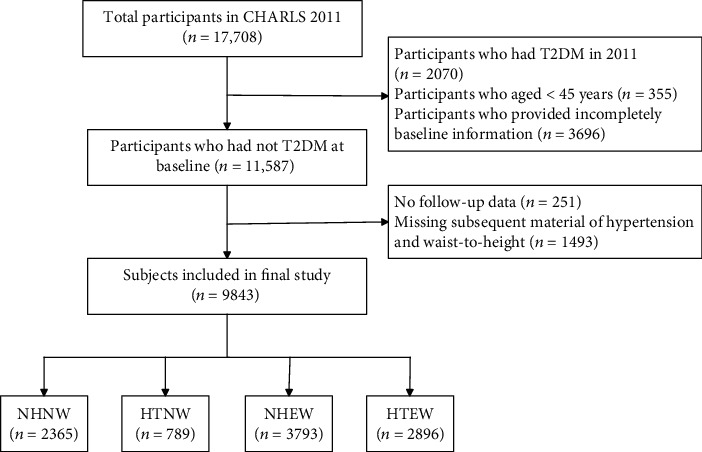
We analyzed 9843 participants free of T2DM (average age, 59.04 ± 9.26 years) at baseline from the China Health and Retirement Longitudinal Study. We classified the participants into the following four categories based on hypertension and WHtR statuses: nonhypertensive with a normal WHtR (NHNW); hypertensive with a normal WHtR (HTNW); nonhypertensive with an elevated WHtR (NHEW); and hypertensive with an elevated WHtR (HTEW). By using a Cox proportional hazards regression model, we assessed whether hypertension, WHtR, and their transitions over time correlated with T2DM risk.
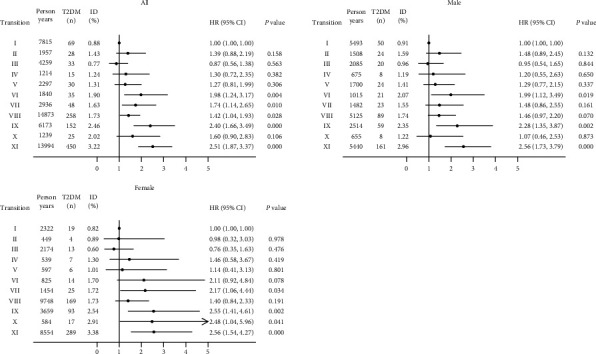
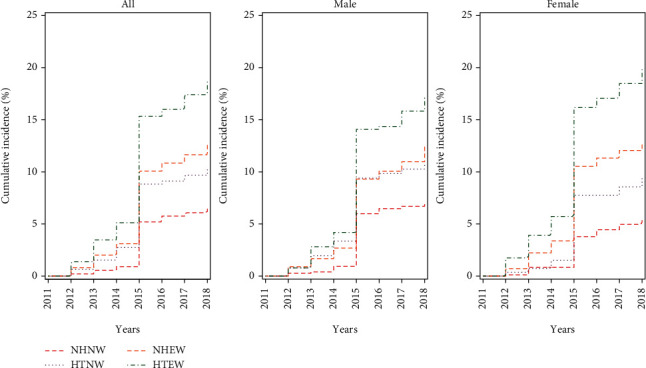
During the follow-up of 8 years, 1263 participants developed incident T2DM. The hazard ratio (HR) for T2DM was 1.48 (95% CI: 1.12, 1.97), 1.56 (95% CI: 1.27, 1.92), and 2.15 (95% CI: 1.74, 2.67) in the HTNW, NHEW, and HTEW groups, respectively, compared with the NHNW group after controlling for confounding factors. When stratified by statuses of hypertension and WHtR transitions, the participants who transitioned from HTNW to HTEW (HR = 1.98, 95% CI: 1.24-3.17), or NHEW to NHNW/HTNW (HR = 1.74, 95% CI: 1.14-2.65), or remained NHEW (HR = 1.42, 95% CI: 1.04-1.93), or NHEW to HTEW (HR = 2.40, 95% CI: 1.66-3.49), or remained HTEW (HR = 2.51, 95% CI: 1.87-3.37) during the follow-up period showed a higher T2DM risk than the consistently NHNW participants.
Being HTNW, NHEW or HTEW or occurring adverse transitions between those states was strongly associated with T2DM onset. Effectively warding off hypertension and central obesity or preventing their further aggravation may substantially decrease the T2DM risk.
糖尿病是全球范围内死亡和残疾的主要原因,并且常与高血压和中心性肥胖并存。本研究旨在探讨高血压、腰高比(WHtR)及其动态变化对中国中老年人 2 型糖尿病(T2DM)发病的影响。
我们分析了来自中国健康与退休纵向研究的 9843 名无 T2DM(平均年龄 59.04±9.26 岁)的参与者。根据高血压和 WHtR 状况,我们将参与者分为以下四类:非高血压且 WHtR 正常(NHNW);高血压且 WHtR 正常(HTNW);非高血压且 WHtR 升高(NHEW);高血压且 WHtR 升高(HTEW)。我们使用 Cox 比例风险回归模型评估高血压、WHtR 及其随时间的变化是否与 T2DM 风险相关。
在 8 年的随访期间,有 1263 名参与者发生了 T2DM 事件。与 NHNW 组相比,HTNW、NHEW 和 HTEW 组的 T2DM 风险比(HR)分别为 1.48(95%CI:1.12,1.97)、1.56(95%CI:1.27,1.92)和 2.15(95%CI:1.74,2.67),在控制混杂因素后。按高血压和 WHtR 变化的情况分层后,从 HTNW 转变为 HTEW(HR=1.98,95%CI:1.24-3.17),或从 NHEW 转变为 NHNW/HTNW(HR=1.74,95%CI:1.14-2.65),或仍为 NHEW(HR=1.42,95%CI:1.04-1.93),或从 NHEW 转变为 HTEW(HR=2.40,95%CI:1.66-3.49),或仍为 HTEW(HR=2.51,95%CI:1.87-3.37)的参与者,T2DM 发病风险高于一直为 NHNW 的参与者。
HTNW、NHEW 或 HTEW,或这些状态之间的不良转变与 T2DM 发病密切相关。有效预防高血压和中心性肥胖或阻止其进一步加重,可能会显著降低 T2DM 的发病风险。