Department of Laboratory Medicine, The First Affiliated Hospital of Chongqing Medical University, No. 1 Youyi Road, Yuzhong District, Chongqing 400016, China.
Assisted Reproductive Center, Department of Obstetrics and Gynecology, The First Affiliated Hospital of Chongqing Medical University, Chongqing 400016, China.
Dis Markers. 2022 Aug 21;2022:2195393. doi: 10.1155/2022/2195393. eCollection 2022.
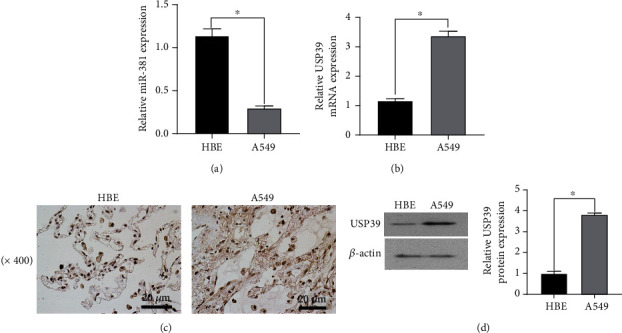
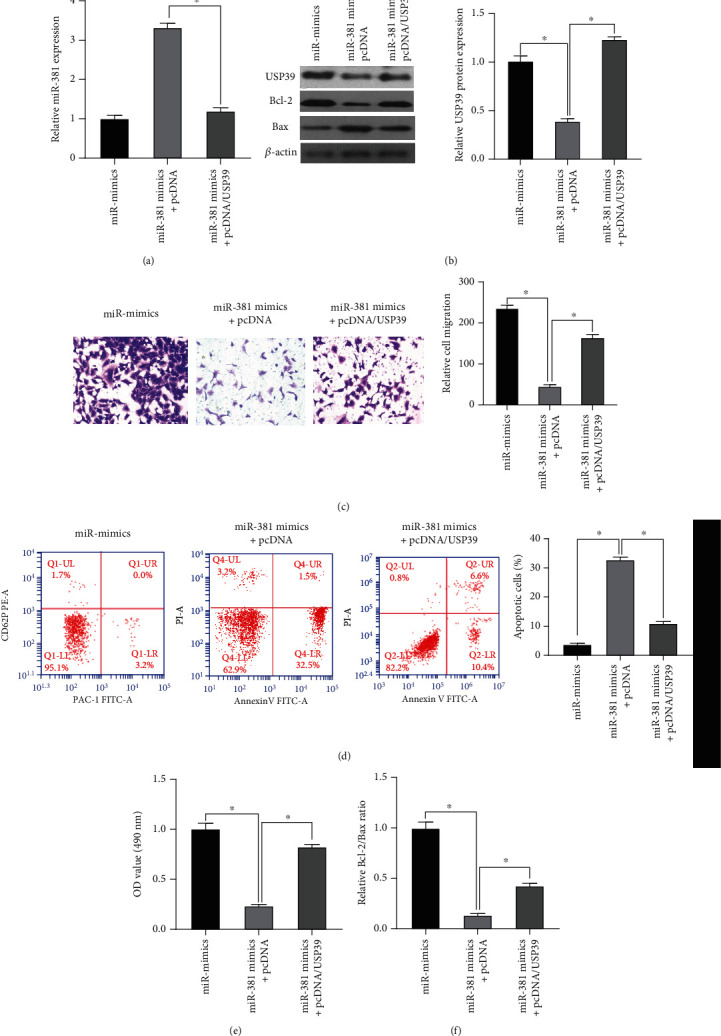
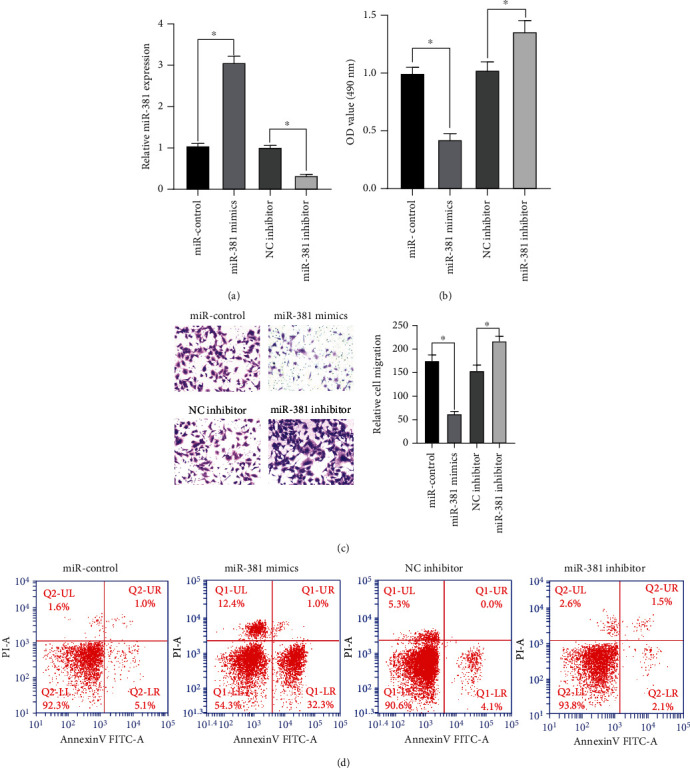
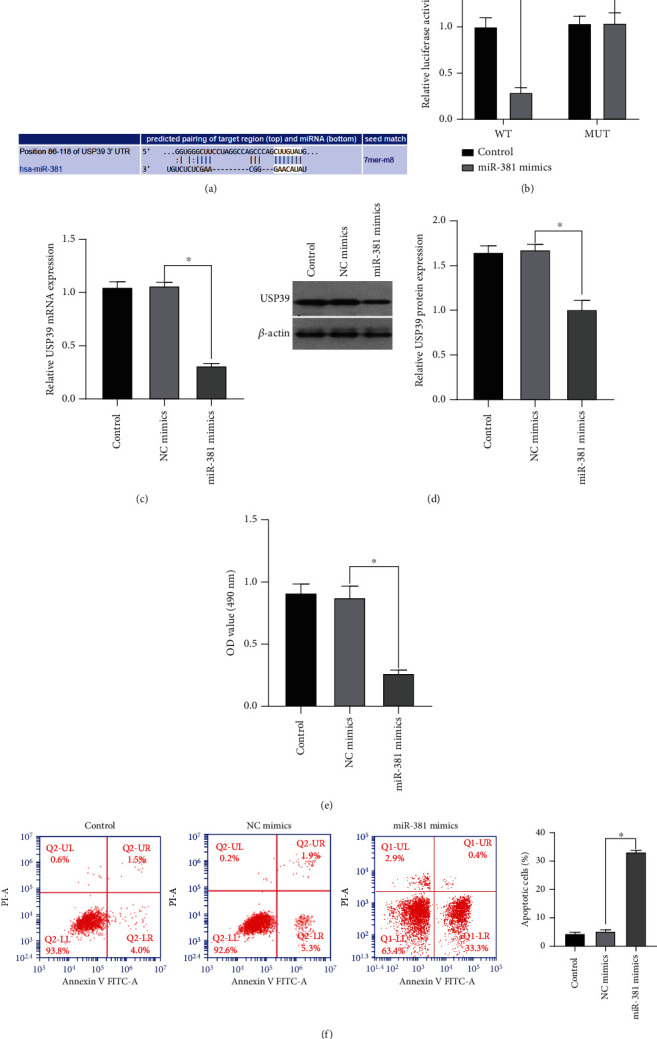
It is known that miR-381 plays a therapeutic role in a variety of cancers, but the regulatory mechanism of miR-381 in the treatment of lung cancer remains unclear. This study is aimed at exploring the expression level and mechanism of miR-381 in lung cancer. In this experiment, quantitative real-time PCR (qRT-PCR), western blot, and other methods were used to detect the expression of miR-381 and ubiquitin-specific protease 39 (USP39) in lung cancer tissues. The target genes of miR-381 were predicted by bioinformatics techniques, and the targeting relationship between miR-381 and USP39 was verified by the dual-luciferase reporting method. The expression levels of miR-381 and USP39 were adjusted to verify the effect of miR-381 on the expression of USP39 gene. The effect of miR-381 expression on proliferation of lung cancer cells was verified by cell proliferation and invasion experiments. miR-381 was downregulated in non-small-cell lung cancer tissues and cell lines, while USP39 was upregulated. The dual-luciferase reporter gene assay showed that miR-381 and USP39 had targeted binding sites. After transfection with miR-381 mimics, USP39 expression was significantly decreased, cell proliferation decreased, and apoptosis increased. After transfection with miR-381 inhibitor, USP39 expression was significantly increased, cell proliferation increased, and cell apoptosis decreased. Overexpression of USP39 significantly increased the invasion ability and cell survival curve ( < 0.05). In conclusion, overexpression of miR-381 can regulate the expression of USP39, inhibit the proliferation and invasion of cancer cells, and induce apoptosis of cancer cells. This may provide a new perspective and strategy for targeted therapy of non-small-cell lung cancer.
已知 miR-381 在多种癌症中发挥治疗作用,但 miR-381 在肺癌治疗中的调控机制尚不清楚。本研究旨在探讨 miR-381 在肺癌中的表达水平及作用机制。本实验采用实时定量 PCR(qRT-PCR)、western blot 等方法检测肺癌组织中 miR-381 和泛素特异性蛋白酶 39(USP39)的表达。通过生物信息学技术预测 miR-381 的靶基因,并通过双荧光素酶报告基因法验证 miR-381 与 USP39 的靶向关系。调节 miR-381 和 USP39 的表达水平,验证 miR-381 对 USP39 基因表达的影响。通过细胞增殖和侵袭实验验证 miR-381 表达对肺癌细胞增殖的影响。miR-381 在非小细胞肺癌组织和细胞系中表达下调,而 USP39 表达上调。双荧光素酶报告基因检测显示,miR-381 与 USP39 具有靶向结合位点。转染 miR-381 模拟物后,USP39 表达明显下调,细胞增殖减少,凋亡增加。转染 miR-381 抑制剂后,USP39 表达明显上调,细胞增殖增加,细胞凋亡减少。过表达 USP39 可显著增加细胞侵袭能力和细胞存活曲线(<0.05)。综上所述,过表达 miR-381 可调节 USP39 的表达,抑制癌细胞的增殖和侵袭,诱导癌细胞凋亡。这可能为非小细胞肺癌的靶向治疗提供新的视角和策略。