Bandiera Carole, Pasquier Jérôme, Locatelli Isabella, Niquille Anne, Wuerzner Grégoire, Dotta-Celio Jennifer, Hachfeld Anna, Wandeler Gilles, Wagner Anna Dorothea, Csajka Chantal, Zanchi Anne, Cavassini Matthias, Schneider Marie P
School of Pharmaceutical Sciences, University of Geneva, Geneva, Switzerland.
Institute of Pharmaceutical Sciences of Western Switzerland, University of Geneva, University of Lausanne, Geneva, Switzerland.
Patient Prefer Adherence. 2022 Aug 25;16:2313-2320. doi: 10.2147/PPA.S377780. eCollection 2022.
During the 2020 COVID-19 lockdown, patients included in the Interprofessional Medication Adherence Program (IMAP) in Switzerland continued to use electronic monitors (EMs) that registered daily drug-dose intake. We aimed to understand to what extent patients' medication implementation (ie, the extent to which the patient took the prescribed medicine), measured with EMs, was impacted by the lockdown.
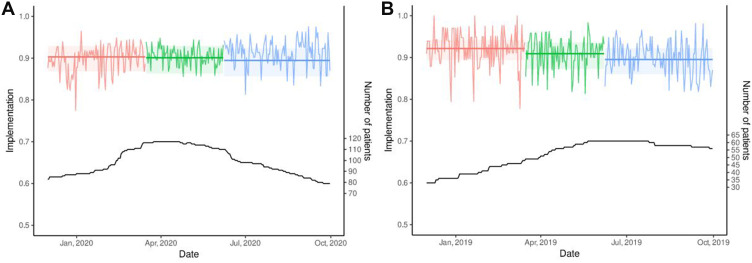
Patients participating in the IMAP were diagnosed with diabetic kidney disease (DKD), solid cancer, human immunodeficiency virus (HIV) and miscellaneous long-term diseases (MLTD). Patient implementation was defined through a proxy: if all patient EMs were opened at least once daily, implementation was considered active (=1), and no implementation was considered (=0) otherwise. Implementation before (from December 2019 to March 2020), during (March to June 2020) and after (June to September 2020) the lockdown was compared. Subanalyses were performed according to the patients' diseases. Subanalyses were performed in patients who used at least one EM in 2018-2019 during the same periods (defined as winter, spring and summer). The logistic regression models used to estimate medication implementation according to the period were fitted using generalized estimating equations.
In 2020, patient implementation (n = 118) did not differ significantly before versus during (OR = 0.98, 95% CI: 0.84-1.15, p = 0.789) and before versus after (OR = 0.91, 95% CI: 0.79-1.06, p = 0.217) the lockdown. These findings remained stable when separately analyzing the implementation of patients with HIV (n = 61), DKD (n = 25) or MLTD (n = 22). Too few patients with cancer were included (n = 10) to interpret the results. In 2019, the implementation of 61/118 (51.7%) patients was significantly lower during summertime versus wintertime (OR = 0.73, 95% CI: 0.60-0.89, p = 0.002).
Medication implementation remained steady before, during and after the lockdown in 2020. The IMAP before, during and after the lockdown may have supported the adherence of most patients, by ensuring continuity of care during periods of routine disturbances.
在2020年新冠疫情封锁期间,瑞士跨专业药物依从性项目(IMAP)纳入的患者继续使用电子监测器(EM)记录每日药物剂量摄入情况。我们旨在了解通过电子监测器测量的患者药物服用情况(即患者服用规定药物的程度)受封锁影响的程度。
参与IMAP的患者被诊断患有糖尿病肾病(DKD)、实体癌、人类免疫缺陷病毒(HIV)和其他慢性疾病(MLTD)。通过一个替代指标定义患者的服药情况:如果所有患者的电子监测器每天至少打开一次,则服药情况被视为有效(=1),否则视为无效(=0)。比较了封锁前(2019年12月至2020年3月)、封锁期间(2020年3月至6月)和封锁后(2020年6月至9月)的服药情况。根据患者的疾病进行亚组分析。对在2018 - 2019年同期(定义为冬季、春季和夏季)至少使用过一个电子监测器的患者进行亚组分析。用于根据时间段估计药物服用情况的逻辑回归模型使用广义估计方程进行拟合。
2020年,患者的服药情况(n = 118)在封锁前与封锁期间(OR = 0.98,95%CI:0.84 - 1.15,p = 0.789)以及封锁前与封锁后(OR = 0.91,95%CI:0.79 - 1.06,p = 0.217)之间无显著差异。分别分析HIV患者(n = 61)、DKD患者(n = 25)或MLTD患者(n = 22)的服药情况时,这些结果保持稳定。纳入的癌症患者太少(n = 10),无法解释结果。2019年,61/118(51.7%)的患者在夏季的服药情况显著低于冬季(OR = 0.73,95%CI:0.60 - 0.89,p = 0.002)。
2020年封锁前、封锁期间和封锁后,药物服用情况保持稳定。封锁前、期间和之后的IMAP可能通过在日常干扰期间确保护理的连续性,支持了大多数患者的依从性。