Lu Xianjun, Liu Tingjun, Zhou Jiani, Liu Jia, Yuan Zijian, Guo Lihong
Hospital of Stomatology, Guanghua School of Stomatology, Sun Yat-sen University, Guangdong Provincial Key Laboratory of Stomatology, Guangzhou, China.
J Periodontal Implant Sci. 2022 Aug;52(4):282-297. doi: 10.5051/jpis.2103460173.
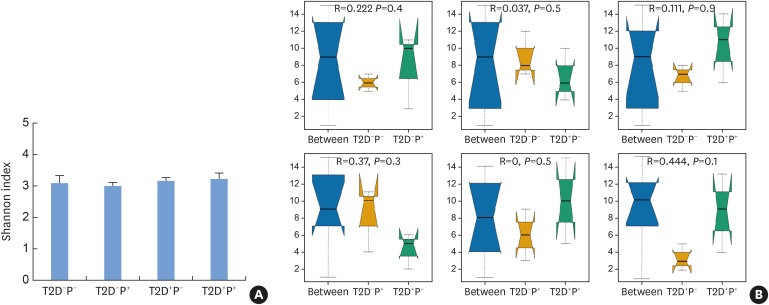
To explore differences in the subgingival microbiome according to the presence of periodontitis and/or type 2 diabetes mellitus (T2D), a metagenomic sequencing analysis of the subgingival microbiome was performed.
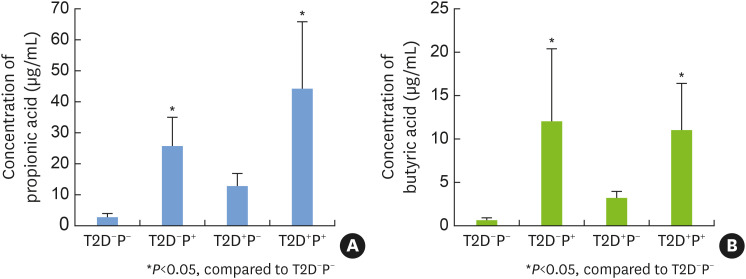
Twelve participants were divided into 4 groups based on their health conditions (periodontitis, T2D, T2D complicated with periodontitis, and generally healthy). Subgingival plaque was collected for metagenomic sequencing, and gingival crevicular fluids were collected to analyze the concentrations of short-chain fatty acids.
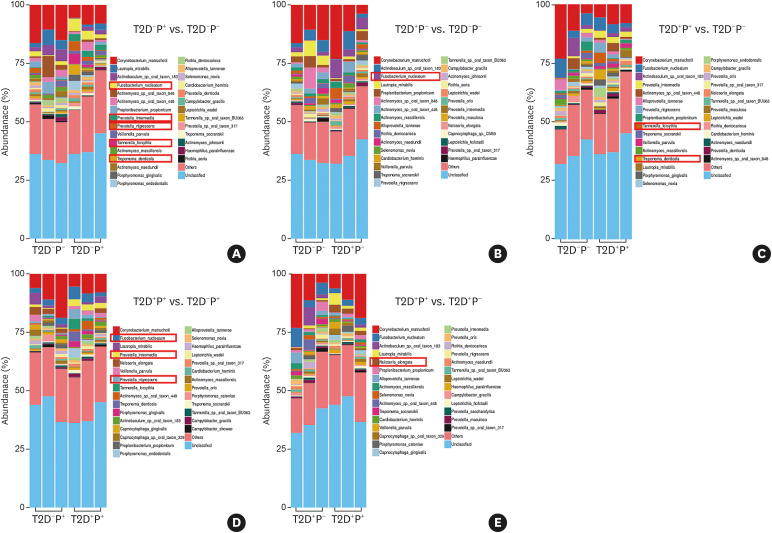
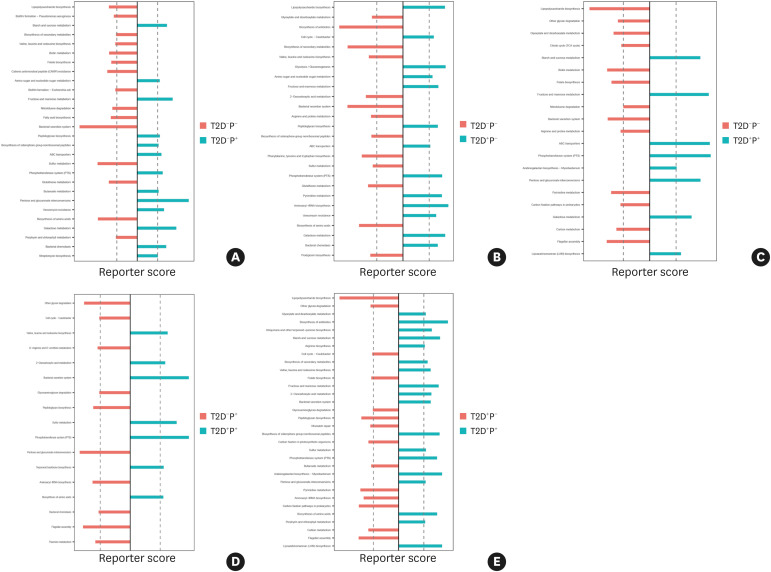
The shifts in the subgingival flora from the healthy to periodontitis states were less prominent in T2D subjects than in subjects without T2D. The pentose and glucuronate interconversion, fructose and mannose metabolism, and galactose metabolism pathways were enriched in the periodontitis state, while the phosphotransferase system, lipopolysaccharide (LPS) and peptidoglycan biosynthesis, bacterial secretion system, sulfur metabolism, and glycolysis pathways were enriched in the T2D state. Multiple genes whose expression was upregulated from the red and orange complex bacterial genomes were associated with bacterial biofilm formation and pathogenicity. The concentrations of propionic acid and butyric acid were significantly higher in subjects with periodontitis, with or without T2D, than in healthy subjects.
T2D patients are more susceptible to the presence of periodontal pathogens and have a higher risk of developing periodontitis. The pentose and glucuronate interconversion, fructose and mannose metabolism, galactose metabolism, and glycolysis pathways may represent the potential microbial functional association between periodontitis and T2D, and butyric acid may play an important role in the interaction between these 2 diseases. The enrichment of the LPS and peptidoglycan biosynthesis, bacterial secretion system, and sulfur metabolism pathways may cause T2D patients to be more susceptible to periodontitis.
为了根据牙周炎和/或2型糖尿病(T2D)的存在情况探索龈下微生物组的差异,我们对龈下微生物组进行了宏基因组测序分析。
12名参与者根据其健康状况分为4组(牙周炎、T2D、T2D合并牙周炎和一般健康)。收集龈下菌斑进行宏基因组测序,并收集龈沟液分析短链脂肪酸浓度。
与无T2D的受试者相比,T2D受试者从健康状态到牙周炎状态时龈下菌群的变化不那么明显。戊糖与葡糖醛酸相互转化、果糖和甘露糖代谢以及半乳糖代谢途径在牙周炎状态下富集,而磷酸转移酶系统、脂多糖(LPS)和肽聚糖生物合成、细菌分泌系统、硫代谢和糖酵解途径在T2D状态下富集。多个从红色和橙色复合体细菌基因组上调表达的基因与细菌生物膜形成和致病性相关。无论有无T2D,牙周炎患者丙酸和丁酸的浓度均显著高于健康受试者。
T2D患者更容易感染牙周病原体,患牙周炎的风险更高。戊糖与葡糖醛酸相互转化、果糖和甘露糖代谢、半乳糖代谢和糖酵解途径可能代表了牙周炎和T2D之间潜在的微生物功能关联,丁酸可能在这两种疾病的相互作用中起重要作用。LPS和肽聚糖生物合成、细菌分泌系统以及硫代谢途径的富集可能导致T2D患者更容易患牙周炎。