Emerg Infect Dis. 2022 Oct;28(10):2016-2026. doi: 10.3201/eid2810.212567. Epub 2022 Sep 1.
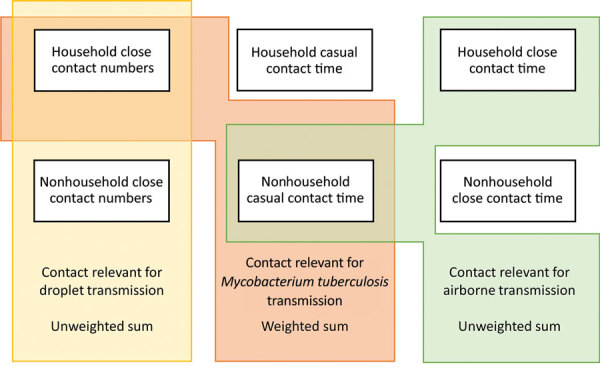
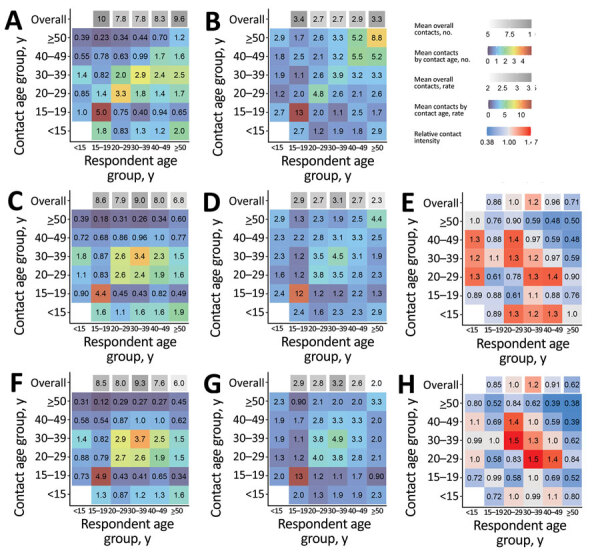
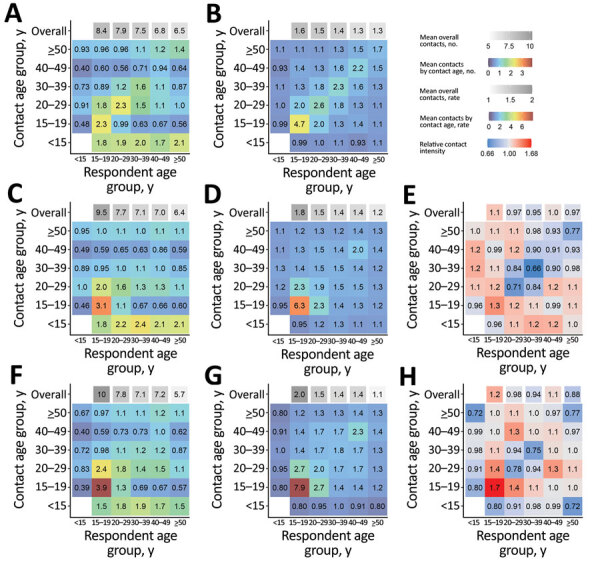
Data on social contact patterns are widely used to parameterize age-mixing matrices in mathematical models of infectious diseases. Most studies focus on close contacts only (i.e., persons spoken with face-to-face). This focus may be appropriate for studies of droplet and short-range aerosol transmission but neglects casual or shared air contacts, who may be at risk from airborne transmission. Using data from 2 provinces in South Africa, we estimated age mixing patterns relevant for droplet transmission, nonsaturating airborne transmission, and Mycobacterium tuberculosis transmission, an airborne infection where saturation of household contacts occurs. Estimated contact patterns by age did not vary greatly between the infection types, indicating that widespread use of close contact data may not be resulting in major inaccuracies. However, contact in persons >50 years of age was lower when we considered casual contacts, and therefore the contribution of older age groups to airborne transmission may be overestimated.
社交接触模式的数据被广泛用于传染病数学模型中的年龄混合矩阵的参数化。大多数研究只关注密切接触者(即面对面交谈的人)。这种关注可能适用于飞沫和短程气溶胶传播的研究,但忽略了偶然或共享空气接触者,他们可能有感染空气传播的风险。利用来自南非 2 个省份的数据,我们估计了与飞沫传播、非饱和空气传播和结核分枝杆菌传播(一种空气传播感染,家庭接触者会饱和)相关的年龄混合模式。不同感染类型的年龄混合模式差异不大,这表明广泛使用密切接触数据可能不会导致重大误差。然而,当我们考虑偶然接触者时,50 岁以上人群的接触减少,因此,老年人群对空气传播的贡献可能被高估。