Department of Laboratory Medicine, Clinical Microbiology, Stockholm, Sweden.
Department of Infectious Diseases, Karolinska University Hospital, Stockholm, Sweden.
J Clin Immunol. 2023 Jan;43(1):136-150. doi: 10.1007/s10875-022-01351-0. Epub 2022 Sep 2.
The aim of this study was to characterize clinical effects and biomarkers in three patients with chronic mucocutaneous candidiasis (CMC) caused by gain-of-function (GOF) mutations in the STAT1 gene during treatment with Janus kinase (JAK) inhibitors.
Mass cytometry (CyTOF) was used to characterize mononuclear leukocyte populations and Olink assay to quantify 265 plasma proteins. Flow-cytometric Assay for Specific Cell-mediated Immune-response in Activated whole blood (FASCIA) was used to quantify the reactivity against Candida albicans.
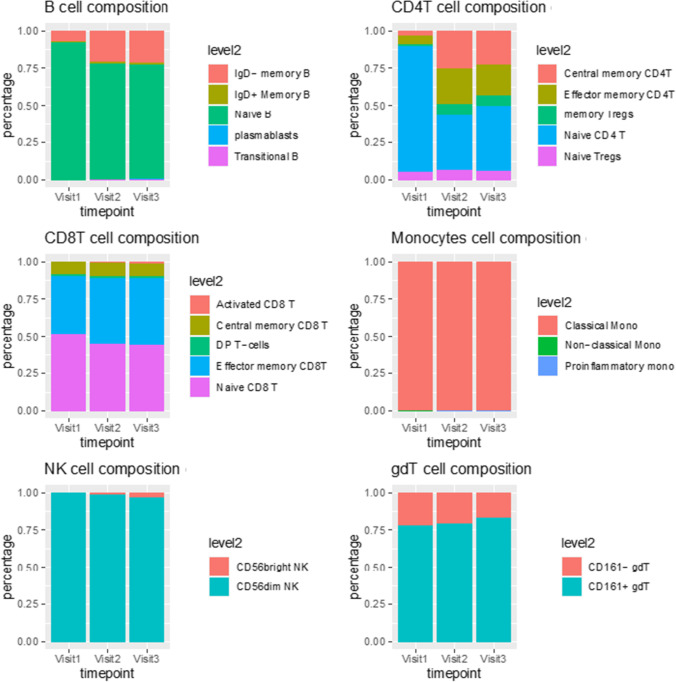
Overall, JAK inhibitors improved clinical symptoms of CMC, but caused side effects in two patients. Absolute numbers of neutrophils, T cells, B cells, and NK cells were sustained during baricitinib treatment. Detailed analysis of cellular subsets, using CyTOF, revealed increased expression of CD45, CD52, and CD99 in NK cells, reflecting a more functional phenotype. Conversely, monocytes and eosinophils downregulated CD16, consistent with reduced inflammation. Moreover, T and B cells showed increased expression of activation markers during treatment. In one patient with a remarkable clinical effect of baricitinib treatment, the immune response to C. albicans increased after 7 weeks of treatment. Alterations in plasma biomarkers involved downregulation of cellular markers CXCL10, annexin A1, granzyme B, granzyme H, and oncostatin M, whereas FGF21 was the only upregulated marker after 7 weeks. After 3 months, IFN-ɣ and CXCL10 were downregulated.
The clinical effect of JAK inhibitor treatment of CMC is promising. Several biological variables were altered during baricitinib treatment demonstrating that lymphocytes, NK cells, monocytes, and eosinophils were affected. In parallel, cellular reactivity against C. albicans was enhanced.
本研究旨在描述三位因 STAT1 基因功能获得性(GOF)突变导致慢性黏膜皮肤念珠菌病(CMC)的患者在接受 Janus 激酶(JAK)抑制剂治疗时的临床效果和生物标志物特征。
使用质谱流式细胞术(CyTOF)分析单核细胞群体,使用 Olink 测定法检测 265 种血浆蛋白。使用流式细胞术激活全血中针对特定细胞介导免疫反应的检测方法(FASCIA)来定量测定针对白色念珠菌的反应性。
总体而言,JAK 抑制剂改善了 CMC 的临床症状,但在两位患者中引起了副作用。巴利昔替尼治疗期间,中性粒细胞、T 细胞、B 细胞和 NK 细胞的绝对数量保持不变。使用 CyTOF 对细胞亚群进行详细分析,发现 NK 细胞中 CD45、CD52 和 CD99 的表达增加,反映出更具功能性的表型。相反,单核细胞和嗜酸性粒细胞中 CD16 的表达下调,表明炎症减轻。此外,T 和 B 细胞在治疗过程中表现出更高的激活标志物表达。在一位患者中,巴利昔替尼治疗的临床效果显著,治疗 7 周后对白色念珠菌的免疫反应增强。治疗 7 周后,血浆生物标志物的变化涉及细胞标志物 CXCL10、膜联蛋白 A1、颗粒酶 B、颗粒酶 H 和肿瘤坏死因子-α的下调,而 FGF21 是唯一上调的标志物。3 个月后,IFN-γ和 CXCL10 下调。
JAK 抑制剂治疗 CMC 的临床效果有前景。巴利昔替尼治疗期间有几个生物学变量发生改变,表明淋巴细胞、NK 细胞、单核细胞和嗜酸性粒细胞受到影响。同时,对白色念珠菌的细胞反应增强。