Central Catalonia Chronicity Research Group (C3RG), Centre for Health and Social Care Research (CESS), Faculty of Medicine, University of Vic-Central University of Catalonia (UVIC-UCC), Rambla Hospital 52, 08500, Vic, Barcelona, Spain.
Geriatric and Palliative Care Department, Hospital Universitari de La Santa Creu and Hospital Universitari de Vic. Vic, Barcelona, Spain.
BMC Geriatr. 2022 Sep 1;22(1):722. doi: 10.1186/s12877-022-03378-9.
Frailty is a dynamic condition that is clinically expected to change in older individuals during and around admission to an intermediate care (IC) facility. We aimed to characterize transitions between degrees of frailty before, during, and after admission to IC and assess the impact of these transitions on health outcomes.
Multicentre observational prospective study in IC facilities in Catalonia (North-east Spain). The analysis included all individuals aged ≥ 75 years (or younger with chronic complex or advanced diseases) admitted to an IC facility. The primary outcome was frailty, measured by the Frail-VIG index and categorized into four degrees: no frailty, and mild, moderate, and advanced frailty. The Frail-VIG index was measured at baseline (i.e., 30 days before IC admission) (Frail-VIG), on IC admission (Frail-VIG), at discharge (Frail-VIG), and 30 days post-discharge (Frail-VIG).
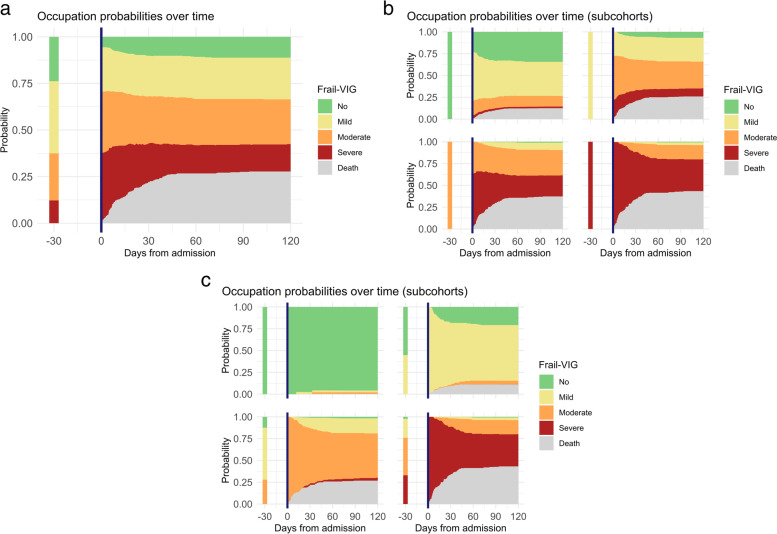
The study included 483 patients with a mean (SD) age of 81.3 (10.2) years. At the time of admission, 27 (5.6%) had no frailty, and 116 (24%), 161 (33.3%), and 179 (37.1%) mild, moderate, and severe frailty, respectively. Most frailty transitions occurred within the 30 days following admission to IC, particularly among patients with moderate frailty on admission. Most patients maintained their frailty status after discharge. Overall, 135 (28%) patients died during IC stay. Frailty, measured either at baseline or admission, was significantly associated with mortality, although it showed a stronger contribution when measured on admission (HR 1.16; 95%CI 1.10-1.22; p < 0.001) compared to baseline (HR 1.10; 1.05-1.15; p < 0.001). When including frailty measurements at the two time points (i.e., baseline and IC admission) in a multivariate model, frailty measured on IC admission but not at baseline significantly contributed to explaining mortality during IC stay.
Frailty status varied before and during admission to IC. Of the serial frailty measures we collected, frailty on IC admission was the strongest predictor of mortality. Results from this observational study suggest that routine frailty measurement on IC admission could aid clinical management decisions.
衰弱是一种动态的状态,预计在老年人入住和入住期间在中级护理(IC)设施中会发生变化。我们的目的是描述入住前、入住期间和入住后衰弱程度之间的转变,并评估这些转变对健康结果的影响。
在加泰罗尼亚(西班牙东北部)的 IC 设施中进行了多中心观察性前瞻性研究。该分析包括所有年龄≥75 岁(或患有慢性复杂或晚期疾病的年龄较小的患者)入住 IC 设施的患者。主要结局是通过 Frail-VIG 指数测量的衰弱程度,并分为四个等级:无衰弱、轻度、中度和重度衰弱。Frail-VIG 指数在基线(即入住 IC 前 30 天)(Frail-VIG)、入住时(Frail-VIG)、出院时(Frail-VIG)和出院后 30 天(Frail-VIG)进行测量。
该研究纳入了 483 名平均(SD)年龄为 81.3(10.2)岁的患者。入院时,27 名(5.6%)无衰弱,116 名(24%)、161 名(33.3%)和 179 名(37.1%)分别为轻度、中度和重度衰弱。大多数衰弱转变发生在入住 IC 后的 30 天内,特别是在入院时患有中度衰弱的患者中。大多数患者在出院后保持其衰弱状态。总体而言,135 名(28%)患者在 IC 住院期间死亡。衰弱程度,无论是在基线还是入院时测量,都与死亡率显著相关,尽管与基线时相比,入院时测量的贡献更强(HR 1.16;95%CI 1.10-1.22;p<0.001)。当在多变量模型中包含两个时间点(即基线和 IC 入院时)的衰弱测量值时,IC 入院时测量的衰弱程度而不是基线时的衰弱程度显著有助于解释 IC 住院期间的死亡率。
衰弱状况在入住 IC 前后发生变化。在我们收集的一系列衰弱测量中,IC 入院时的衰弱程度是死亡率的最强预测指标。这项观察性研究的结果表明,在 IC 入院时常规进行衰弱测量可以帮助临床管理决策。