Dipartimento Di Sociologia E Ricerca Sociale, Università degli Studi di Milano - Bicocca, Via Bicocca degli Arcimboldi, 8, 20126, Milano, Italy.
University of Applied Sciences and Arts of Southern Switzerland, Institute of Applied Sustainability to the Built Environment, Via Flora Ruchat-Roncati, 15, CH-6850, Mendrisio, Switzerland.
BMC Public Health. 2022 Sep 1;22(1):1657. doi: 10.1186/s12889-022-14048-1.
This study investigated changes in the prevalence of insomnia in Italy during COVID-19, starting from the first lockdown period (8 March 2020). We hypothesized that lockdown precipitated increased prevalence of insomnia symptoms relative to the pre-pandemic period; b) the gradual relaxation of containment measures - post-lockdown period (Phase 2 and Phase 3) - reduced insomnia severity, leading to a relative recovery of pre-pandemic levels; and c) we tested age-related heterogeneity in sleep responses, with an expected higher increase in insomnia in younger and middle-age groups.
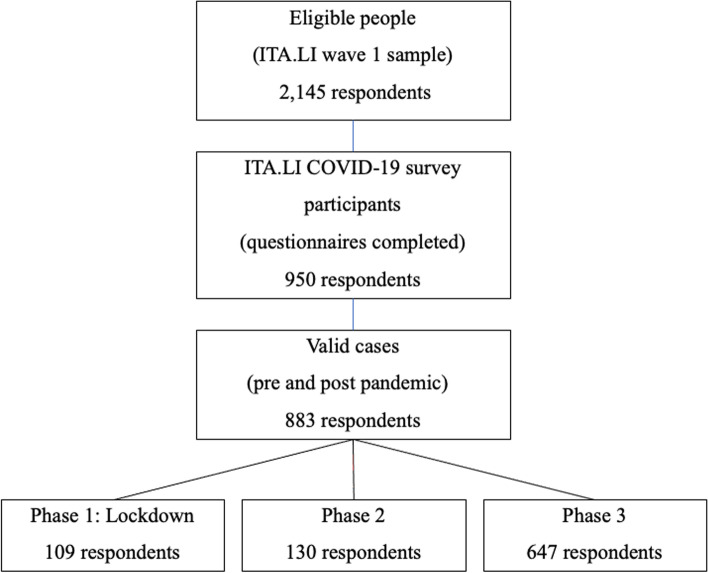
Analyses drew on a subsample (N = 883) of respondents to ITA.LI - Italian Lives, a recently established panel study on a probability sample of individuals aged 16 + living in Italy. To estimate patterns of change in insomnia, we first fitted a random-effects ordered logistic model on the whole sample. We then added an interaction term between policy phases and the respondent age to test whether the relationship between insomnia and policy phases differed across age groups. Analyses accounted for survey non-response weights.
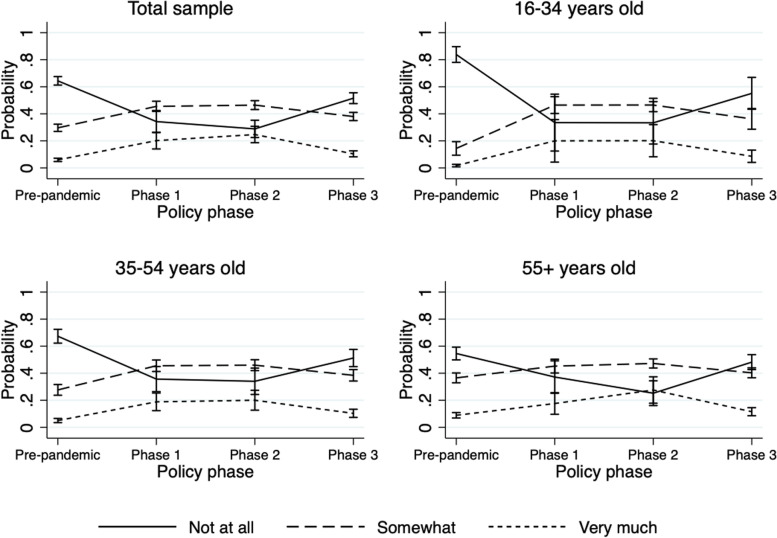
The fraction of respondents reporting moderate ("somewhat" + 0.159, S.E. 0.017) or severe ("very much" + 0.142, S.E. 0.030) sleep disturbances significantly increased during Phase 1. The prevalence of insomnia followed an inverted U-shaped curve across policy phases, with further increases from baseline levels ("somewhat" + 0.168, S.E. 0.015; "very much" + 0.187, S.E. 0.030) during Phase 2, followed by a relative reduction in Phase 3, although it remained significantly higher than in the pre-pandemic period ("somewhat", + 0.084, S.E. 0.016; "very much", + 0.045, S.E. 0.010). There were significant age-related differences in insomnia patterns, as the discrete change from pre-pandemic levels in the probability of not suffering from insomnia was negative and significant for the younger age group (- 0.269, S.E. 0.060) and for respondents aged 35-54 (- 0.163, S.E. 0.039).
There is reason to believe that the emergency policy response to the COVID-19 crisis may have had unintended and possibly scarring effects in terms of increased prevalence of insomnia. The hardest hit were young adults and, to a lesser extent, the middle-aged; however, older respondents (55 +) remained resilient, and their insomnia trajectory bounced back to pre-pandemic levels.
本研究旨在调查 COVID-19 期间意大利失眠症患病率的变化,研究起始于首次封锁期(2020 年 3 月 8 日)。我们假设封锁期会导致失眠症状的患病率相对高于大流行前水平;b)随着封锁的逐步放宽(后封锁期,即第二阶段和第三阶段),失眠严重程度降低,从而使患病率相对恢复到大流行前水平;c)我们测试了与年龄相关的睡眠反应异质性,预计年轻人和中年人组的失眠症患病率会更高。
分析使用 ITA.LI-意大利生活(最近建立的一个基于概率抽样的 16 岁及以上意大利居民的面板研究)的受访者的子样本(N=883)。为了估计失眠症变化模式,我们首先在全样本中拟合了一个随机效应有序逻辑模型。然后,我们在政策阶段和受访者年龄之间添加了一个交互项,以检验失眠症与政策阶段之间的关系是否因年龄组而异。分析考虑了调查无回应权重。
报告中度(“有些”+0.159,标准误 0.017)或重度(“非常多”+0.142,标准误 0.030)睡眠障碍的受访者比例在第一阶段显著增加。失眠症的患病率在政策阶段呈倒 U 型曲线变化,第二阶段从基线水平进一步上升(“有些”+0.168,标准误 0.015;“非常多”+0.187,标准误 0.030),然后在第三阶段相对减少,但仍显著高于大流行前水平(“有些”+0.084,标准误 0.016;“非常多”+0.045,标准误 0.010)。失眠症模式存在显著的年龄相关差异,因为从大流行前水平开始,不患失眠症的概率发生了显著的负向变化,这一变化在年轻组(-0.269,标准误 0.060)和 35-54 岁的受访者中更为明显(-0.163,标准误 0.039)。
有理由相信,针对 COVID-19 危机的紧急政策反应可能在增加失眠症患病率方面产生了意想不到的、可能会留下后遗症的影响。受影响最大的是年轻人,其次是中年人;然而,年龄较大的受访者(55 岁及以上)仍然具有弹性,他们的失眠轨迹恢复到大流行前的水平。