Skipper Mette Tiedemann, Rank Cecilie Utke, Jarvis Kirsten Brunsvig, Lynggaard Line Stensig, Andrés-Jensen Liv, Quist-Paulsen Petter, Semaskeviciene Ruta, Hallböök Helene, Waitiovaara-Kautto Ulla, Ranta Susanna, Trakymiene Sonata, Abrahamsson Jonas, Huttunen Pasi, Albertsen Birgitte Klug, Schmiegelow Kjeld, Tuckuviene Ruta
Department of Paediatrics and Adolescent Medicine Aarhus University Hospital Aarhus Denmark.
Department of Clinical Medicine Aarhus University Aarhus Denmark.
EJHaem. 2022 Jun 24;3(3):754-763. doi: 10.1002/jha2.484. eCollection 2022 Aug.
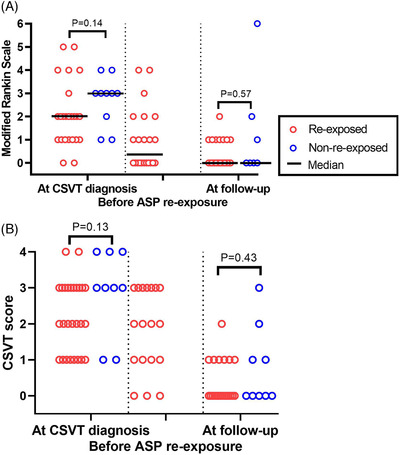
Cerebral sinovenous thrombosis (CSVT) is a serious complication during asparaginase therapy in patients with acute lymphoblastic leukaemia (ALL). We identified 46 patients with CSVT among 2651 patients (1‒45 years) treated according to the Nordic Society of Paediatric Haematology and Oncology (NOPHO) ALL2008 protocol between 2008 and 2018. CSVT cases were prospectively registered in the NOPHO database with retrospective updates. We examined the frequency of asparaginase re-exposure after CSVT, potential factors associated with asparaginase truncation, and sequelae after CSVT. This work was supported by the Danish Cancer Society and the Danish Childhood Cancer Foundation. The 2.5-year cumulative incidence of CSVT was 1.9% (95% confidence interval 1.4%-2.5%). The majority of patients (74%, = 31) were re-exposed to asparaginase (with low-molecular-weight heparin coverage), one of whom had a second CSVT, without neurological sequelae. Patients re-exposed to asparaginase were earlier in ALL treatment and lacked more asparaginase doses than non-re-exposed patients at CSVT diagnosis (median 50 vs. 81 days, = 0.03; mean 11.2 vs. 8.4 asparaginase doses, = 0.04). No other examined factors had an impact on asparaginase re-exposure. At the last follow-up (median 4.5 years after CSVT), 61% of patients had normal neurological status, and 57% had complete recanalisation of CSVT, with no significant difference between patients re-exposed and non-re-exposed to asparaginase. Our results indicate that re-exposure to asparaginase is safe after CSVT during anticoagulation.
脑静脉窦血栓形成(CSVT)是急性淋巴细胞白血病(ALL)患者接受门冬酰胺酶治疗期间的一种严重并发症。我们在2008年至2018年期间按照北欧儿科学血液学和肿瘤学会(NOPHO)ALL2008方案治疗的2651例患者(1至45岁)中识别出46例CSVT患者。CSVT病例前瞻性登记于NOPHO数据库,并进行回顾性更新。我们研究了CSVT后门冬酰胺酶再次暴露的频率、与门冬酰胺酶截断相关的潜在因素以及CSVT后的后遗症。这项工作得到了丹麦癌症协会和丹麦儿童癌症基金会的支持。CSVT的2.5年累积发病率为1.9%(95%置信区间1.4% - 2.5%)。大多数患者(74%,n = 31)再次接受了门冬酰胺酶治疗(伴有低分子量肝素覆盖),其中1例发生了第二次CSVT,但无神经后遗症。与未再次接受门冬酰胺酶治疗的患者相比,再次接受门冬酰胺酶治疗的患者在CSVT诊断时处于ALL治疗的早期阶段,且接受的门冬酰胺酶剂量更少(中位数分别为50天和81天,P = 0.03;平均门冬酰胺酶剂量分别为11.2剂和8.4剂,P = 0.04)。没有其他检查因素对门冬酰胺酶再次暴露有影响。在最后一次随访时(CSVT后中位4.5年),61%的患者神经状态正常,57%的患者CSVT完全再通,再次接受和未接受门冬酰胺酶治疗的患者之间无显著差异。我们的结果表明,CSVT后在抗凝期间再次接受门冬酰胺酶治疗是安全的。