Maltoni Marco, Scarpi Emanuela, Dall'Agata Monia, Micheletti Simona, Pallotti Maria Caterina, Pieri Martina, Ricci Marianna, Romeo Antonino, Tenti Maria Valentina, Tontini Luca, Rossi Romina
Medical Oncology Unit, Department of Specialized, Experimental and Diagnostic Medicine (DIMES), University of Bologna, Bologna, Italy.
Unit of Biostatistics and Clinical Trials, IRCCS Istituto Romagnolo per lo Studio dei Tumori (IRST) "Dino Amadori", Meldola, Italy.
Front Oncol. 2022 Aug 16;12:918414. doi: 10.3389/fonc.2022.918414. eCollection 2022.
Prognostication can be used within a tailored decision-making process to achieve a more personalized approach to the care of patients with cancer. This prospective observational study evaluated the accuracy of the Palliative Prognostic score (PaP score) to predict survival in patients identified by oncologists as candidates for palliative radiotherapy (PRT). We also studied interrater variability for the clinical prediction of survival and PaP scores and assessed the accuracy of the Survival Prediction Score (SPS) and TEACHH score.
Consecutive patients were enrolled at first access to our Radiotherapy and Palliative Care Outpatient Clinic. The discriminating ability of the prognostic models was assessed using Harrell's C index, and the corresponding 95% confidence intervals (95% CI) were obtained by bootstrapping.
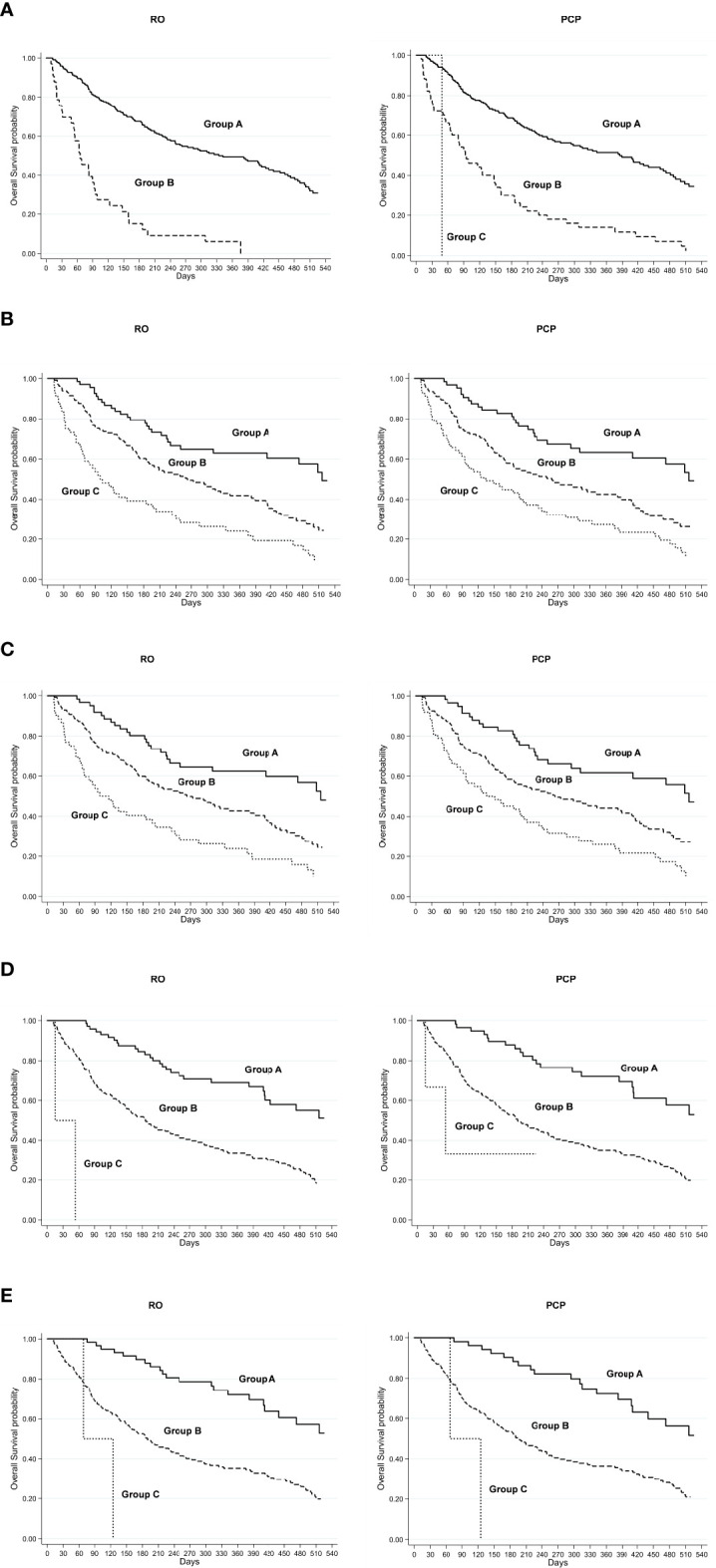
In total, 255 patients with metastatic cancer were evaluated, and 123 (48.2%) were selected for PRT, all of whom completed treatment without interruption. Then, 10.6% of the irradiated patients who died underwent treatment within the last 30 days of life. The PaP score showed an accuracy of 74.8 (95% CI, 69.5-80.1) for radiation oncologist (RO) and 80.7 (95% CI, 75.9-85.5) for palliative care physician (PCP) in predicting 30-day survival. The accuracy of TEACHH was 76.1 (95% CI, 70.9-81.3) and 64.7 (95% CI, 58.8-70.6) for RO and PCP, respectively, and the accuracy of SPS was 70 (95% CI, 64.4-75.6) and 72.8 (95% CI, 67.3-78.3).
Accurate prognostication can identify candidates for low-fraction PRT during the last days of life who are more likely to complete the planned treatment without interruption.All the scores showed good discriminating capacity; the PaP had the higher accuracy, especially when used in a multidisciplinary way.
在个性化决策过程中,预后评估可用于实现对癌症患者更具个性化的护理方法。这项前瞻性观察性研究评估了姑息预后评分(PaP评分)在预测肿瘤学家确定为姑息性放疗(PRT)候选患者生存情况方面的准确性。我们还研究了生存临床预测和PaP评分的评分者间变异性,并评估了生存预测评分(SPS)和TEACHH评分的准确性。
连续患者在首次就诊于我们的放疗与姑息治疗门诊时入组。使用Harrell's C指数评估预后模型的鉴别能力,并通过自抽样获得相应的95%置信区间(95%CI)。
总共评估了255例转移性癌症患者,其中123例(48.2%)被选入PRT组,所有患者均顺利完成治疗。然后,10.6%的接受放疗且死亡的患者在生命的最后30天内接受了治疗。在预测30天生存率方面,PaP评分对放射肿瘤学家(RO)的准确性为74.8(95%CI,69.5 - 80.1),对姑息治疗医生(PCP)的准确性为80.7(95%CI,75.9 - 85.5)。TEACHH评分对RO和PCP的准确性分别为76.1(95%CI,70.9 - 81.3)和64.7(95%CI,58.8 - 70.6),SPS评分对RO和PCP的准确性分别为70(95%CI,64.4 - 75.6)和72.8(95%CI,67.3 - 78.3)。
准确的预后评估可以识别出在生命最后几天更有可能顺利完成计划治疗的低分割PRT候选患者。所有评分均显示出良好的鉴别能力;PaP评分具有更高的准确性,尤其是以多学科方式使用时。