Department of Thoracic and Cardiovascular Surgery, Cardiovascular Center, Myongji Hospital, Hanyang University College of Medicine, Seoul, Korea.
Department of Statistics, College of Natural Science, University of Seoul, Seoul, Korea.
J Card Surg. 2022 Nov;37(11):3623-3630. doi: 10.1111/jocs.16908. Epub 2022 Sep 2.
The aim of this study was to compare the clinical outcomes and long-term survival in patients who underwent isolated aortic valve replacement (AVR) with mechanical versus bioprosthetic valves.
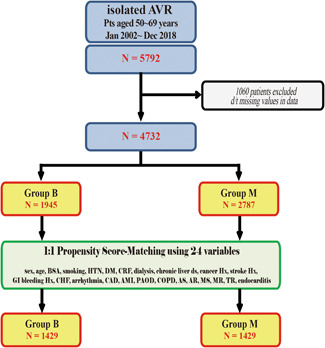
Patients aged 50-69 years who had undergone AVR from 2002 to 2018 were identified and their characteristics were collected from Korean National Health Information Database formed by the National Health Insurance Service, Republic of Korea. Of the 5792 patients, 1060 patients were excluded due to missing values on characteristics. Of the 4732 study patients, 1945 patients (41.1%) had received bioprosthetic valves (Group B) and 2787 patients (58.9%) had received mechanical valves (Group M). A propensity score-matched analysis was performed to match 1429 patients in each group. Data on mortality, cardiac mortality, reoperations, cerebrovascular accidents, and bleeding complications were obtained.
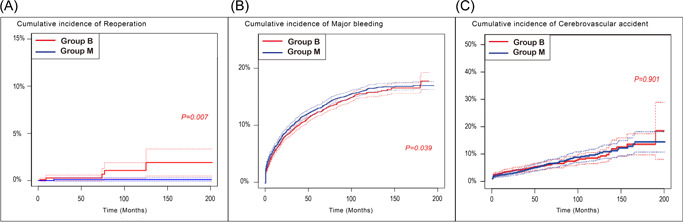
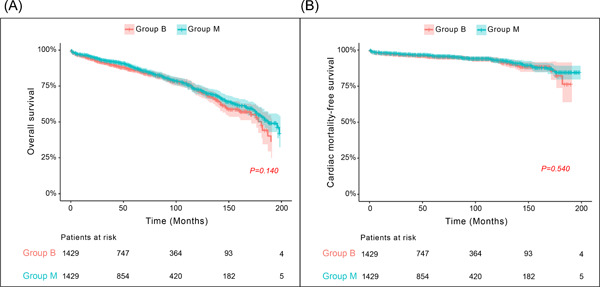
The overall survival rates at 5 and 10 years postoperatively were 87.8% and 75.2% in the matched Group B and 91.2% and 76.7% in the matched Group M, respectively (p = .140). Freedom from cardiac death rates at postoperative 5 and 10 years were 95.6% and 92.4% in the matched Group B and 96.0% and 92.1% in the matched Group M, respectively (p = .540). The cumulative incidence of reoperation was higher in the matched Group B than in the matched Group M (p = .007), and the cumulative incidence of major bleeding was higher in the matched Group M than in the matched Group B (p = .039).
In patients aged 50-69 years who underwent isolated AVR, the patients who received bioprosthetic valves showed similar cardiac mortality-free survival and long-term survival rates to the patients who received mechanical valves.
本研究旨在比较 50-69 岁接受机械瓣膜与生物瓣膜行主动脉瓣置换术(AVR)的患者的临床结局和长期生存情况。
从韩国国家健康保险服务(National Health Insurance Service)的韩国国家健康信息数据库中确定了 2002 年至 2018 年期间接受 AVR 的 5792 名患者,并收集了他们的特征。在 4732 名研究患者中,由于特征缺失,1060 名患者被排除在外。在 4732 名研究患者中,1945 名患者(41.1%)接受了生物瓣膜(B 组),2787 名患者(58.9%)接受了机械瓣膜(M 组)。进行倾向评分匹配分析,以匹配每组 1429 名患者。获取死亡率、心脏死亡率、再次手术、脑血管意外和出血并发症的数据。
在匹配的 B 组中,术后 5 年和 10 年的总生存率分别为 87.8%和 75.2%,在匹配的 M 组中,术后 5 年和 10 年的总生存率分别为 91.2%和 76.7%(p=0.140)。在匹配的 B 组中,术后 5 年和 10 年的无心脏死亡生存率分别为 95.6%和 92.4%,在匹配的 M 组中,术后 5 年和 10 年的无心脏死亡生存率分别为 96.0%和 92.1%(p=0.540)。在匹配的 B 组中,再次手术的累积发生率高于匹配的 M 组(p=0.007),在匹配的 M 组中,大出血的累积发生率高于匹配的 B 组(p=0.039)。
在 50-69 岁接受单纯 AVR 的患者中,接受生物瓣膜的患者与接受机械瓣膜的患者相比,无心脏死亡生存率和长期生存率相似。