Jiang Yefan, Wang Song, Bian Jinhui, Chen Si, Shao Yongfeng
Department of Cardiovascular Surgery, The First Affiliated Hospital of Nanjing Medical University, Guangzhou Road, No. 300, Nanjing 210000, China.
Department of Cardiovascular Surgery, Union Hospital, Tongji Medical College, Huazhong University of Science and Technology, Jiefang Road, No. 1277, Wuhan 430022, China.
J Cardiovasc Dev Dis. 2023 Feb 20;10(2):90. doi: 10.3390/jcdd10020090.
Mechanical prostheses and bioprosthetic prostheses have their own advantages and disadvantages. Mechanical ones are recommended for younger patients (<50 years old), and bioprosthetic ones are recommended for older patients (>70 years old). There is still debate regarding which kind of prosthesis is better for middle-aged patients (50 to 70 years old) receiving aortic valve replacement (AVR). To solve this problem, we conducted this meta-analysis. Given that only one randomized controlled trial (RCT) study was included, we conducted a subgroup analysis of RCT and propensity score matching (PSM) retrospective studies to reduce the bias.
We systematically searched articles related to clinical outcomes of mechanical and bioprosthetic prostheses in middle-aged patients receiving AVR in the PubMed, Cochrane Library, and China National Knowledge Infrastructure (CNKI) databases. The published date was up to 1 October 2022. Studies were excluded if not only middle-aged patients were included, or if they lacked direct comparisons between mechanical and bioprosthetic prostheses.
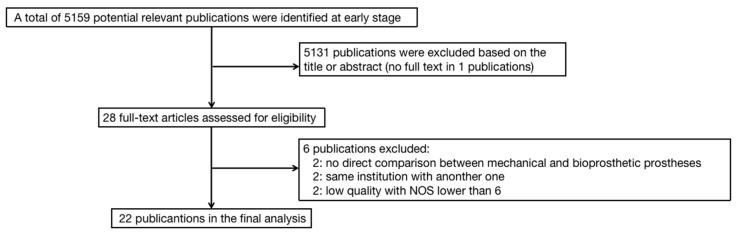
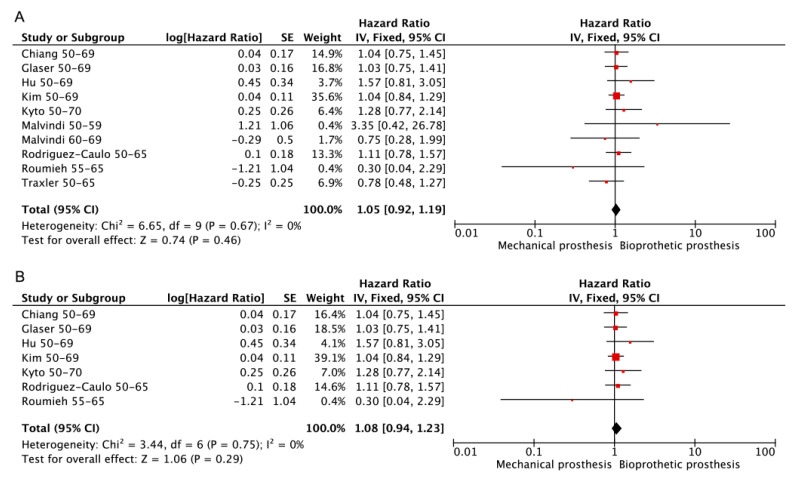
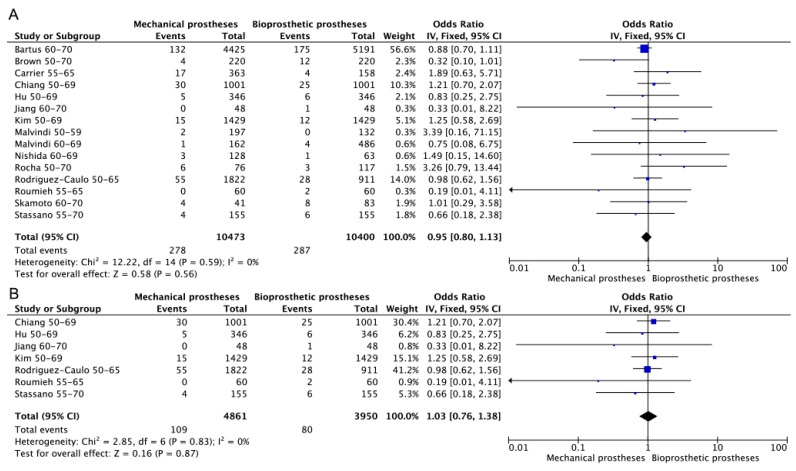
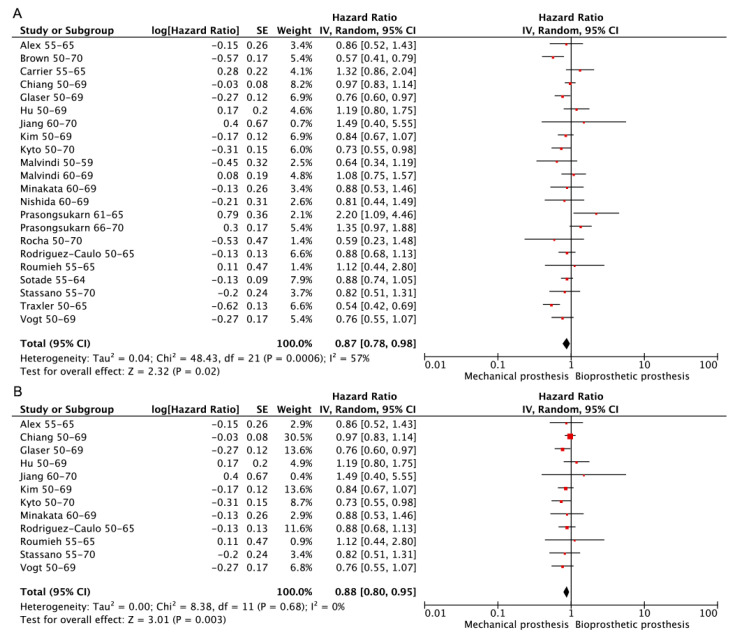
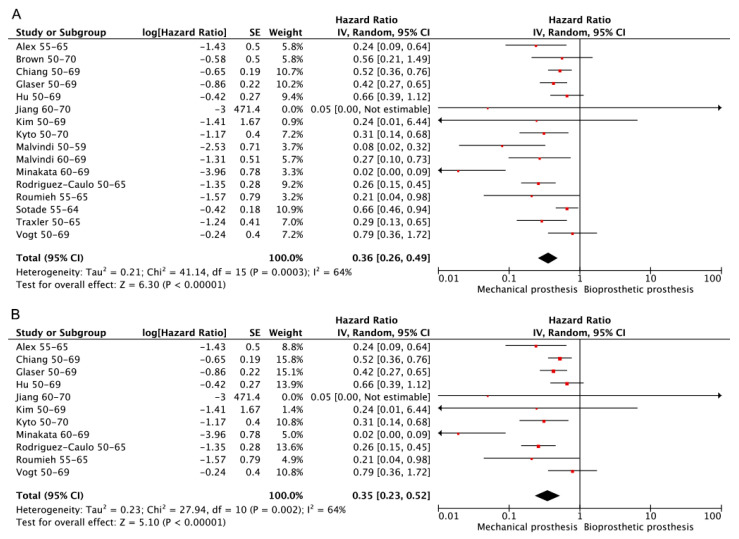
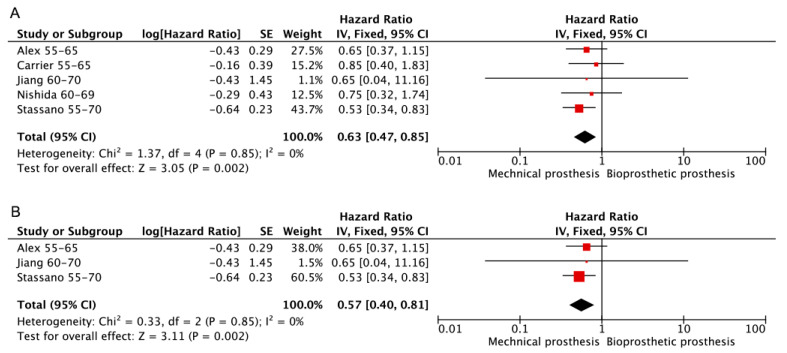
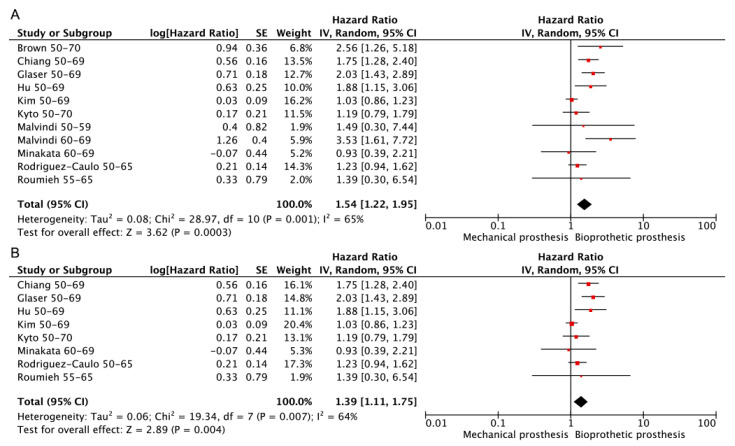
In total, 22 studies with 32,298 patients were included in the final analysis. The results show that patients aged between 50 and 70 receiving AVR with mechanical prostheses achieved better long-term survival and fewer reoperations and valve-related events but suffered more with bleeding events. No significant difference could be found in terms of early mortality and long-term cardiac death. The same results could be observed in the subgroup analysis of RCT and PSM retrospective studies.
Both mechanical and bioprosthetic prostheses are beneficial to middle-aged patients undertaking AVR procedures. However, mechanical prostheses show better clinical outcomes in long-term survival and comorbidities. Individual recommendation is still necessary.
机械瓣膜和生物瓣膜各有优缺点。机械瓣膜推荐用于年轻患者(<50岁),生物瓣膜推荐用于老年患者(>70岁)。对于接受主动脉瓣置换术(AVR)的中年患者(50至70岁),哪种瓣膜更好仍存在争议。为解决这一问题,我们进行了这项荟萃分析。鉴于仅纳入了一项随机对照试验(RCT)研究,我们对RCT和倾向评分匹配(PSM)回顾性研究进行了亚组分析,以减少偏倚。
我们在PubMed、Cochrane图书馆和中国知网(CNKI)数据库中系统检索了与接受AVR的中年患者机械瓣膜和生物瓣膜临床结局相关的文章。发表日期截至2022年10月1日。如果研究不仅纳入了中年患者,或者缺乏机械瓣膜和生物瓣膜之间的直接比较,则将其排除。
最终分析共纳入22项研究,涉及32298例患者。结果显示,年龄在50至70岁之间接受机械瓣膜AVR的患者长期生存率更高,再次手术和瓣膜相关事件更少,但出血事件更多。在早期死亡率和长期心源性死亡方面未发现显著差异。在RCT和PSM回顾性研究的亚组分析中也观察到了相同的结果。
机械瓣膜和生物瓣膜对接受AVR手术的中年患者均有益。然而,机械瓣膜在长期生存和合并症方面显示出更好的临床结局。仍需要进行个体化推荐。