Department of Anaesthesiology, Intensive Care, Emergency and Pain Medicine, University Hospital Wuerzburg, Wuerzburg, Germany.
Evidence-based Oncology, Department I of Internal Medicine, Center for Integrated Oncology Aachen Bonn Cologne Duesseldorf, Faculty of Medicine and University Hospital Cologne, University of Cologne, Cologne, Germany.
Res Synth Methods. 2023 May;14(3):357-369. doi: 10.1002/jrsm.1599. Epub 2022 Sep 15.
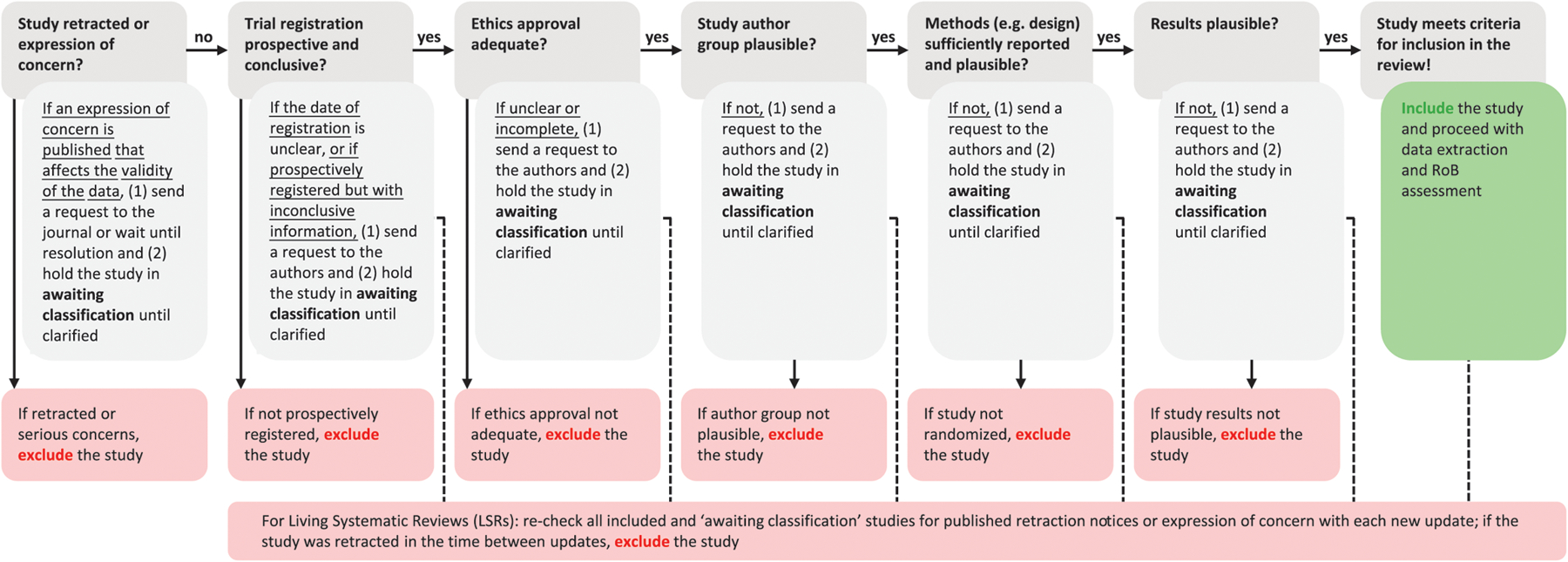
Evidence synthesis findings depend on the assumption that the included studies follow good clinical practice and results are not fabricated or false. Studies which are problematic due to scientific misconduct, poor research practice, or honest error may distort evidence synthesis findings. Authors of evidence synthesis need transparent mechanisms to identify and manage problematic studies to avoid misleading findings. As evidence synthesis authors of the Cochrane COVID-19 review on ivermectin, we identified many problematic studies in terms of research integrity and regulatory compliance. Through iterative discussion, we developed a research integrity assessment (RIA) tool for randomized controlled trials for the update of this Cochrane review. In this paper, we explain the rationale and application of the RIA tool in this case study. RIA assesses six study criteria: study retraction, prospective trial registration, adequate ethics approval, author group, plausibility of methods (e.g., randomization), and plausibility of study results. RIA was used in the Cochrane review as part of the eligibility check during screening of potentially eligible studies. Problematic studies were excluded and studies with open questions were held in awaiting classification until clarified. RIA decisions were made independently by two authors and reported transparently. Using the RIA tool resulted in the exclusion of >40% of studies in the first update of the review. RIA is a complementary tool prior to assessing "Risk of Bias" aiming to establish the integrity and authenticity of studies. RIA provides a platform for urgent development of a standard approach to identifying and managing problematic studies.
证据综合的结果取决于一个假设,即纳入的研究遵循良好的临床实践,且结果没有捏造或虚假。由于科学不端行为、研究实践不佳或诚实错误而存在问题的研究可能会歪曲证据综合的结果。证据综合的作者需要透明的机制来识别和管理有问题的研究,以避免产生误导性的结果。作为科克伦 COVID-19 关于伊维菌素综述的证据综合作者,我们发现许多研究在研究诚信和法规遵从性方面存在问题。通过反复讨论,我们为本次科克伦综述的更新制定了一个用于随机对照试验的研究诚信评估(RIA)工具。在本文中,我们解释了在这种情况下该 RIA 工具的基本原理和应用。RIA 评估了六个研究标准:研究撤回、前瞻性试验注册、充分的伦理批准、作者群体、方法的合理性(例如,随机化)和研究结果的合理性。RIA 在科克伦综述中作为潜在合格研究筛选过程中资格检查的一部分使用。有问题的研究被排除在外,有开放问题的研究在得到澄清之前被搁置在待分类状态。RIA 由两位作者独立做出决定,并透明地报告。使用 RIA 工具导致综述的第一次更新中排除了超过 40%的研究。RIA 是在评估“偏倚风险”之前的一个补充工具,旨在建立研究的完整性和真实性。RIA 为确定和管理有问题的研究提供了一个平台,以紧急制定一种标准方法。