Department of Neuroscience, University of Wisconsin-Madison, Madison, WI, USA.
Leonard Davis School of Gerontology, University of Southern California, Los Angeles, CA, USA.
Sci Rep. 2022 Sep 2;12(1):15001. doi: 10.1038/s41598-022-19055-1.
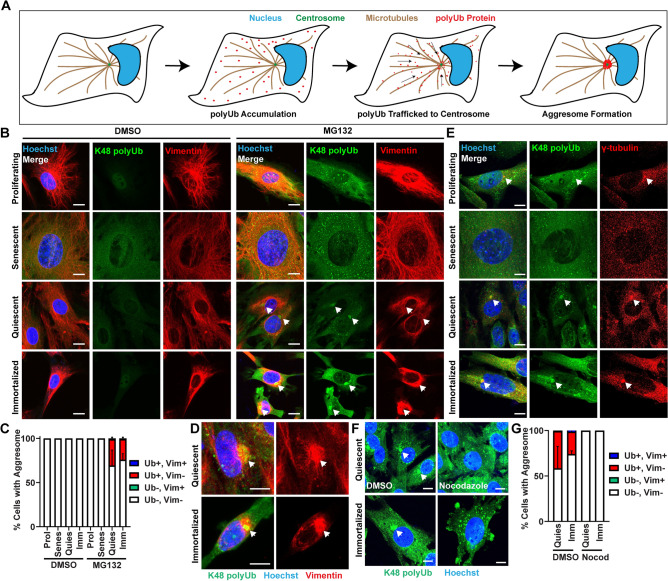
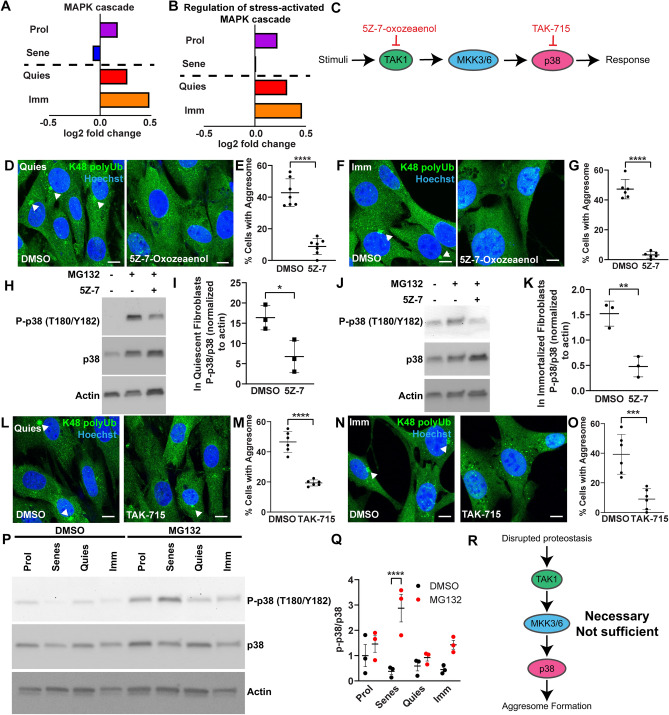
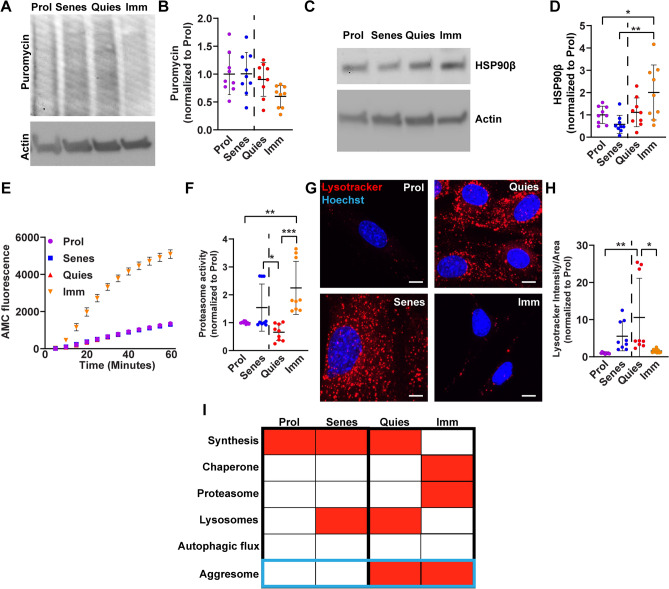
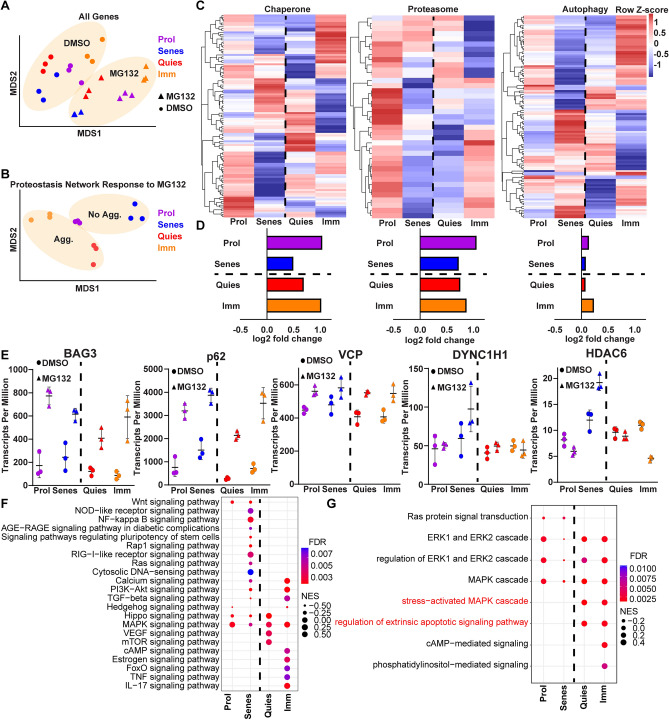
The aggresome is a protein turnover system in which proteins are trafficked along microtubules to the centrosome for degradation. Despite extensive focus on aggresomes in immortalized cell lines, it remains unclear if the aggresome is conserved in all primary cells and all cell-states. Here we examined the aggresome in primary adult mouse dermal fibroblasts shifted into four distinct cell-states. We found that in response to proteasome inhibition, quiescent and immortalized fibroblasts formed aggresomes, whereas proliferating and senescent fibroblasts did not. Using this model, we generated a resource to provide a characterization of the proteostasis networks in which the aggresome is used and transcriptomic features associated with the presence or absence of aggresome formation. Using this resource, we validate a previously reported role for p38 MAPK signaling in aggresome formation and identify TAK1 as a novel driver of aggresome formation upstream of p38 MAPKs. Together, our data demonstrate that the aggresome is a non-universal protein degradation system which can be used cell-state specifically and provide a resource for studying aggresome formation and function.
聚集体是一种蛋白质周转系统,其中蛋白质沿着微管被运送到中心体进行降解。尽管人们对永生化细胞系中的聚集体进行了广泛的关注,但聚集体是否在所有原代细胞和所有细胞状态中都保守仍然不清楚。在这里,我们研究了在四种不同细胞状态下转化的原代成年小鼠真皮成纤维细胞中的聚集体。我们发现,在蛋白酶体抑制后,静止和永生化的成纤维细胞形成了聚集体,而增殖和衰老的成纤维细胞则没有。使用这种模型,我们生成了一个资源,以提供聚集体所使用的蛋白质稳态网络的特征描述,以及与聚集体形成存在或不存在相关的转录组特征。使用这个资源,我们验证了先前报道的 p38 MAPK 信号在聚集体形成中的作用,并确定 TAK1 是 p38 MAPKs 上游聚集体形成的新驱动因素。总之,我们的数据表明,聚集体是一种非普遍的蛋白质降解系统,它可以在细胞状态特异性地使用,并为研究聚集体的形成和功能提供了一个资源。