Influenza Division, National Center for Immunization and Respiratory Diseases, Centers for Disease Control and Prevention, MS H17-5, 1600 Clifton Road, Atlanta, GA, 30329, USA.
Section of Infectious Diseases, University of Manitoba, Winnipeg, Canada.
Sci Rep. 2022 Sep 2;12(1):14971. doi: 10.1038/s41598-022-18977-0.
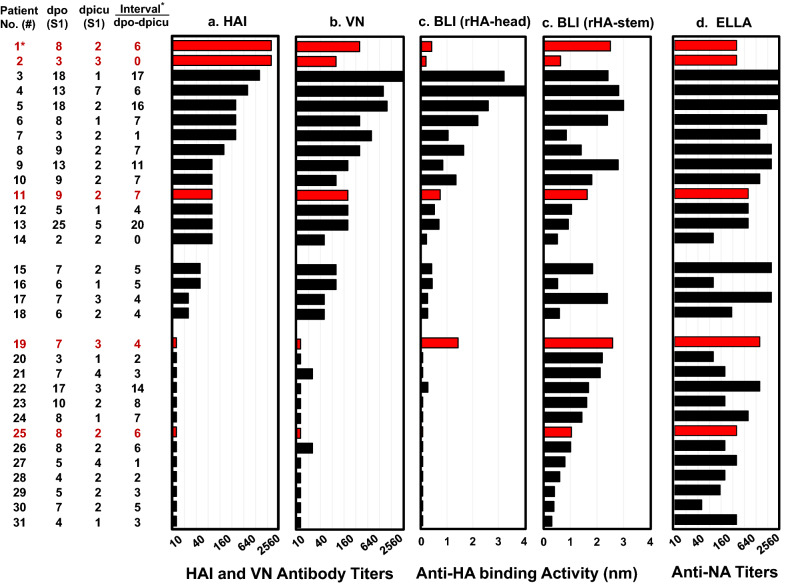
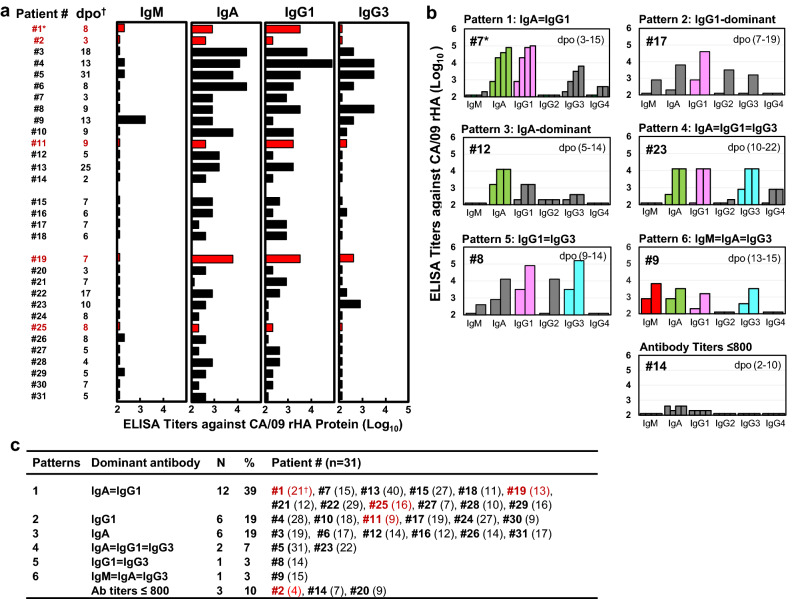
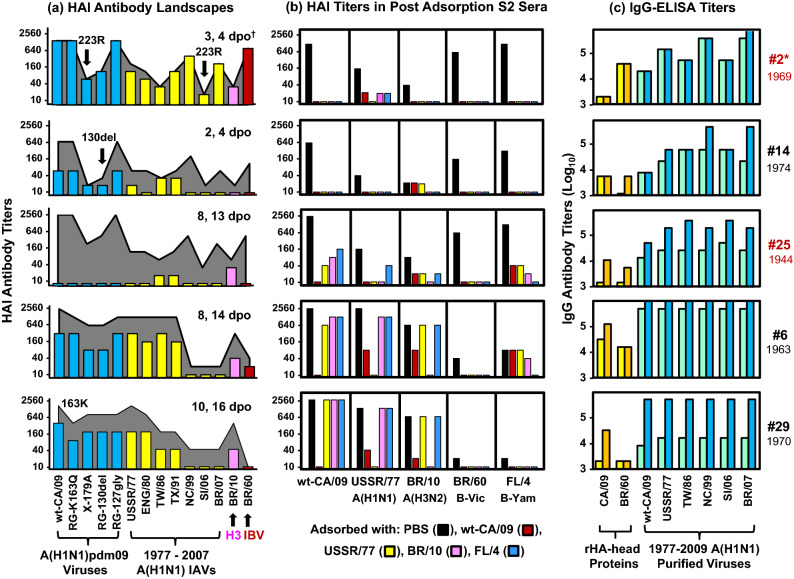
Although some adults infected with influenza 2009 A(H1N1)pdm09 viruses mounted high hemagglutination inhibition (HAI) antibody response, they still suffered from severe disease, or even death. Here, we analyzed antibody profiles in patients (n = 31, 17-65 years) admitted to intensive care units (ICUs) with lung failure and invasive mechanical ventilation use due to infection with A(H1N1)pdm09 viruses during 2009-2011. We performed a comprehensive analysis of the quality and quantity of antibody responses using HAI, virus neutralization, biolayer interferometry, enzyme-linked-lectin and enzyme-linked immunosorbent assays. At time of the ICU admission, 45% (14/31) of the patients had HAI antibody titers ≥ 80 in the first serum (S1), most (13/14) exhibited narrowly-focused HAI and/or anti-HA-head binding antibodies targeting single epitopes in or around the receptor binding site. In contrast, 42% (13/31) of the patients with HAI titers ≤ 10 in S1 had non-neutralizing anti-HA-stem antibodies against A(H1N1)pdm09 viruses. Only 19% (6/31) of the patients showed HA-specific IgG1-dominant antibody responses. Three of 5 fatal patients possessed highly focused cross-type HAI antibodies targeting the (K130 + Q223)-epitopes with extremely low avidity. Our findings suggest that narrowly-focused low-quality antibody responses targeting specific HA-epitopes may have contributed to severe infection of the lower respiratory tract.
虽然一些感染了 2009 年甲型 H1N1 流感病毒的成年人产生了高血凝抑制 (HAI) 抗体反应,但他们仍患有严重疾病,甚至死亡。在这里,我们分析了因感染 2009 年至 2011 年期间的甲型 H1N1 流感病毒而导致肺部衰竭和需要有创机械通气的重症监护病房 (ICU) 患者(n=31,年龄 17-65 岁)的抗体谱。我们使用 HAI、病毒中和、生物层干涉、酶联-凝集和酶联免疫吸附测定对抗体反应的质量和数量进行了综合分析。在入住 ICU 时,45%(14/31)的患者在第一份血清(S1)中 HAI 抗体滴度≥80,其中大多数(13/14)表现出针对受体结合位点内或周围单一表位的狭隘聚焦的 HAI 和/或抗 HA-头结合抗体。相比之下,在 S1 中 HAI 滴度≤10 的 42%(13/31)的患者具有针对 A(H1N1)pdm09 病毒的非中和性抗 HA-茎抗体。只有 19%(6/31)的患者表现出针对 HA 的 IgG1 优势抗体反应。5 名死亡患者中有 3 名具有针对(K130+Q223)-表位的高度集中的交叉型 HAI 抗体,亲和力极低。我们的研究结果表明,针对特定 HA-表位的狭隘聚焦低质量抗体反应可能导致下呼吸道的严重感染。