Department of Clinical Epidemiology, Hyogo Medical University, 1-1 Mukogawa, Nishinomiya, Hyogo, 663-8501, Japan.
Department of General Medicine, Nara City Hospital, Nara, Japan.
Sci Rep. 2022 Sep 2;12(1):14967. doi: 10.1038/s41598-022-19079-7.
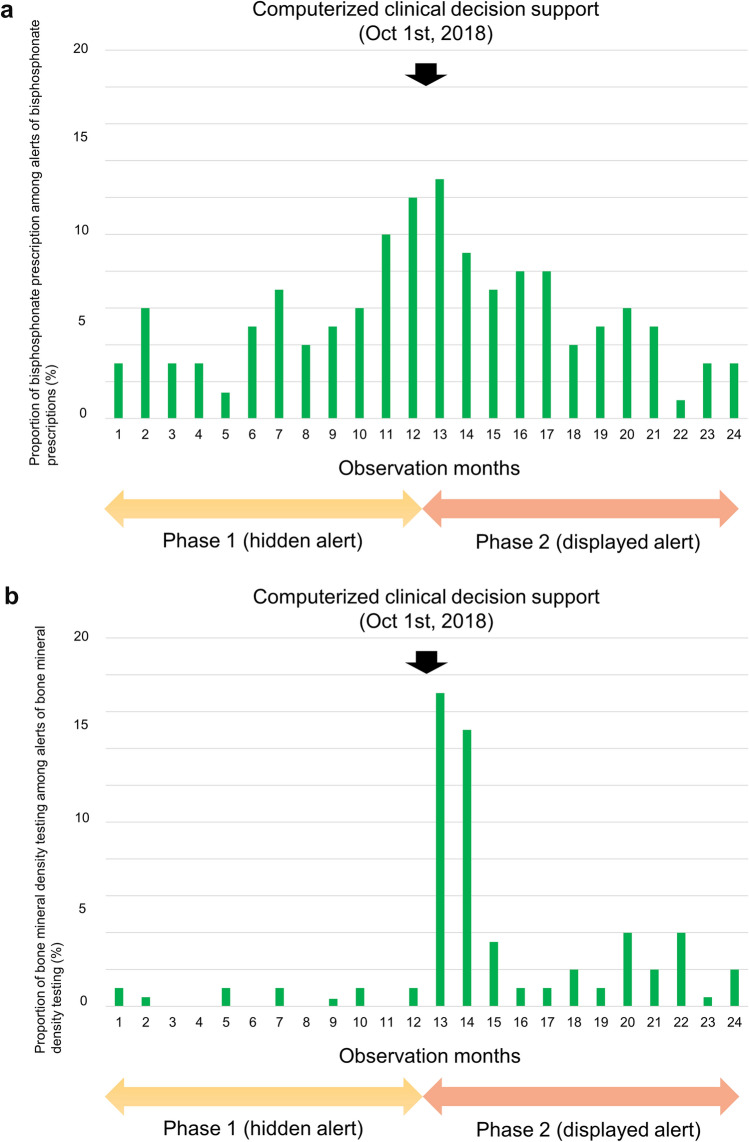
Glucocorticoids are widely used for a variety of diseases, but the prevention of glucocorticoid-induced osteoporosis is sometimes neglected. Therefore, the effectiveness of a computerized clinical decision support system (CDSS) to improve the performance rate of preventive care for glucocorticoid-induced osteoporosis was evaluated. We conducted a prospective cohort study of outpatients who used glucocorticoids for three months or longer and who met the indication for preventive care based on a guideline. The CDSS recommended bisphosphonate (BP) prescription and bone mineral density (BMD) testing based on the risk of osteoporosis. The observation period was one year (phase 1: October 2017-September 2018) before implementation and the following one year (phase 2: October 2018-September 2019) after implementation of the CDSS. Potential alerts were collected without displaying them during phase 1, and the alerts were displayed during phase 2. We measured BP prescriptions and BMD testing for long-term prescription of glucocorticoids. A total of 938 patients (phase 1, 457 patients; phase 2, 481 patients) were included, and the baseline characteristics were similar between the phases. The median age was 71 years, and men accounted for 51%. The primary disease for prescription of glucocorticoids was rheumatic disease (28%), followed by hematologic diseases (18%). The prevalence of patients who needed an alert for BP prescription (67% vs. 63%, P = 0.24) and the acceptance rate of BP prescription (16% vs. 19%, P = 0.33) were similar between the phases. The number of patients who had orders for BMD testing was significantly increased (4% vs. 24%, P < 0.001) after CDSS implementation. The number of patients who needed an alert for BMD testing was significantly decreased from 93% in phase 1 to 87% in phase 2 (P = 0.004). In conclusion, the CDSS significantly increased BMD testing in patients with a higher risk of glucocorticoid-induced osteoporosis, but did not increase BP prescription.
糖皮质激素被广泛用于治疗各种疾病,但有时会忽视预防糖皮质激素引起的骨质疏松症。因此,评估了计算机临床决策支持系统(CDSS)提高预防糖皮质激素引起的骨质疏松症护理绩效的效果。我们对使用糖皮质激素治疗三个月或更长时间且符合基于指南的预防护理指征的门诊患者进行了前瞻性队列研究。CDSS 根据骨质疏松症的风险建议使用双膦酸盐(BP)处方和骨密度(BMD)检测。观察期为实施 CDSS 之前的一年(第 1 阶段:2017 年 10 月至 2018 年 9 月)和之后的一年(第 2 阶段:2018 年 10 月至 2019 年 9 月)。在第 1 阶段不显示潜在警报,而在第 2 阶段显示警报。我们测量了长期服用糖皮质激素的 BP 处方和 BMD 检测。共纳入 938 例患者(第 1 阶段 457 例,第 2 阶段 481 例),各阶段的基线特征相似。中位年龄为 71 岁,男性占 51%。开具糖皮质激素处方的主要疾病是风湿病(28%),其次是血液疾病(18%)。需要 BP 处方警报的患者比例(67% vs. 63%,P=0.24)和 BP 处方接受率(16% vs. 19%,P=0.33)在两个阶段相似。接受 BMD 检测的患者数量明显增加(4% vs. 24%,P<0.001)。在实施 CDSS 后,需要 BMD 检测警报的患者数量从第 1 阶段的 93%显著减少至第 2 阶段的 87%(P=0.004)。总之,CDSS 显著增加了糖皮质激素诱导性骨质疏松症高危患者的 BMD 检测,但并未增加 BP 处方。