Department of Internal Medicine, Medical School, Universidade Federal de Minas Gerais, Av. Professor Alfredo Balena, Belo Horizonte, 190, Brazil.
Department of Medicine, Universidade Federal de Lavras, R. Tomas Antonio Gonzaga, 277, Lavras, Brazil.
BMC Med. 2022 Sep 2;20(1):324. doi: 10.1186/s12916-022-02503-0.
Acute kidney injury (AKI) is frequently associated with COVID-19, and the need for kidney replacement therapy (KRT) is considered an indicator of disease severity. This study aimed to develop a prognostic score for predicting the need for KRT in hospitalised COVID-19 patients, and to assess the incidence of AKI and KRT requirement.
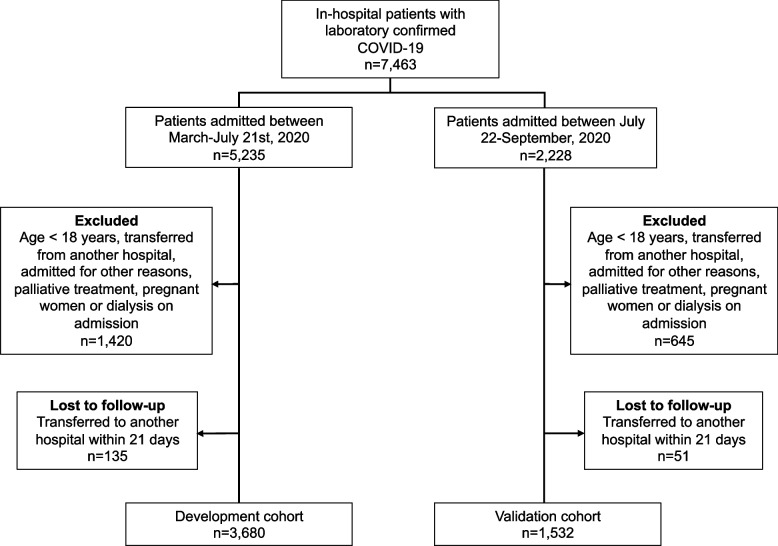
This study is part of a multicentre cohort, the Brazilian COVID-19 Registry. A total of 5212 adult COVID-19 patients were included between March/2020 and September/2020. Variable selection was performed using generalised additive models (GAM), and least absolute shrinkage and selection operator (LASSO) regression was used for score derivation. Accuracy was assessed using the area under the receiver operating characteristic curve (AUC-ROC).
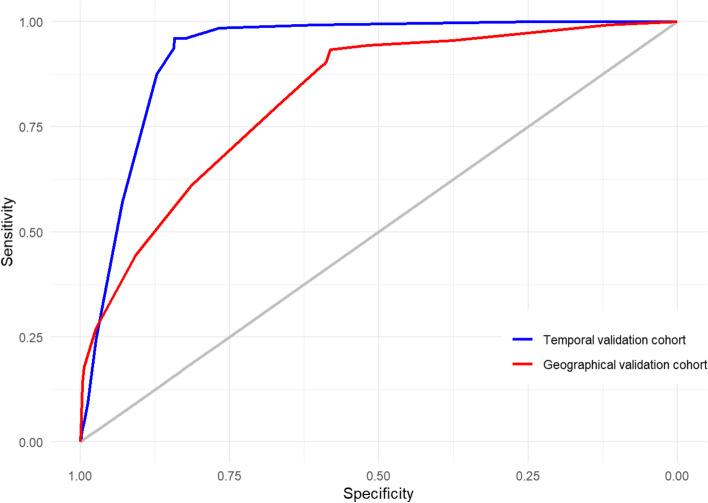
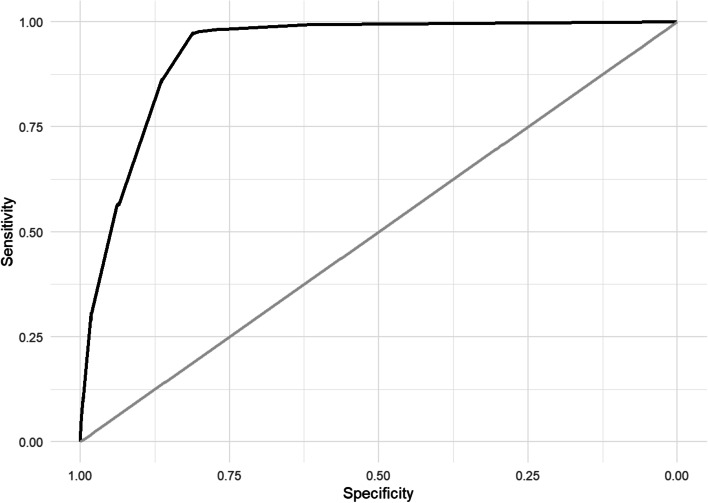
The median age of the model-derivation cohort was 59 (IQR 47-70) years, 54.5% were men, 34.3% required ICU admission, 20.9% evolved with AKI, 9.3% required KRT, and 15.1% died during hospitalisation. The temporal validation cohort had similar age, sex, ICU admission, AKI, required KRT distribution and in-hospital mortality. The geographic validation cohort had similar age and sex; however, this cohort had higher rates of ICU admission, AKI, need for KRT and in-hospital mortality. Four predictors of the need for KRT were identified using GAM: need for mechanical ventilation, male sex, higher creatinine at hospital presentation and diabetes. The MMCD score had excellent discrimination in derivation (AUROC 0.929, 95% CI 0.918-0.939) and validation (temporal AUROC 0.927, 95% CI 0.911-0.941; geographic AUROC 0.819, 95% CI 0.792-0.845) cohorts and good overall performance (Brier score: 0.057, 0.056 and 0.122, respectively). The score is implemented in a freely available online risk calculator ( https://www.mmcdscore.com/ ).
The use of the MMCD score to predict the need for KRT may assist healthcare workers in identifying hospitalised COVID-19 patients who may require more intensive monitoring, and can be useful for resource allocation.
急性肾损伤(AKI)常与 COVID-19 相关,需要肾脏替代治疗(KRT)被认为是疾病严重程度的指标。本研究旨在开发一种预测住院 COVID-19 患者需要 KRT 的预后评分,并评估 AKI 和 KRT 需求的发生率。
本研究是多中心队列巴西 COVID-19 登记研究的一部分。共纳入 2020 年 3 月至 9 月期间的 5212 例成年 COVID-19 患者。使用广义加性模型(GAM)进行变量选择,最小绝对值收缩和选择算子(LASSO)回归用于评分推导。使用受试者工作特征曲线下的面积(AUC-ROC)评估准确性。
模型推导队列的中位年龄为 59 岁(IQR 47-70),54.5%为男性,34.3%需要入住 ICU,20.9%发生 AKI,9.3%需要 KRT,15.1%在住院期间死亡。时间验证队列的年龄、性别、入住 ICU、AKI、需要 KRT 分布和住院死亡率相似。地理验证队列的年龄和性别相似;然而,该队列的 ICU 入住率、AKI、需要 KRT 和住院死亡率更高。使用 GAM 确定了 4 个 KRT 需求预测因素:需要机械通气、男性、入院时肌酐升高和糖尿病。MMCD 评分在推导(AUROC 0.929,95%CI 0.918-0.939)和验证(时间 AUROC 0.927,95%CI 0.911-0.941;地理 AUROC 0.819,95%CI 0.792-0.845)队列中具有出色的区分能力,且总体表现良好(Brier 评分分别为 0.057、0.056 和 0.122)。该评分已在一个免费的在线风险计算器(https://www.mmcdscore.com/)中实施。
使用 MMCD 评分预测 KRT 的需求可能有助于医疗保健工作者识别可能需要更密切监测的住院 COVID-19 患者,并可用于资源分配。