J Glob Health. 2022 Sep 3;12:05023. doi: 10.7189/jogh.12.05023.
Essential health and nutrition services for pregnant women, newborns, and children, particularly in low- and middle-income countries (LMICs), are disrupted by the COVID-19 pandemic. This formative research was conducted at five LMICs to understand the pandemic's impact on barriers to and mitigation for strategies of care-seeking and managing possible serious bacterial infection (PSBI) in young infants.
We used a convergent parallel mixed-method design to explore the possible factors influencing PSBI management, barriers, and facilitators at three levels: 1) national and local policy, 2) the health systems, public and private facilities, and 3) community and caregivers. We ascertained trends in service provision and utilisation across pre-lockdown, lockdown, and post-lockdown periods by examining facility records and community health worker registers.
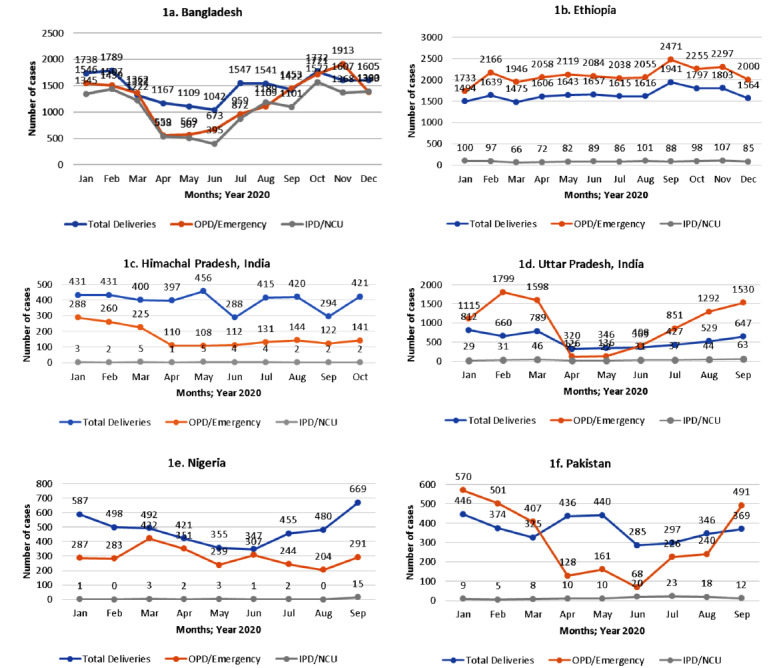
The pandemic aggravated pre-existing challenges in the identification of young infants with PSBI; care-seeking, referral, and treatment due to several factors at the policy level (limited staff and resource reallocation), health facility level (staff quarantine, sub-optimal treatment in facilities, limited duration of service availability, lack of clear guidelines on the management of sick young infants, and inadequate supplies of protective kits and essential medicines) and at the community level (travel restrictions, lack of transportation, and fear of contracting the infection in hospitals). Care-seeking shifted to faith healers, traditional and informal private sources, or home remedies. However, caregivers were willing to admit their sick young infants to the hospital if advised by doctors. A review of facility records showed low attendance (<50%) of sick young infants in the OPD/emergencies during lockdowns in Bangladesh, India (both sites) and Pakistan, but it gradually increased as lockdowns eased. Stakeholders suggested aspirational and pragmatic mitigation strategies.
We obtained useful insights on health system preparedness during catastrophes and strategies to strengthen services and improve utilisation regarding PSBI management. The current pandemic provides an opportunity for implementing various mitigation strategies at the policy, health system, and community levels to improve preparedness.
在新冠疫情大流行期间,孕产妇、新生儿和儿童的基本健康和营养服务受到影响,尤其是在中低收入国家(LMICs)。本研究在五个 LMIC 开展,旨在了解疫情对寻求医疗服务和管理婴幼儿可能严重细菌感染(PSBI)的策略的障碍和缓解措施的影响。
我们采用了汇聚式平行混合方法设计,从三个层面探索可能影响 PSBI 管理的因素、障碍和促进因素:1)国家和地方政策,2)卫生系统、公立和私立机构,3)社区和照护者。我们通过检查机构记录和社区卫生工作者登记簿,了解了在封锁前、封锁中和封锁后期间服务提供和利用的趋势。
疫情加剧了在政策层面(员工和资源重新分配有限)、医疗机构层面(员工隔离、机构内治疗效果不佳、服务可用时间有限、对管理患病婴幼儿的明确指南缺乏、防护套件和基本药物供应不足)和社区层面(旅行限制、缺乏交通工具、以及对在医院感染的恐惧)识别患有 PSBI 的婴幼儿的固有挑战;寻求医疗服务、转诊和治疗的机会减少。寻求医疗服务的途径转向了信仰治疗师、传统和非正式的私人来源或家庭疗法。然而,如果医生建议,照护者仍愿意将患病的婴幼儿送往医院。对机构记录的审查显示,在孟加拉国、印度(两个地点)和巴基斯坦,封锁期间,患有 PSBI 的婴幼儿在 OPD/急诊的就诊率较低(<50%),但随着封锁的放宽,就诊率逐渐增加。利益相关者提出了理想和务实的缓解策略。
我们获得了在灾难期间卫生系统准备情况的有用见解,并制定了加强服务和提高 PSBI 管理利用的策略。当前的疫情为在政策、卫生系统和社区层面实施各种缓解策略提供了机会,以提高应对准备。